
Key takeaways
- Digital supply chain compromises represent a significant risk for energy companies. A single compromised supplier, library, or service provider can rapidly impact multiple organizations, making vendor risk a shared, ecosystem-level problem rather than an isolated incident.
- Organizations must assume that suppliers will be compromised and design accordingly. This means embedding security across the supplier life cycle to reduce impacts, maintain operations, and recover quickly.
- Effective risk management depends on understanding dependencies beyond Tier 1 suppliers and coordinating across procurement, legal, cybersecurity, information technology (IT), OT, and operations.
- Organizations that achieve alignment can respond faster, manage risk more proactively, and treat supply chain security as an operational discipline rather than a paperwork exercise.
Within the oil and gas and energy sectors, software supply chain compromise is no longer an edge case; it’s a repeatable disruption pattern affecting how software is built, secured, and delivered. A single compromised vendor, library, or managed service provider can propagate quickly across multiple customers, turning one breach into many.
Today’s digital ecosystems span cloud platforms, APIs, industrial technologies, remote access, subprocessors, and open-source dependencies that extend beyond Tier 1 visibility. In this environment, point-in-time questionnaires simply cannot keep pace. Adequately protecting against evolving cyberthreats requires a more comprehensive approach built around the thesis that resilience beats compliance.
Organizations need to design for supplier failure with governance, visibility, monitoring, and incident readiness so operations can absorb compromise without cascading outages, safety impacts, or loss of trust. What follows is a practical framework for doing exactly that: managing supply chain cyber risk as an end-to-end resilience discipline rather than a simple paperwork exercise.
Why traditional third-party risk models no longer match reality
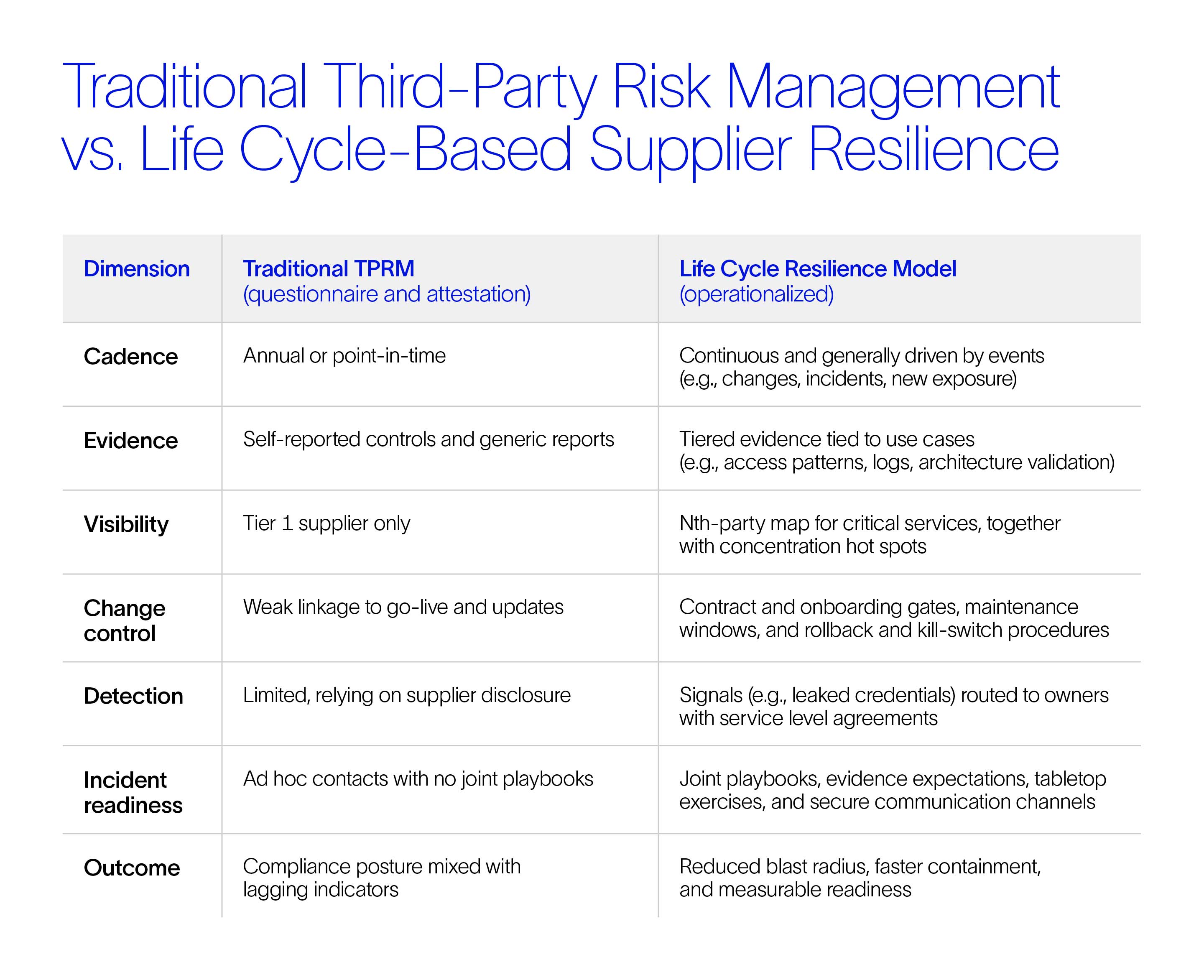
Traditional third-party risk management (TPRM)—the process of managing risks associated with outsourcing work to external vendors—relies primarily on questionnaires, financial checks, and baseline security attestations. Today, however, the risk landscape looks very different.
- Cloud environments introduce shared-responsibility chains and inherited dependencies that can extend risk beyond a single organization.
- In software, reliance on third-party libraries, APIs, and continuous integration and deployment (CI and CD) pipelines creates additional exposure points across the development life cycle.
- Access models often include persistent remote support pathways into critical environments, which can be difficult to fully secure.
- Beyond primary vendors, subcontractors and subprocessors—especially those deeper in the supply chain—add further layers of complexity and risk.
- Threat actors increasingly target vendors as leverage points to gain access to multiple customers at once.
Point-in-time assessments fall short in today’s interconnected, continuously evolving digital environment. Guidance from the National Institute of Standards and Technology (NIST) and the European Union Agency for Cybersecurity (ENISA) underscores this reality and reinforces that effective cyber supply chain risk management must be continuous, life cycle-driven, and comprehensive—spanning sourcing, contracting, system architecture, ongoing monitoring, and coordinated incident response.
The visibility problem: From Tier 1 vendors to nth-party interdependencies
Most dependencies that matter are hidden beyond Tier 1, including dependencies such as:
- Cloud infrastructures
- Data analytics processors
- Offshore development teams
- Firmware update channels
- Specialized hardware original equipment manufacturers (OEMs)
- Open-source libraries
- Embedded software suppliers.
These dependencies often don’t appear in procurement records, yet they create real operational exposure. In practice, a significant share of major cyber events involves third parties (and, often, their upstream providers), which is why nth-party risk is a persistent failure mode.
For example, if an analytics subprocessor used by a key software-as-a-service (SaaS) vendor is breached, the attacker may be able to steal service credentials, access customer environments through trusted integrations, and force a shutdown of data pipelines. The breach would likely lead to degraded dashboards, delayed decisions, and in some cases, an interruption of automated workflows tied to operations.
This is where nth-party visibility matters. It enables organizations to identify shared upstream dependencies and concentration risk (i.e., when multiple critical vendors rely on the same cloud region, identity provider, code-signing service, or niche firmware supplier). The World Economic Forum (WEF) and ENISA both highlight concentration risk as a strategic blind spot that can make systems more fragile.
Addressing the problem requires prioritizing visibility and a focused effort on the deeper dependencies that are most likely to create a material operational impact if they fail or are compromised.
Why converging operational and information technology raises the stakes
Digital supply chain cyber risk becomes materially more serious when it intersects with OT environments.
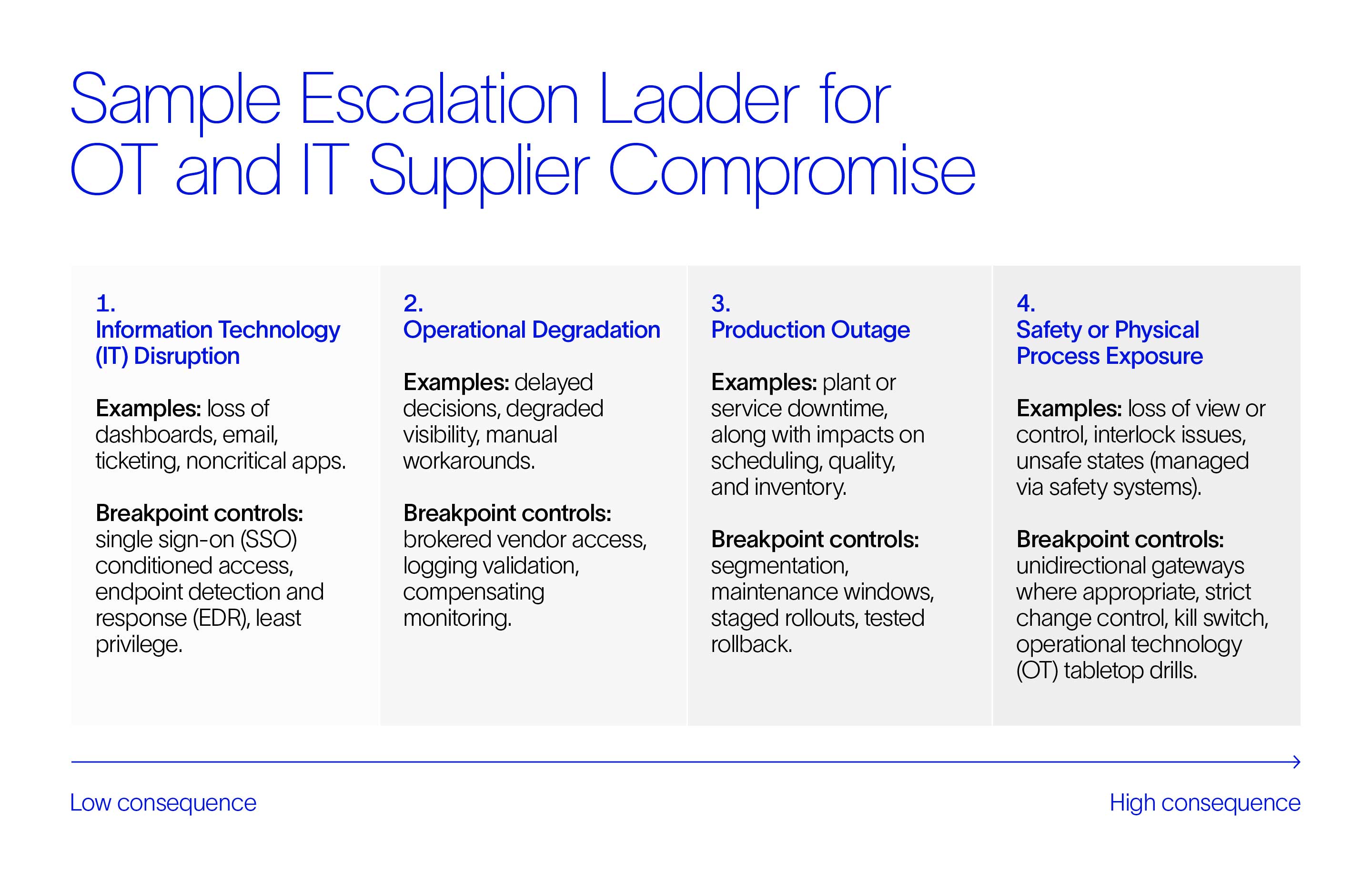
The convergence of OT and IT doesn’t always increase the likelihood of compromise, but it does increase the potential consequences. The same supplier weakness that might have been contained as an IT disruption can become a production, reliability, or safety event once it’s connected to physical processes.
An example would be if a supplier’s remote support connection used to troubleshoot Programmable Logic Controllers (PLCs) or Human Machine Interface (HMI) servers is compromised. An attacker could reuse that trusted access path to change configurations, stop services, or deliver a malicious file—thereby triggering alarms, forcing a controlled shutdown, or degrading control performance until operations can be safely restored.
NIST’s OT security guidance stresses that OT failures affect physical processes, continuity, and safety, not just confidentiality. Supply chain cyber incidents that touch OT are therefore high-consequence scenarios requiring cross-functional readiness in addition to IT security controls.
Integrated cyber governance across the supplier life cycle
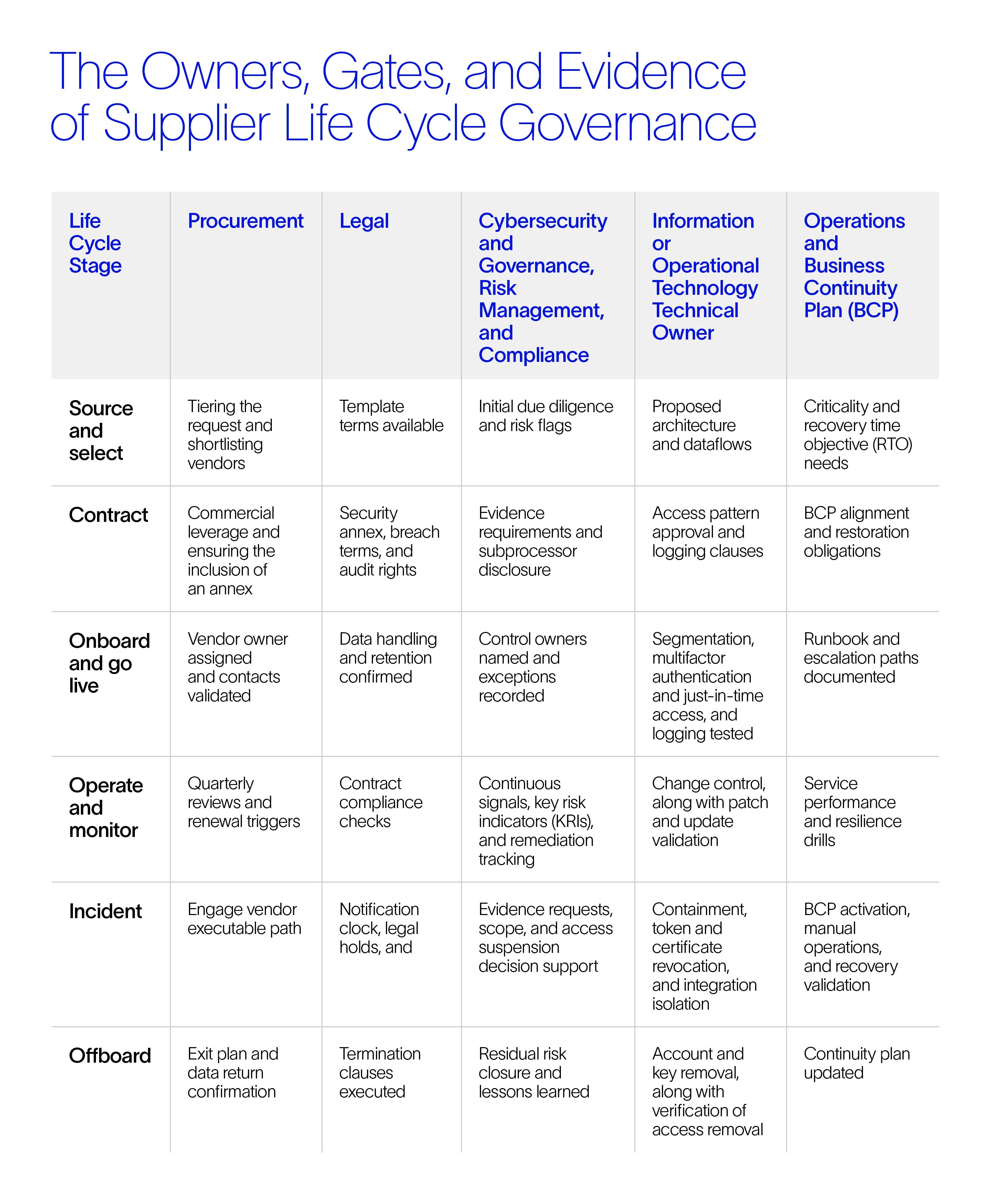
Integrated governance embeds cybersecurity requirements into every stage of the supplier life cycle, including:
- Sourcing and vendor selection
- Contracting and commercial negotiations
- Technical architecture and access design
- Onboarding workflows
- Continuous monitoring and performance reviews
- Incident readiness and collaboration
- Offboarding and access removal.
Supplier cyber risk is often created (or reduced) through dozens of small decisions—for example, what access is granted, how changes are approved, what evidence is required, and how incidents are handled. When governance is embedded across the life cycle, those decisions become consistent, auditable, and aligned to operational impact rather than left to ad-hoc negotiation.
NIST and ENISA both advocate for going beyond simple risk assessments to establish corporate-wide frameworks where cybersecurity expectations influence procurement decisions, vendor performance, and long-term operational design.
Good governance defines decision rights (who can accept exceptions), establishes control owners (who can verify access, logging, and segmentation), and sets operational triggers (when a supplier issue escalates to leadership, when to suspend access, and when to activate joint incident playbooks).
Over time, these mechanisms convert supplier risk into measurable performance through key risk and performance indicators (KRIs and KPIs), periodic assurance, and disciplined change control, so dependencies remain safe as relationships and technology evolve.
Procurement and contracting as early cyber control points
Today, procurement isn’t just a commercial function but an early and high-leverage cybersecurity control point. At the earliest stages of the supplier life cycle, buyers have the most leverage to set clear, enforceable requirements for:
- Security evidence (assurance reports, testing, certifications)
- Architecture constraints (segmentation, approved patterns, hardening)
- Incident response obligations (notification, cooperation, forensics support)
- Continuous monitoring expectations (telemetry, reporting cadence)
- Data protection controls (classification, encryption, retention)
- Access requirements [least privilege, multifactor authentication (MFA), time-bound access]
- Software bill of materials (SBOM) transparency (components, update provenance)
- Subprocessor disclosures (who they use, where, and for what).
Contract language is tested on the worst day, not the signing day. If notification timelines are vague, buyers may learn about a breach late—after credentials have been reused or malicious updates have propagated. If cooperation and evidence obligations [e.g., logs, forensic images, access to incident subject matter experts (SMEs)] are weak, response teams lose time validating scope and containment. This turns a supplier incident into a prolonged outage and higher downstream cost.
That is why CISA and NIST encourage organizations to embed cybersecurity requirements upfront, before selection and integration, rather than trying to renegotiate controls after operational dependence is already formed.
From supplier complexity to operationally governed resilience
Digital supply chains are becoming more complex, not less. For large oil and gas and energy organizations, the first step in addressing this complexity is to acknowledge the reality that digital supply chain cyber risk isn’t a security questionnaire problem, but a resilience problem.
Organizations that embed cyber into supplier governance and operational planning can safely scale digital operations with confidence. Those that rely on legacy, vendor-centric models will remain vulnerable to dependencies they cannot see.
Cyber supply chain resilience is ultimately becoming a differentiator—enabling faster transformation with fewer disruptions, higher safety, and more predictable operations.