
Key takeaways
- As drilling operations digitally transform, it's increasingly important that operators understand the difference between advanced automation and actual autonomy.
- True autonomy in drilling cannot be achieved by automating isolated tasks in succession. It requires the development of a closed-loop decision framework that connects every workflow of the well construction process.
- High-quality real-time data, strong communication links, standardization, and coordinated surface and subsurface systems are all prerequisites for achieving reliable autonomy.
- No single technology or proprietary solution can deliver full drilling autonomy on its own. It requires a holistic approach, with several elements of both hardware and software working cohesively.
“Drilling automation” has become a widely used term among professionals working in upstream oil and gas. Today, nearly every oilfield service (OFS) provider claims to have some level of autonomous capability, and at first glance, the industry appears to be moving rapidly toward fully self-directed operations.
However, much of what is currently described as autonomy is, in reality, an advanced form of automation.
Across the well construction workflow, many activities are now structured and repeatable enough to be handled by digital systems. Routine parameter adjustments, repetitive control functions, workflow sequencing, and optimization tasks can increasingly be executed with limited human involvement. These capabilities are delivering real value by increasing rate of penetration (ROP), improving safety, and helping rigs operate more efficiently.
But that’s still not autonomy. You can’t achieve true drilling autonomy by simply automating isolated tasks in series. It requires a far more integrated approach, where your workflows, systems, and decision-making processes are connected across every stage of your well construction to create a continuous, context-aware operational framework.
What does autonomous drilling really mean?
Even among experienced professionals, the terms automation, assistance, and autonomy are used interchangeably. But it’s important to know their differences.
Automation focuses on isolated tasks, such as holding inclination or managing tool face orientation. Assistance provides recommendations or partial support, with human operators remaining fully in control.
Drilling autonomy represents something fundamentally different. It’s not simply about removing people from repetitive activities. It’s about creating systems capable of understanding operational context, connecting decisions across workflows, and responding intelligently to changing conditions.
Effectively, the connected, multidomain automation suite maintains the well path, adjusts steering settings, and responds to geological changes without human input or interpretation. Every system “talks” to the others, eliminating data gaps and pushing performance beyond what traditional methods can achieve, reliably and repeatedly, well after well.
Automation vs. autonomy in practice
So, how do automation and autonomy differ in practice? To understand the distinction, let’s imagine a hypothetical drilling operation where multiple automated systems are running simultaneously.
If it were a highly automated, but not truly autonomous workflow, then each individual system would be optimizing its own tasks in isolation. The ROP optimization system, for example, might push the drilling process toward maximum performance without fully accounting for trajectory control, hole cleaning, or stuck pipe risk. Meanwhile, the directional drilling automation system might aggressively try to correct the well path but struggle to maintain its objective because the ROP is too high. All of this while cuttings are accumulating in the wellbore, hole cleaning is deteriorating, and the risk of stuck pipe is increasing.
In this scenario, the burden falls back on the driller. They must intervene to adjust the ROP automation system so the directional tool can achieve its target. They also have to monitor the directional drilling system to make sure it’s not becoming overly conservative and reducing performance unnecessarily. During connections, operators may need to take manual control to modify the procedure and address the hole-cleaning issue. The automated systems create so many coordination challenges that, in the end, it almost feels easier to manage the operation manually.
True autonomy is different because it coordinates the entire drilling workflow rather than optimizing individual tasks separately.
For example, in an autonomous workflow, subsurface targets flow directly from automated interpretation software into the directional automation system, which issues downlink commands to the rig. These actions aren’t executed in isolation. Real-time engineering models continuously monitor conditions and balance competing objectives (e.g., parameter optimization, downlink execution, and pressure management), adjusting or halting commands as needed to stay within operating boundaries.
The result is a more integrated and intelligent drilling process. Instead of forcing the driller to constantly micromanage each automated function, autonomous systems work through operational trade-offs together. The driller remains in oversight, but the workflow itself becomes more coordinated, adaptive, and capable of balancing performance, well placement, and risk in real time.
Why autonomy has been so difficult to achieve
The most difficult and highest-value challenges in drilling rarely occur during steady-state operations. They emerge when downhole conditions change unexpectedly, operational objectives begin to conflict, data quality deteriorates, or multiple systems must coordinate decisions based on a shared understanding of the well plan.
Although these situations represent only a small portion of the overall workflow, they carry a disproportionate impact on safety, performance, and cost.
And this is exactly why full autonomy has remained elusive.
Drilling environments are inherently dynamic and uncertain. Data quality can vary, communications aren’t always reliable, and no two wells behave exactly the same way.
Even highly capable automated systems often struggle when conditions move outside the scenarios they were explicitly designed to handle. But the industry is moving closer. Improvements in real-time sensing, edge computing, physics-informed models, interoperability between systems, and AI-driven decision support are steadily expanding the range of situations where machines can operate with greater independence and confidence.
Some of the most meaningful benefits are less obvious. Autonomy can:
- reduce operational variability from crew to crew and rig to rig
- preserve and scale expertise across entire drilling programs
- improve consistency in well placement
- enable faster adaptation to changing subsurface conditions.
It also creates opportunities to optimize energy usage, reduce equipment stress and vibration, improve tool reliability, and support safer operations by shifting personnel away from repetitive, high-consequence decisions.
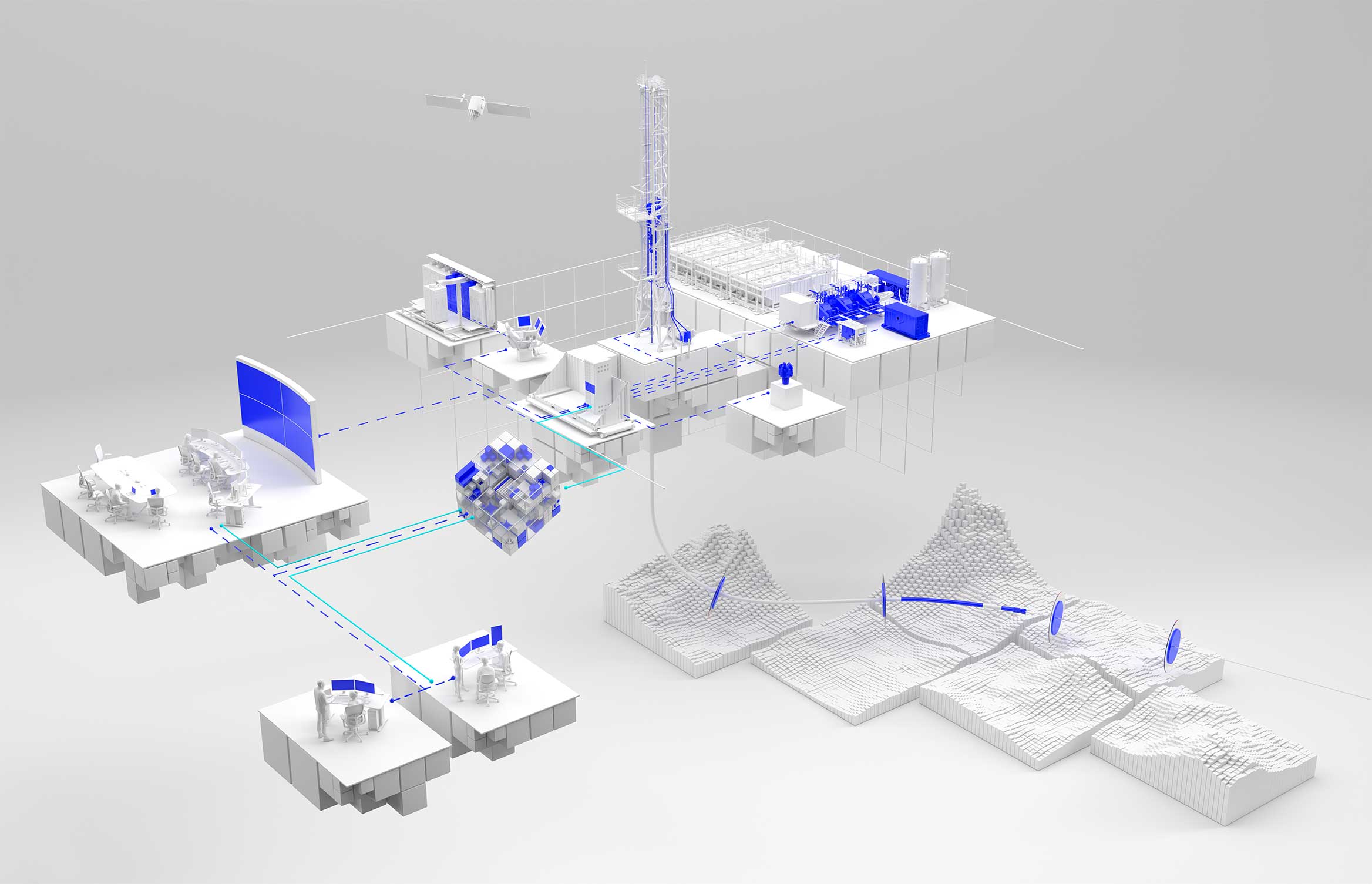
It’s this shift from isolated automated tasks to coordinated system-wide action that makes autonomy a true step change rather than an incremental improvement.
The result? Smoother workflows and more predictable results. Human domain expertise and judgment remain crucial to success, of course. Individuals set objectives, define safe boundaries, supervise, and step in when exceptions or higher-stakes decisions arise. But the rest is hands off.
And it’s completely possible today.
Using curved sections as the ultimate test
Among all well sections, curves are often the most challenging, as they require precise trajectory control and continuous adjustment to changing conditions. Logically, these situations serve as a valid test to assess the current capabilities of today’s “autonomous” drilling systems.
Field results show that this capability is within the realm of today’s technologies and digital workflows. Across multiple basins and hole sizes, autonomous systems have successfully handled curve builds while significantly reducing the need for downlinks, leading to fewer disruptions and better overall economics.
In one example, an operator in the Middle East was drilling a slim reservoir in carbonate rock. Precise placement was crucial, and it came with long decision cycles—the same decision cycles that caused reservoir sections to previously take more than seven days to drill.
To minimize reservoir damage and cut rig time, a fully autonomous workflow was employed—one that combined multiple advanced technologies, including multilayer mapping while drilling, autonomous geosteering, and an intelligent subsurface drilling advisory platform. The solutions were used as a unified system, continuously analyzing formation properties and executing real-time steering actions to ensure precise wellbore placement.
Real-time formation data fed into the dynamic subsurface model, where inversion and dip-picking were automated. Downlinks were communicated directly to rig equipment and executed automatically without human intervention.
The end result was a 98% improvement in ROP, a 50% reduction in downlinks, and nearly 4 days of savings against the offset benchmark of 7.5 days. Throughout the interval, the wellbore remained within 5–7 feet of the reservoir top.
What makes reliable autonomy possible?
No single technology or solution can deliver full drilling autonomy. It requires a holistic approach, with several elements of both hardware and software working cohesively.
High-quality real-time data is critical, as are accurate downhole sensors and consistent communication between systems above and below the surface. Equally important are integrated planning and execution workflows, along with standardized operating procedures.
Achieving autonomy without introducing added operational risk ultimately requires looking beyond the BHA. It depends on a broader ecosystem that includes rig automation, cloud-based workflows for real-time access and learnings from various wells, and remote operations centers that support centralized and consistent oversight.
Together, these elements can make autonomous drilling a repeatable operating model that can be deployed across wells and geologies with significantly different characteristics.
Autonomy delivers the greatest value at scale
Autonomous drilling has progressed a great deal over the past five years, moving from concept to real-world field application. But scaling and broad commercialization will require more than standalone digital tools. It will depend on deeper system integration, greater workflow standardization, and closer collaboration between operators and technology providers.
Many solutions marketed as autonomous today still rely on predefined workflows, human supervision, or isolated control loops operating within narrow boundaries. True autonomy is far more demanding. It requires systems that can interpret changing downhole and surface conditions, understand operational objectives in context, reconcile competing constraints, and coordinate decisions across multiple domains in real time.
Workflows still vary across rigs and regions; interoperability gaps remain between downhole tools, surface systems, and digital platforms; and real-time data quality, telemetry bandwidth, and communication latency can all constrain closed-loop performance. In high-consequence environments, human expertise remains essential, especially when abnormal drilling events or equipment anomalies arise.
At the end of the day, autonomy should be viewed as a system-level capability that minimizes operational variability and standardizes execution across the well construction life cycle. It represents a fundamental shift toward integrated, data-driven drilling workflows rather than a discrete improvement to existing practices. And that makes all the difference.