Seeing the future we believed in become a reality

Early in my career, I was part of a team working on a pilot plant test for a carbon capture and storage (CCS) project at the Heidelberg Materials cement plant in Brevik, Norway. CCS takes CO2 and stores it underground, thereby reducing emissions.
This was in 2014, when we used a mobile test unit to demonstrate that our technology could capture CO2 from cement kiln flue gas. For more than a year, we tested the process on exhaust gas from the cement facility, analyzed the results, and documented what we learned.
What we learned would eventually help shape an industrial-scale CCS facility—the first in the cement industry.
I’m not sure any of us truly believed we would see it built at the time! The Brevik CCS project moved through years of studies, stopping and restarting as funding changed.
My life and career also evolved: I had twins, came back, and after taking time off with my third child, stepped into the technology manager role. My task? Helping lead our team through the challenges of creating a working carbon capture plant.
It was my first big project after earning my master’s degree, and I still remember the remarkable moment I realized that this was no longer just a paper exercise—it was actually becoming a reality.
At Brevik, our role (and that of SLB Capturi) is removing CO2 from the cement plant’s exhaust gas and preparing it for transfer to its permanent storage site. Because carbon capture is only valuable if the carbon has somewhere to go. That’s what makes this project’s connection to Longship—Norway’s initiative to develop a full CCS value chain across Europe—so important.
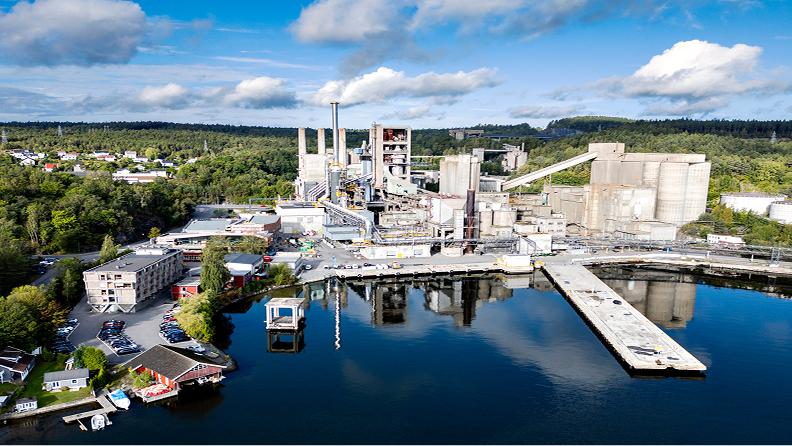
Brevik CCS is where that chain begins. The ship transport and storage component of Longship is called Northern Lights, which brings the CO2 we’ve captured to a holding facility in western Norway. From there it’s piped to a permanent storage site deep under the North Sea.
After more than a decade of testing, learning, and believing in CCS at scale, it’s an incredible feeling to see it finally happening. But our impact extends far beyond one cement plant.
Scaling the technology from a mobile pilot to a full-scale facility has given us many technical challenges, such as designing a process that runs on waste heat from the cement plant. But each challenge we solve gives us knowledge and experience that we carry into the next project.
Though CCS technology has existed for decades, the Brevik project (and others) is showing the world that large-scale CCS is possible.
SLB’s investment in this effort reflects our broader belief that industrial decarbonization will play an important role in shaping the world’s future energy system. And as we look toward our next 100 years, I believe CCS is one of the most exciting areas where we’re innovating for the future.
I’m excited to take what we’ve learned through Brevik CCS and use it to make the next pioneering project—and the one after that—even better.

