
Key takeaways
- Global lithium demand is forecast to triple by 2035 from current levels—reaching 3.7 million tons of lithium carbonate equivalent (LCE).
- Project success in brine-hosted lithium depends on subsurface intelligence and fully integrated workflows that connect reservoir management, processing, brine production, and reinjection into one framework.
- Many of the subsurface and regulatory integration challenges associated with lithium production have already been addressed by the oil and gas industry over previous years.
- Technology-neutral, performance-based policies anchored in reservoir modeling and environmental monitoring are key to scaling lithium production responsibly and efficiently.
Lithium is one of the most strategically important minerals to the global energy transition, with demand continuing to rise sharply as electrification efforts accelerate worldwide.
Global lithium demand is growing at around 30% annually and could surge nearly five-fold by 2040, driven largely by increased adoption of battery-dependent systems, including electric vehicles (EVs) and grid-scale energy storage. Today’s production, which is concentrated in a handful of countries, will likely struggle to keep pace with the current growth rate. Even with planned additions in mining and processing capacity coming online, demand is expected to outstrip supply by as much as 40% by 2035.
Against this backdrop, the question facing project developers is no longer simply how to extract lithium, but how to develop it efficiently, predictably, and responsibly. This will require the industry to shift its focus from extraction technology alone to the foundational disciplines that determine project success: subsurface intelligence and integrated workflows.
Using integration to rethink the lithium development challenge
When it comes to developing lithium reserves, much of the focus in recent years has been on the challenges and technology developments in direct lithium extraction (DLE). However, projects succeed or fail based on a much deeper question: Do we truly understand the reservoir, and can we manage it over time through a connected workflow?
Key decisions about where to drill, how to space wells, how brine chemistry varies, how fluids flow, and how reinjection behaves over time are questions every oil and gas operator faces. Many DLE challenges are, in fact, subsurface and integration challenges, which means that countries with mature oil and gas frameworks already possess the technical and regulatory foundations needed to drive projects forward.
In an integrated workflow, the process begins with resource characterization, where geological, geophysical, and geochemical data are used to understand the subsurface and define the reservoir. These insights then inform reservoir simulation, which predicts fluid behavior, productivity, and pressure evolution over time.
Based on the reservoir model, operators design and plan wells and completions that are optimized for safe, efficient brine production. Once wells are drilled, controlled brine production is carried out in a manner that aligns with subsurface expectations and sustainability targets.
At the surface, processing systems are designed to treat and extract lithium in a way that is compatible with the actual chemistry and variability of the brine. After lithium is removed, the spent brine is reinjected in a pressure-managed manner that protects aquifers and maintains long-term reservoir performance.
Throughout the entire lifecycle, continuous monitoring and environmental assurance provide real-time feedback, ensuring that each stage reinforces the next and the overall system operates safely and predictably. This creates a seamless development pathway where subsurface understanding, engineering decisions, operational execution, and environmental stewardship are tightly integrated.
Applying lessons learned from oil and gas to lithium production
Aligning lithium development with existing oil and gas permitting systems is logical, as these systems are technically robust, operationally coordinated, and environmentally rigorous, especially in subsurface resource management, well integrity, fluid handling, and injection control.
Oil and gas frameworks were built to regulate interdependent activities (e.g., drilling, completions, production, and injection) as part of one continuous system. This is precisely what brine-hosted lithium requires. Leveraging these established, connected workflows reduces regulatory gaps, accelerates timelines, and strengthens environmental assurance.
Here are some specific areas where best practices from oil and gas can be applied to lithium production:
- Subsurface characterization and environmental risk—Brines rich in lithium and other aqueous minerals (e.g., in the Smackover Formation) can contain high dissolved solids and scaling agents. Their chemistry can vary laterally and over time. Integrated workflows link brine sampling and geochemical modeling with facility design and reinjection plans, ensuring the surface plant is tuned to actual subsurface behavior and that reservoirs stay pressure balanced and protected.
- Water rights and fluid movement—Brine systems are often largely non consumptive, with closed loop designs reinjecting the majority of produced fluids. Nevertheless, high volumes and pressure management require careful aquifer protection and monitoring. Treating water rights, subsurface access, and reinjection performance within a single, integrated regulatory path reduces conflict and clarifies expectations.
- Surface processing and multi agency oversight—Subsurface operations mirror oilfield practices, while surface plants function like chemical facilities. Integrated workflows help agencies coordinate permitting and compliance across oil and gas commissions, water regulators, and environmental/public health authorities—so subsurface and surface decisions remain synchronized.
- Whole system modeling—In brine hosted lithium, decision quality rises when multidisciplinary data are integrated across basin, reservoir, and fluid flow domains. Advanced 3D basin modeling reconstructs basin history and geochemical conditions, while static modeling ties geology, geophysics, and petrophysics to spatial rock property distributions. Aqueous flow modeling provides early production estimates and well count assurance. Dynamic modeling can then be applied to optimize long term reserves, well patterns, and reinjection strategies.
- Securing public trust—Communities expect transparency on water, subsurface integrity, and long term monitoring. Integrated workflows provide a consistent, data driven way to communicate reservoir behavior, reinjection performance, and environmental safeguards, building trust with local authorities and residents.
Global pathways to lithium regulation built on subsurface intelligence
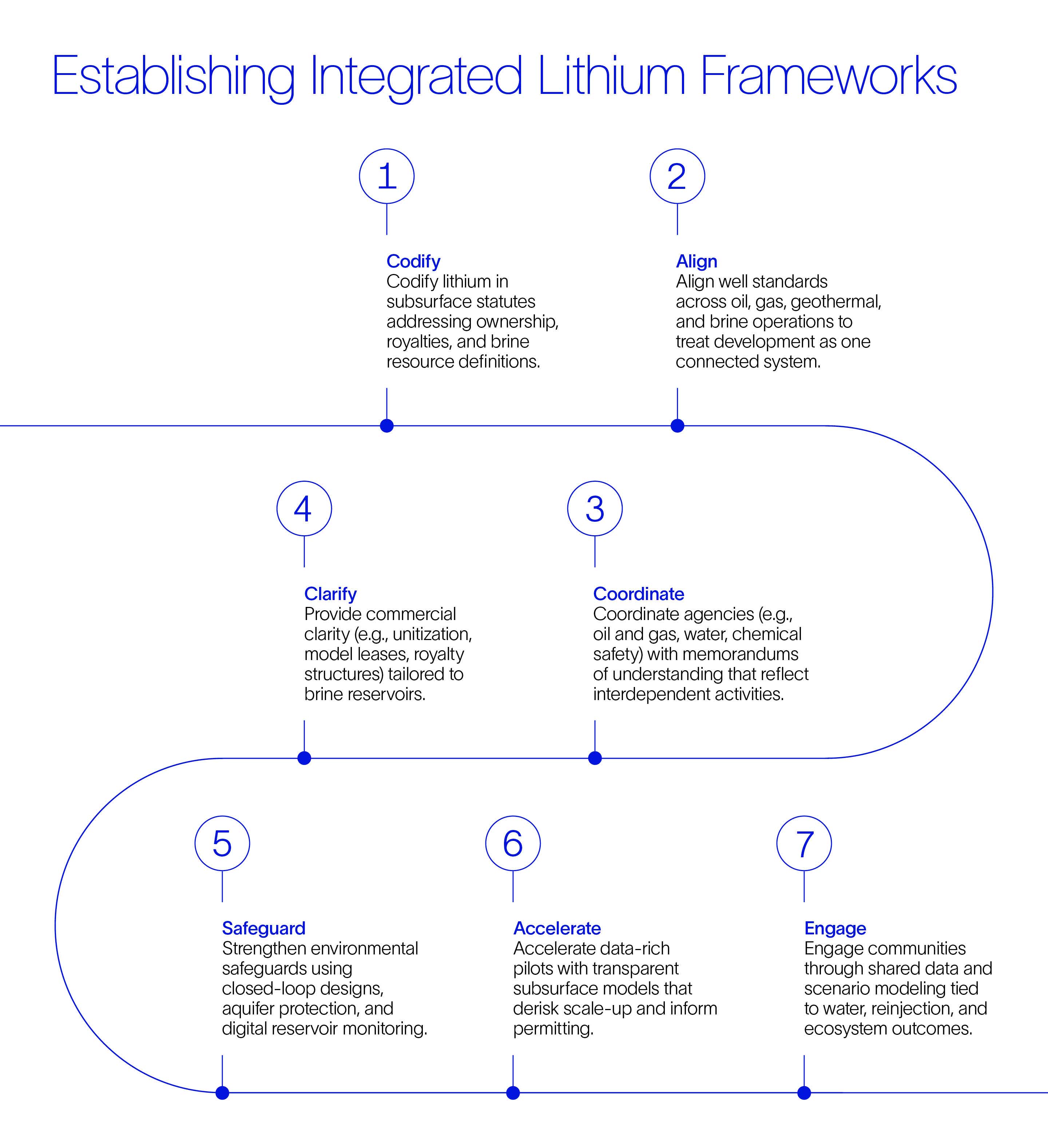
As lithium demand accelerates, national and international bodies are exploring how to regulate brine development effectively. The most durable policies are technology-neutral and performance-based, anchored in subsurface models, monitoring, and pressure-managed reinjection, rather than prescriptive extraction technology recommendations.
Many of these policies prioritize:
- Updates to mining and water laws for brine systems so ownership, unitization, reinjection, and monitoring reflect fluid reservoirs; not just solid minerals.
- Cross sector coordination between energy, water, chemical safety, and environmental policy to streamline permits and align safeguards.
- Standards and benchmarks for reservoir modeling, monitoring, reinjection performance, and community engagement.
- Technology neutral regulation that rewards outcomes like aquifer protection, water neutrality, emissions, and closure standards.
How the U.S. is leading in subsurface first adaptation
The U.S. is emerging as a case study in “subsurface-first” adaptation—leveraging existing oil, gas, brine, and geothermal regulatory frameworks to enable new production pathways. Rather than building policy from scratch, several states are aligning lithium development with established rules governing fluid management, well integrity, mineral rights, and reinjection.
Arkansas, for example, is building on its legacy as a bromine producer. The Arkansas’ Brine Conservation Act treats brine as a regulated subsurface resource, enabling unitization and royalty structures analogous to oil and gas, and offering commercial clarity for Smackover developments.
Texas applies robust oilfield well standards to brine production and injection, with environmental oversight coordinated across agencies. Key questions remain around mineral classification and ownership, but the integrated, subsurface-aware permitting baseline is robust.
Meanwhile, geothermal permitting in California and Nevada offers a natural template for pressure managed reinjection and continuous monitoring. States are evaluating how best to align lithium recovery with geothermal rules, reflecting the need to regulate the entire workflow, not just individual steps.
And finally, Great Salt Lake-focused efforts in Utah emphasize nonconsumptive fluid management and ecological safeguards, highlighting the value of integrated planning from reservoir through reinjection and monitoring.
Positive lithium developments internationally
Several countries outside of the U.S. are also demonstrating how lithium development can advance within established subsurface and geothermal frameworks.
- Chile and Argentina: Chile’s National Lithium Strategy positions brine focused approaches to reduce water use and environmental impact, while Argentina demonstrates early commercial pathways where subsurface understanding and operational integration enable scale. Aligning lithium development with geothermal/oilfield style permitting (especially for reinjection and aquifer protection) helps operators execute end to end, integrated plans.
In Argentina’s Salar del Hombre Muerto, long operating brine production has been expanded in staged programs, and new DLE based plants that do not rely on evaporation ponds have recently entered commissioning and startup alongside legacy pond operations.
- Australia: In geothermal rich regions like Australia, petroleum based subsurface workflows, including geologic modeling, well integrity standards, and environmental management plans, are being adapted to lithium brine development. The emphasis is shifting toward water neutral, integrated designs that link subsurface and surface performance.
- Germany and France: Europe’s geothermal basins show how subsurface to surface integration fit naturally within the permitting process. Pilots and early projects illustrate that extending geothermal rules to lithium coproduction works best when the entire workflow is treated as one system.
Accelerating time to lithium production
The future of lithium does not depend solely on new extraction technologies, but rather on understanding the subsurface and managing it through integrated workflows that connect characterization, modeling, drilling, production, processing, and reinjection with continuous monitoring. Oil and gas regulatory systems already embody this approach. With thoughtful adaptation for brine chemistry and water stewardship, jurisdictions can scale lithium responsibly—earning public trust while accelerating time to production.