
Key takeaways
- The energy transition is ultimately a system design challenge, not a like-for-like replacement of one generation source with another.
- Reliability will depend on planning for the services different assets provide, including inertia, voltage support, flexibility, dispatchability, and resilience during stress events.
- Transition strategies must account for infrastructure constraints because generation, storage, transmission, demand growth, and market rules don’t always evolve at the same pace.
- Digital modeling, scenario testing, and AI-enabled optimization will be critical for understanding tradeoffs and building energy systems that can adapt as conditions change.
The energy transition is often described as a shift from traditional fossil fuels to renewable or lower-carbon technologies. But that framing is too narrow.
The challenge we face today goes beyond simply replacing one energy source with another. The real challenge is creating a system that’s more interconnected, sustainable, and affordable, without compromising the inherent resiliency or reliability characteristics we’ve grown accustomed to over the years. That’s the energy trilemma: a balance between affordability and security, in addition to environmental sustainability.
For decades, power systems were built around large, centralized assets that could be dispatched with a high degree of predictability. Conventional thermal generation, hydro, and nuclear plants provided not only energy, but also inertia, voltage and frequency stability, and controllable dispatch. As grids increasingly incorporate a higher share of distributed energy resources (DERs)—including wind, solar, batteries, and electric consumers—the operating logic of the system is changing. What was once predictable now needs to react to real-time changing conditions in weather and demand.
In this sense, the energy transition cannot and should not be viewed primarily as a capacity substitution problem. It’s a system design problem.
Why embracing an energy systems mindset is important
Energy system planning has historically followed an asset-centric model, whereby infrastructure additions and upgrades are evaluated in isolation. A power plant operator focuses on generating power, a network operator focuses on transmission capacity, and an industrial consumer focuses on securing low-cost supply. Each player optimizes their own part of the system, often assuming the wider system will absorb the consequences.
A systems mindset takes the opposite view.
It recognizes that every decision creates effects elsewhere. Adding large volumes of solar photovoltaic may reduce emissions, but it also changes intraday generation profiles, increases the need for flexibility, and can create curtailment if transmission or storage isn’t developed in parallel.
Retiring synchronous generation may reduce fossil fuel use, but it can also reduce inertia, fault current, and voltage stability. Similarly, electrifying industrial processes may lower direct emissions, but it can increase local grid demand and require new infrastructure, backup strategies, or onsite energy management.
A systems approach asks broad, forward-looking questions like:
- How will the full system—not just the asset—behave?
- What happens during periods of low renewable output?
- Where are the transmission constraints?
- How will demand respond?
- What services are needed to maintain frequency and voltage stability?
- How will costs be allocated?
The ultimate goal isn’t simply to add lower-carbon assets quickly, but rather to identify the pathway that delivers the best overall outcome across metrics for reliability, affordability, emissions, and deliverability, both today and into the future. In terms of financials, that means focusing less on the levelized cost of energy (LCOE) and more on the levelized cost of system (LCOS).
Common mistakes in transition planning
A common misunderstanding when it comes to transition planning—particularly among nontechnical professionals—is the assumption of substitution. This means assuming one form of generation can be replaced by another with the same nameplate capacity. The assumption doesn’t hold true. Different resources provide different system attributes with different capacity factors.
Consider the example: During the week of January 5, 2026, wind in the United Kingdom fell from approximately 20 GW to 2 GW, requiring a dispatchable energy carrier (gas) to increase to meet the shortfall. Nuclear couldn’t do it because it’s baseload only. Imports couldn’t do it, and biomass wouldn't have been able to ramp up in time. Meanwhile, solar is only helpful during the day, which creates a big problem for grids.
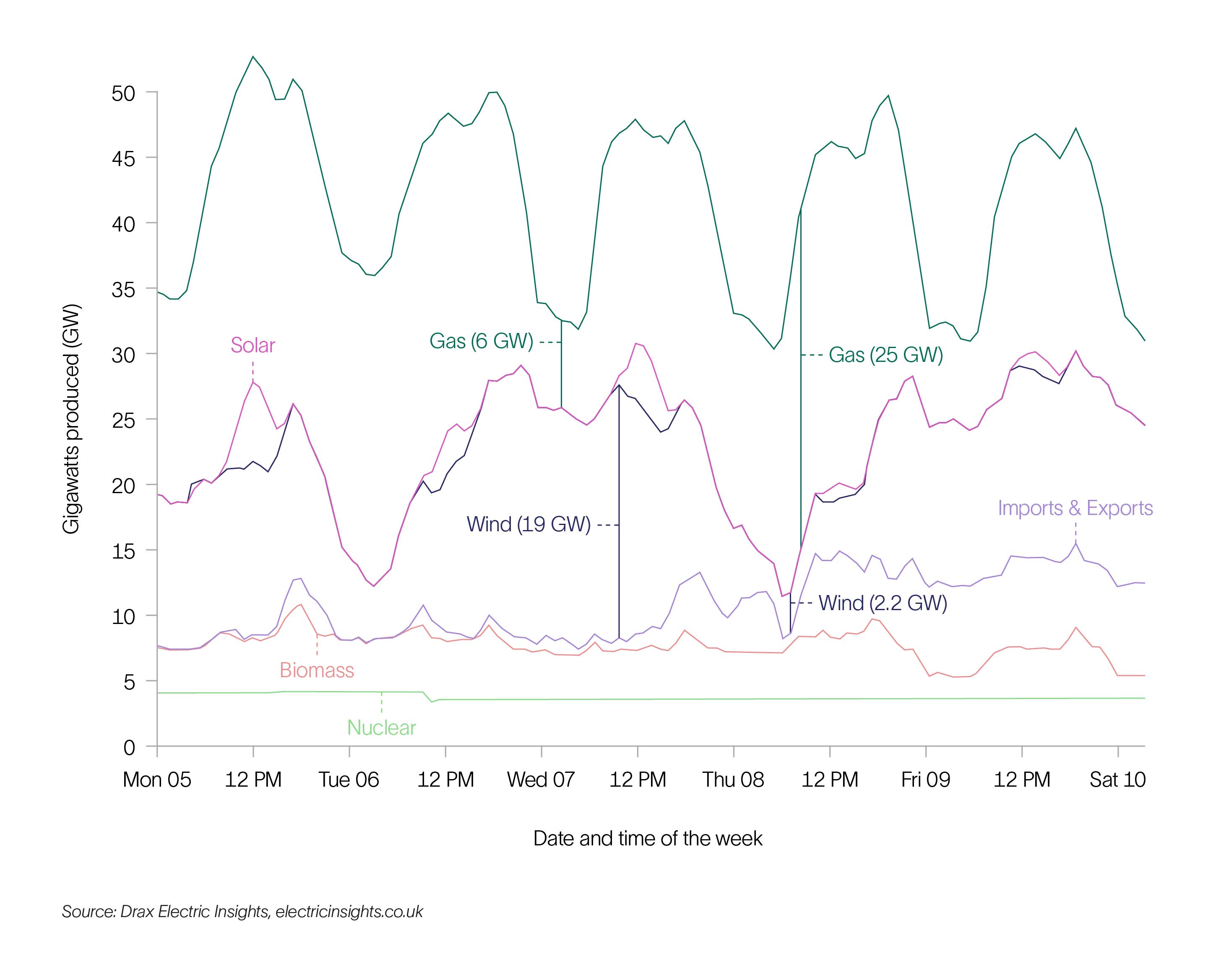
Renewable generation is variable, weather-dependent, and often located far from load centers. It may be abundant when demand is low and scarce when demand is high. It also connects through power electronic converters that provide little or no inherent inertia. This can dramatically change the way the grid behaves during disturbances.
Nuclear presents a different set of tradeoffs. It can provide large volumes of lower-carbon baseload power, but conventional plants aren’t always suited to rapid ramping. Permitting and approval for nuclear plants are also notoriously long, which adds complexity and cost. The emergence of small modular reactors (SMRs) can help address these challenges, but they still need to be considered part of a wider energy architecture rather than a standalone solution.
The same logic applies to distributed energy resources.
Rooftop solar, batteries, microgrids, heat pumps, electric vehicle chargers, and industrial electrification can all support large-scale decarbonization. But they change the way the owner interacts with their utility or energy supplier.
Increasingly, large consumers are embracing the “prosumer” approach, in which they provide power or other ancillary services to the grid when needed. While this creates new opportunities for flexibility and monetization, it (again) adds complexity when planning distribution networks, market coordination, and system operations. Which is precisely why transition strategies require both top-down and bottom-up thinking.
Another common mistake is the assumption of infrastructure services. This means underestimating infrastructure constraints (i.e., the common concept of if you build it, they will come). The reality is that new generation can often be developed faster than transmission, distribution upgrades, market reforms, permitting processes, or regulatory approvals allow.
In the United Kingdom, for example, 98% of electricity grid curtailment occurs because the transmission infrastructure between Scotland and England is severely constrained. This means new projects are unlikely to be built until there is route to market (e.g., the 500 MW Arven). Case in point: 2 GW West of Orkney windfarms have been paused due to transmission grid constraints.
A third widespread issue is the assumption of isolation, also known as planning in silos.
Today, electricity, gas, transport, industry, buildings, alternative fuels, and digital infrastructure are increasingly connected. A plan focused only on the electrical grid can miss the implications of heating demand, fuel demand, or local energy production. Similarly, a national plan that overlooks local constraints may fail when translated into actual projects. And last but not least, planners often rely too heavily on average conditions when evaluating system behavior and performance.
Energy systems are stressed by extreme environmental and operational scenarios, such as cold snaps, heatwaves, low-wind periods (dunkelflaute), high-demand evenings, droughts, storms, cyber risks, fuel supply disruptions, and equipment outages. Transition planning must consider not only expected performance, but also so called “tail events” to ensure designs are sufficiently resilient under stress.
The role of digital modeling and scenario testing
As power systems absorb more distributed energy resources, planners need to understand how different technologies, policies, costs, and operating conditions interact across the whole system.
Digital modeling helps decision-makers move from aspiration to evidence. It allows them to test pathways, identify bottlenecks, compare tradeoffs, and understand the consequences of decisions before large-scale capital is committed. Discovering issues in the late stages of construction or implementation is far more expensive.
Transition strategies are path-dependent. Early choices about transmission corridors, storage duration, generation mix, grid-forming capability, industrial electrification, hydrogen infrastructure, or distributed energy coordination shape what’s possible later. A decision that looks efficient in the short term may create constraints in the future. Conversely, an investment that appears expensive today may unlock lower-cost or more resilient options over time.
Scenario testing is especially important because the future system will be shaped by uncertainty. Demand growth may be faster or slower than expected. Technology costs may fall at different rates. Meanwhile, regulatory frameworks continue to evolve.
A robust model allows leaders to test multiple futures, including faster demand growth, delayed transmission, falling storage costs, extreme weather events, and increased prosumer participation.
The emerging role of agentic AI
In addition to digital modeling, AI is becoming an increasingly important tool for planning and operating complex energy systems.
Traditional AI in energy has typically focused on forecasting, pattern recognition, and decision support. Generative and agentic AI move the conversation further by enabling systems to interpret changing conditions, evaluate options, and act within defined operating limits. This could mean autonomously adjusting flexible demand, rerouting excess power into storage, and dispatching generation.
One of the more immediate opportunities for AI implementation is in electric grids with high levels of weather-dependent renewable generation. Because electricity must be balanced in real time, AI agents could help utility-scale assets respond faster to changing wind, solar, demand, and storage conditions. This can improve asset utilization, strengthen resilience, and support more efficient participation in grid and market operations.
Demand-side flexibility represents a major longer-term opportunity. Many homes, vehicles, buildings, and industrial loads contain flexibility that’s not yet fully accessible because it requires either human intervention or better connectivity. But as Internet-of-Things devices, smart controls, and connected assets become commonplace, AI could enable more dynamic demand-side management. This could mean anything from slightly adjusting heating loads during system stress to charging electric vehicles when surplus renewable power is available. Variable retail pricing is also essential for rewarding those willing to participate and support the system through demand-side management.
Retrofitting older infrastructure, particularly where data is fragmented or systems weren’t designed to communicate, is more difficult. The biggest risks for companies today aren’t the AI models themselves, but rather their weak implementation (i.e., poor testing, limited scale-up plans, insufficient cybersecurity, and lack of data standardization across assets, devices, and facilities).
Taking a holistic view
For a transition strategy to be successful long term, the focus must shift away from maximizing metrics or assets in isolation to optimizing across multiple constraints. That requires decision-makers to ask what level of reliability is required, what cost is acceptable, what emissions trajectory is compatible with policy and market expectations, what infrastructure can realistically be delivered, and what optionality should be preserved.
The answers rarely point to a single technology pathway. More often, it will be a sequenced portfolio of actions that evolves as demand, regulation, technology readiness, and system conditions change.
Moving forward, we must collectively embrace the notion that the energy transition isn’t simply about replacing conventional assets with renewable ones. It’s about redesigning an entirely new system that balances sustainability, security, reliability, and affordability.