Remote monitoring team increases ESP uptime, extends run life, and minimizes deferred production


A Performance Live™ digital service delivery center team used the SLB intelligent lift service to identify early signs of equipment stress, minimize unplanned ESP downtime, and protect equipment integrity. Over a 5-month period, remote interventions avoided approximately 90 hours of downtime or ~3,750 bbl of deferred production, reduced HSE risk, and helped extend ESP run life.
An operator in North Africa with numerous land wells equipped with electric submersible pumps (ESPs) was experiencing recurring electrical outages. Multiple restart attempts were required, with the wells entering low-flow cycles during each restart.
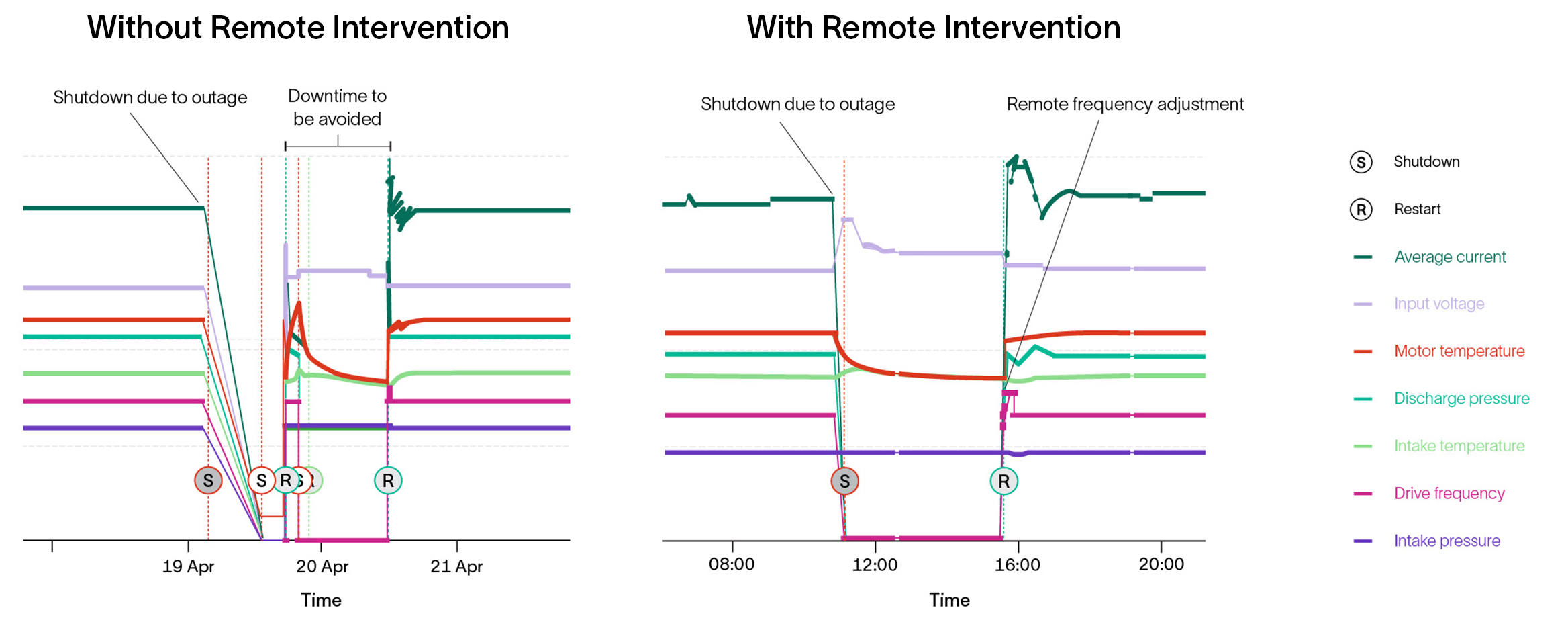
The issue was identified by the regional Performance Live center team monitoring the wells. Through close examination, the SLB team observed a pattern where low-flow cycles caused a rapid increase in motor temperature above maximum thresholds or a drop in motor current below minimum thresholds. These events caused restart failures and resulted in an average of 6 hours of downtime per failed restart.
To mitigate the problem, SLB proposed the following remote intervention strategy and the operator agreed to its implementation.
- Verify that auto-restart is disabled for the specific shutdown cause (power outage or high motor temperature) to prevent the ESP from restarting under the same conditions that caused the trip.
- Restart the ESP when conditions permit (e.g., when the motor has cooled down).
- Increase motor frequency at a rate recommended by the application engineer.
- Closely monitor well performance and return the ESP to the target frequency once it begins picking up load.
- Continue monitoring the well to ensure that it stabilizes.
This procedure ensured that the ESP picked up load gradually after restarting, reducing the number of restart failures for the well.
Using a monitoring tool to analyze shutdown events, the SLB team observed that for 5 wells showing similar behavior, shutdowns due to low flow (high motor temperature) accounted for approximately 25% of the total shutdowns across a 5-month period. In comparison, during the subsequent 5 months when the new startup protocol was in place, this figure decreased to 16%. Approximately 15 shutdowns were prevented, a reduction of 9 percentage points in the number of shutdowns related to low flow.
These remote interventions translated into about 90 hours of recovered production time—equivalent to ~3,750 bbl of oil, lower HSE exposure and workload for the operator’s field team, and extended ESP run life.