Borehole imaging reveals high-potential fault zones for geothermal flow

minus
Taiwan, 亚洲, 陆上

SLB applied advanced borehole imaging and petrophysical analysis to characterize permeable fault systems in a tight slate formation in Taiwan’s Jentse geothermal area. The integrated approach identified zones with enhanced fracture porosity and validated geothermal flow potential—enabling strategic planning for geothermal energy extraction.

The Jentse geothermal area in northeastern Taiwan exhibits significant heat flow but is dominated by low-porosity slate and metasandstone. The primary challenge was identifying subsurface fracture zones capable of sustaining geothermal fluid production. Traditional exploration methods struggled to confirm the presence and quality of permeable conduits because of the complex lithology and poor outcrop continuity.

SLB deployed an integrated workflow using geophysical log interpretation and the FMI™ fullbore formation microimager in the JT‑4 directional well. The aim was to locate permeable fault systems and evaluate their internal structure, porosity, and flow capacity. Tools included gamma ray, density, neutron, sonic, and temperature logs, alongside advanced image interpretation techniques. The SLB workflow combined petrophysical modeling with fracture analysis to resolve fracture density, aperture, and porosity—key indicators of geothermal productivity.

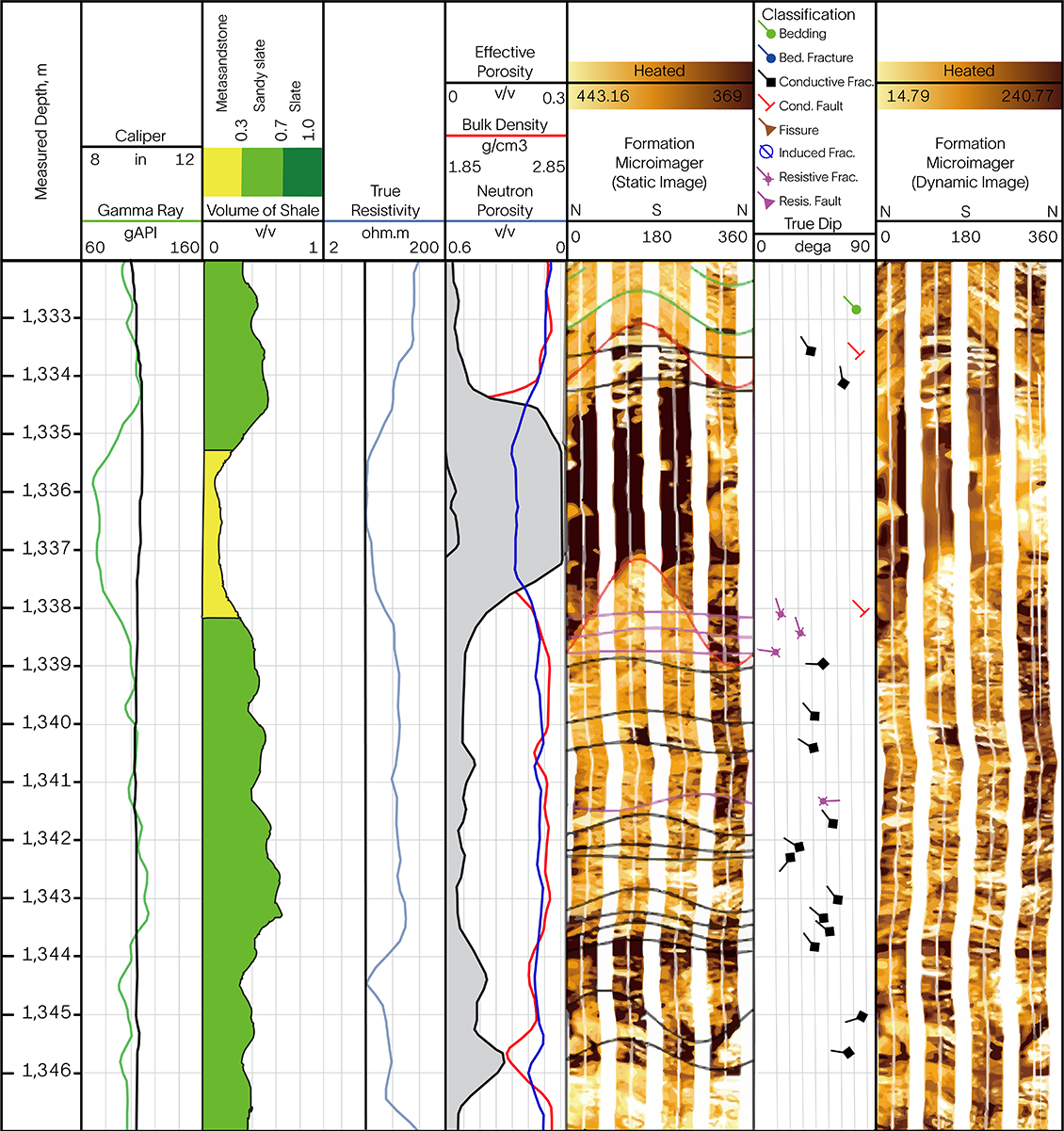
Analysis revealed four distinct fault zones between 754 and 1,480 m depth. Zones 1, 2, and 4 were identified as the most permeable, featuring fault cores composed of porous breccia and damage zones with high open-fracture density. Fault Zone 4 exhibited the most promising interval (1,334–1,346 m MD), with effective porosity exceeding 12%, fracture densities over 1.3/m, and fracture porosity up to 0.5%.

These zones were confirmed as productive using borehole temperature logs, which showed positive anomalies consistent with geothermal fluid inflow.

In contrast, Fault Zone 3 consisted mostly of healed fractures and mirrored the physical properties of the intact host rock—indicating poor permeability. The alignment between drilling-induced fractures and regional stress fields (N50–70°E orientation) supported the interpretation that these open fractures remain critically stressed and hydraulically conductive due to ongoing tectonic extension from the Okinawa Trough.

SLB integrated analysis provided the operator with a clear framework for targeting productive zones and understanding fault‑related heterogeneity. By identifying permeable structures without additional drilling, the study derisked future development and reduced exploration costs. These insights are now being used to inform future geothermal planning across northeastern Taiwan.

For more information, read Geothermal Energy-2023: Geophysical characteristics of a fault system in the northern Central Range of Taiwan and its applications for geothermal energy exploration.

Key geophysical logs and imaging with the FMI microimager of the 1,334–1,346 m MD fault core. The geophysical logs denote the lithology (GR and VSH logs) and porosity (PHIE, RHOB, NPHI, and RT logs). The two most fractured intervals within the fault core are 1,334–1,339 and 1,343–1,346 m MD. The 1,334–1,339 m interval developed in the metasandstones (low GR) with extremely high porosity (low RT, low RHOB, and high NPHI values). This interval is the most permeable interval in the studied well section. The attitude of the bounding fault planes at 1,334 and 1,338 m MD is about N50E/75–80°NW.
相关产品