Spyder bit features both cylindrical and 3D shaped cutters for lower torque and improved bit dynamics.
Hybrid drill bit improves drilling performance in an onshore Middle East well
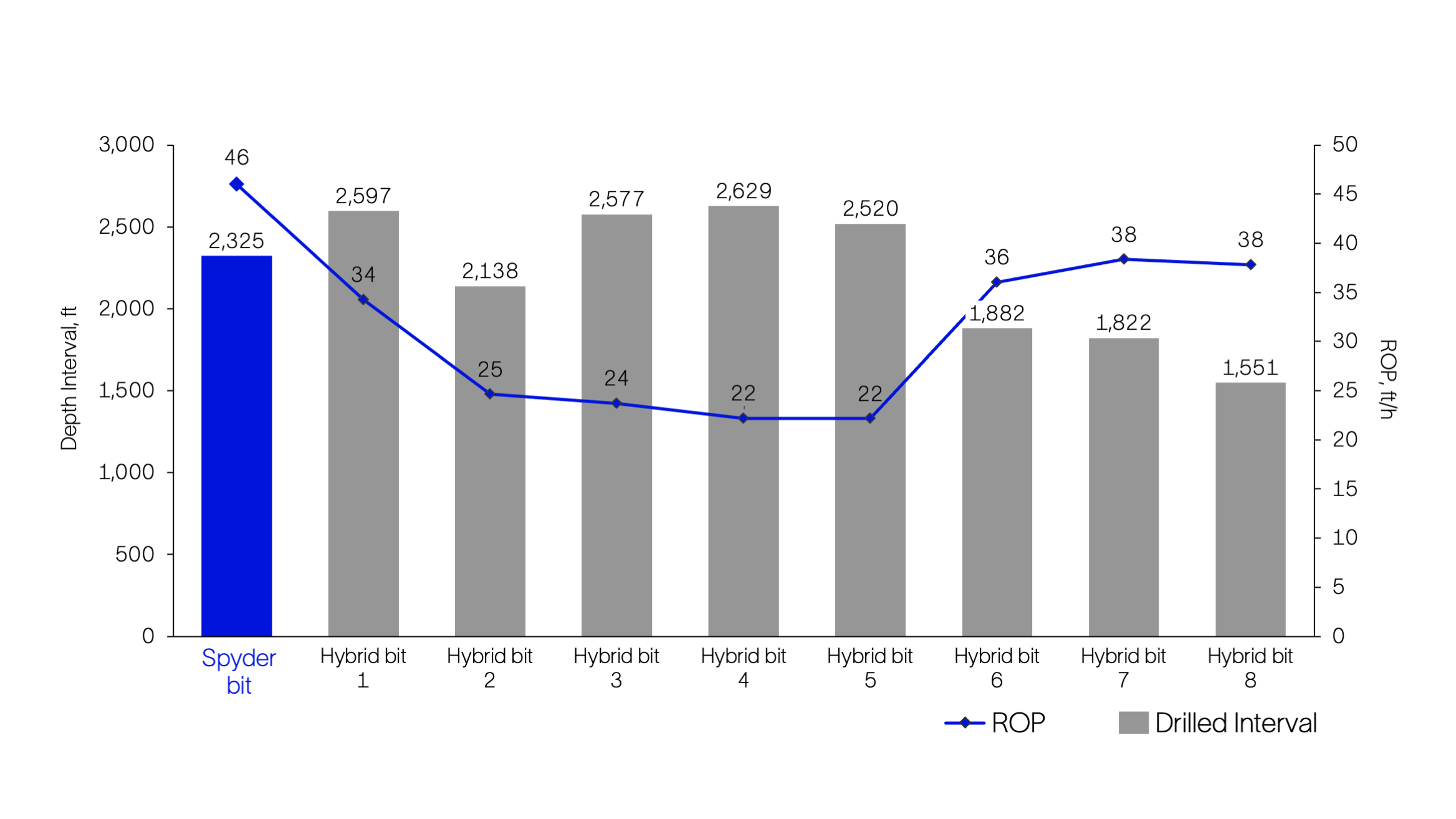
SLB deployed the 22-in Spyder™ hybrid drill bit in a challenging onshore Middle East well, successfully drilling 2,325 ft in a single run at an average ROP of 46.04 ft/h. This performance demonstrated a 58% improvement in ROP compared with previous hybrid bit runs, with minimal vibration and limited wear at TD. The operation demonstrated improved hybrid bit durability and efficiency across complex lithologies.
The operator faced significant drilling challenges in a gas field located onshore Middle East, where the 22-in interval traversed a highly heterogeneous Cretaceous succession. The section comprised alternating carbonate, shale, and sandstone formations, each presenting unique obstacles such as variable rock strength, dynamic loading conditions, and susceptibility to vibration, impact damage, and circulation losses.
In particular, the presence of vugular and fractured carbonates increased the risk of bit damage, while abrasive sandstone-rich sequences accelerated cutter wear. These lithological transitions exposed the BHA to stick-slip and torsional oscillations, making it difficult to maintain high ROP and consistent hole cleaning in the large-diameter vertical section.
The operator sought a solution that could balance aggressiveness, stability, and wear resistance, enabling efficient drilling across the broad range of formation characteristics while minimizing operational risks.
SLB selected the 22-in Spyder hybrid drill bit to address the complex drilling environment. The Spyder hybrid bit integrates PDC cutters for high shearing efficiency and TCI roller cones to absorb impact loads and mitigate cutter damage in abrasive sandstone, carbonate-rich intervals, and hard limestone streaks. This hybrid configuration provided a balanced combination of durability, stability, and drilling efficiency, effectively managing transitions between soft and hard lithologies while reducing torsional and lateral vibrations.
During the operation, the Spyder hybrid bit drilled the entire 2,325-ft section in a single run, achieving an average ROP of 46.04 ft/h. Downhole data confirmed consistently low axial and lateral vibration levels, indicating stable drilling dynamics and effective mitigation of common dysfunctions associated with lithological transitions. The drill bit was pulled at TD in good condition, with limited wear on the body, TCIs, and PDC cutters, demonstrating durability and validating the hybrid design's ability to withstand dynamic loading and abrasive environments.
Compared to the historical average hybrid bit performance in the field, the Spyder hybrid bit delivered a 58% improvement in ROP while maintaining single-run interval delivery. This result reduced rig time and NPT and demonstrated improved performance for hybrid bit applications in the region.