Continuous emissions monitoring system
Gain real-time, facility-level insights to accelerate LDAR and reduce operational risk


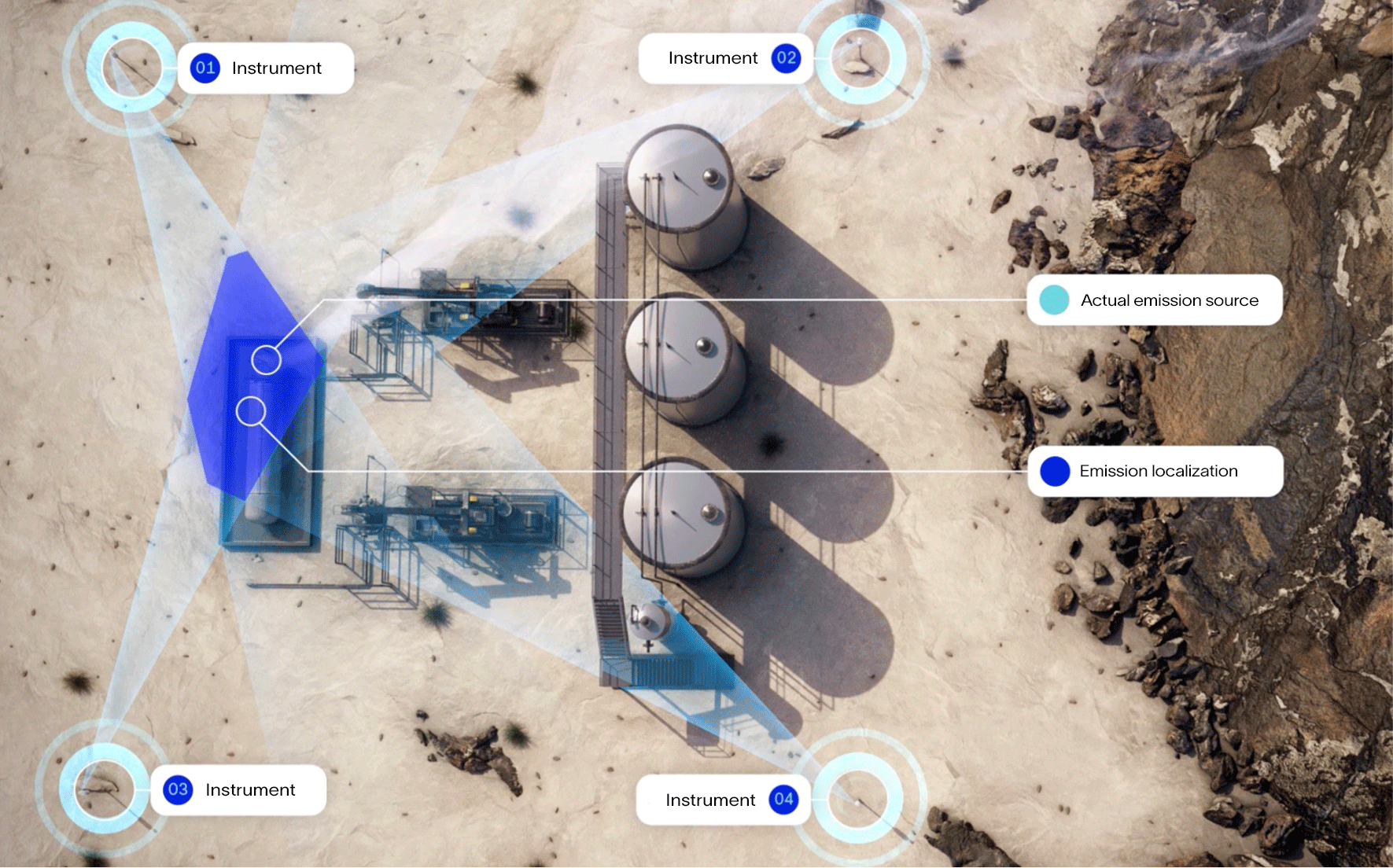
Soofie™ cotinuous emissions monitoring system (CEMS) is designed for continuous monitoring at sites such as well pads and tank batteries. A network of fully calibrated point sensors, which can be quickly and easily self-installed on the site perimeter, measures methane concentrations and wind speeds and directions. This network is used in conjunction with an interpretation algorithm that is continuously updated to reflect the latest science.
The methane point instrument determines when emissions start and stop, where they come from, and quantitatively how large they are.
Detects, localizes, and quantifies methane emissions 24/7, in real time
-
Supports efficient leak detection and repair (LDAR) programs
-
Monitors well pads, tank batteries, compressor stations, and gas processing facilities
-
Enables remote monitoring to reduce unnecessary site visits
-
Quantifies emissions for regulatory and voluntary reporting
-
Provides audit-ready emissions data for compliance reporting
From detection to decision—faster
Accelerate response
Real-time alerts, sent to your Inbox and the Soofie dashboard, when conditions deviate outside of the operating conditions
Improve LDAR efficiency
Validation, categorization, and probable source attribution help crews go straight to the issue.
Minimize alert fatigue
System learning reduces false positives, focusing attention on actionable events.
Quantify impact
Determine magnitude and leak rate for better triage and reporting.
Deploy fast, scale globally
Proven across thousands of sites, capturing millions of datapoints daily.
What makes the system effective in the field
Continuously monitor site conditions with advanced sensing, analytics, and connectivity designed to turn emissions data into actionable insights. Detect abnormal conditions, quantify emissions, identify probable sources, and remotely monitor system performance—all in one connected solution.
Intelligent emissions detection
Continuously monitors methane (CH₄) and TVOC, learns the facility’s operating conditions, and alerts users to abnormal events. Optional sensors extend monitoring to CO, CO₂, and H₂S.
Source localization and quantification
Combines gas concentration, ultrasonic wind measurements, advanced GPS positioning, and analytics to estimate leak rate and identify the probable emission source.
Connected monitoring and diagnostics
Access monitoring data locally in the field or remotely through the mobile app and enterprise dashboard. Remote diagnostics provide visibility into sensor performance, GPS, cellular strength, wind, tilt, and overall instrument health.
Built for reliable field operation
Weather-resistant, ruggedized components, upgraded modems, and directional antennas help maintain reliable performance and connectivity in demanding operating environments.
How does continuous learning reduce false alarms?
By modeling each facility’s normal emissions patterns and operations. Alerts trigger only when signals deviate from learned baselines, which reduces false positives and speeds response.
Can the system quantify a leak and indicate where to look?
Yes. Analytics estimate magnitude/leak rate and provide a probable source to guide crews.
What field data supports reliability at scale?
Deployed across thousands of sites; systems capture more than 2 million datapoints per day for analysis and trending.
What telemetry and device health data are available?
Tilt, GPS, cellular connectivity, sensor performance, wind, and hardware identifiers are accessible via mobile and enterprise dashboards.
Can Soofie be used for EPA-approved periodic screening?
Yes. Soofie is an EPA-approved alternative test method under 40 CFR Part 60 Subpart OOOOb for periodic screening at defined detection thresholds. When activated, it enables facility-wide monitoring and reduces routine site visits by requiring follow-up inspections only when emissions exceed method detection limits.

