SLB Launches QI-FWI Quantitative Interpretation Full-Waveform Inversion Solution
Published: 08/18/2026
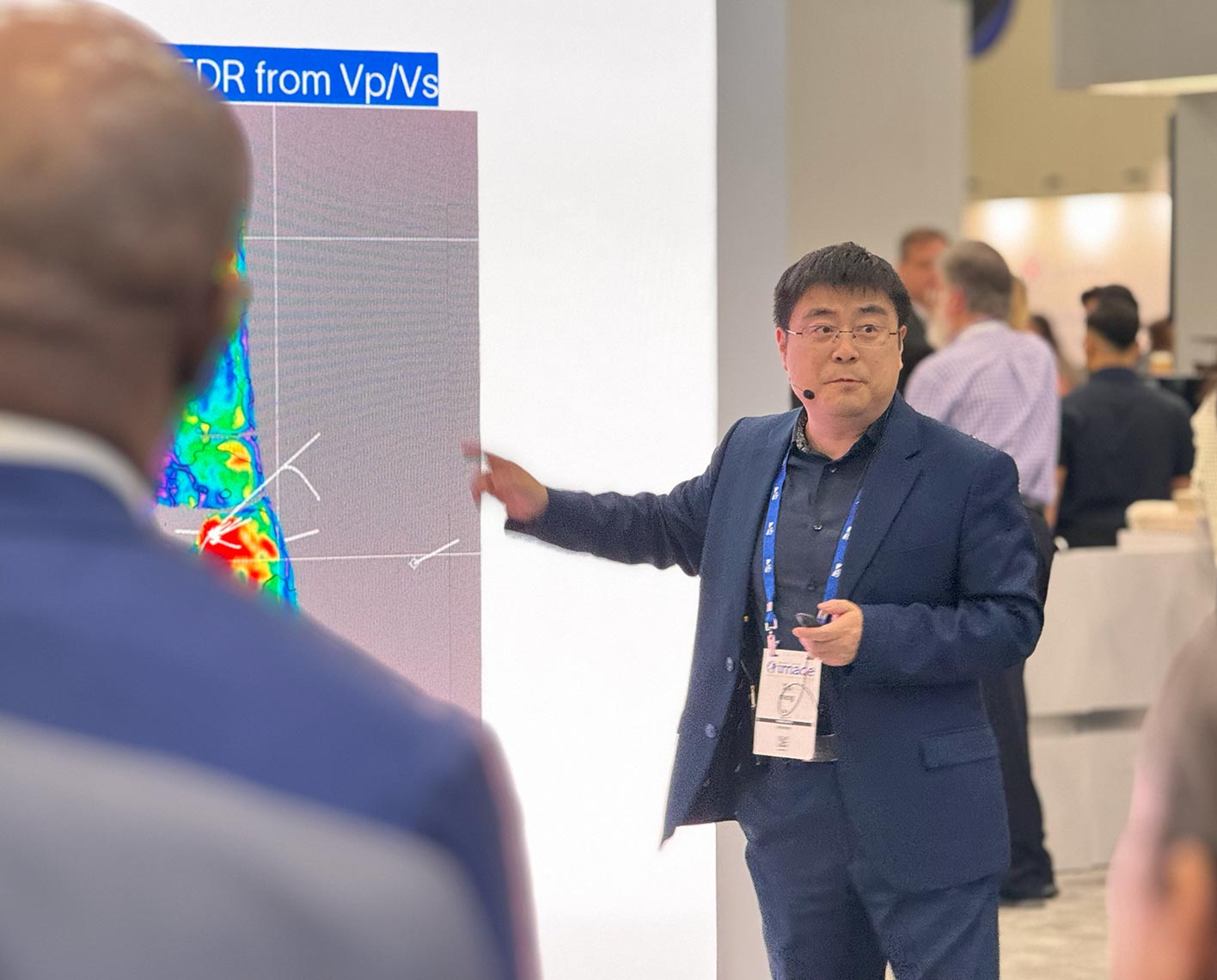
SLB Launches QI-FWI Quantitative Interpretation Full-Waveform Inversion Solution
Published: 08/18/2026
New data-driven seismic solution unveiled at IMAGE 2026 gives geoscientists earlier insight into reservoir rocks and fluids
Energy companies rely on seismic data to understand what lies below the surface before deciding where to explore, drill and develop. Seismic imaging can reveal underground structures but understanding the rock and fluid properties associated with them has traditionally required additional processing.
That’s the challenge that SLB’s QI-FWI™ quantitative interpretation full-waveform inversion solution is designed to address.
The QI-FWI solution connects seismic imaging more directly with reservoir interpretation through a data-driven full-waveform inversion workflow that produces key rock and fluid properties directly from the seismic wavefield.
“Traditional seismic workflows can require multiple processing and inversion steps to move from a subsurface image to information about the reservoir,” said Andrea Lovatini, vice president of exploration data and geosolutions at SLB. “QI-FWI provides a more streamlined and data-driven approach, using the seismic wavefield directly to deliver earlier reservoir insight with fewer technical handoffs and a more direct path to decisions about where to explore, drill and develop.”
How the QI-FWI solution works
The QI-FWI solution analyzes how seismic waves travel through underground rock formations. It compares recorded seismic data with a computer model of the subsurface, then repeatedly adjusts the model until it closely matches the observed wave behavior.
The solution analyzes pressure waves and shear waves, called S-waves. These waves move through rock in different ways, providing information about rock density, stiffness and composition. Studying both wave types helps geoscientists better understand changes in rock properties and potential fluid content.
The QI-FWI solution produces key reservoir properties, including Vp, P-impedance and Vp/Vs, directly from elastic full-waveform inversion. P-impedance combines rock density with the speed of pressure waves, while Vp/Vs compares the speed of pressure waves with S-waves.
In conventional workflows, teams often apply separate seismic imaging, amplitude analysis and AVO inversion steps to estimate reservoir properties. Each stage may require additional data conditioning, technical assumptions, and handoffs between different teams. The QI-FWI solution takes a more integrated, data-driven approach. It produces P-impedance and Vp/Vs from the seismic wavefield within the full-waveform inversion workflow. This reduces processing steps and technical handoffs while keeping the recorded data, subsurface model and interpreted reservoir properties more closely connected.
The outputs can also be checked against well log data, allowing interpreters to compare properties derived from seismic data with measurements taken inside the well. This provides an additional check on whether the seismic-derived properties are consistent with known subsurface conditions.
From seismic data to reservoir decisions
During exploration and appraisal, the QI-FWI solution can help teams evaluate prospective areas and better understand reservoir rock and fluid properties. During development, the information can support well planning and reservoir characterization.
The solution can also be applied to seismic surveys collected at different points in time to help teams monitor reservoir changes during production. This extends the workflow across the reservoir life cycle, from evaluating a prospect to understanding how a producing reservoir changes over time.
