Methane point instrument

Continuous, scalable methane monitoring technology that is simple and cost effective, with proven performance

SLB methane point instrument
minus

Simple, low-cost methane monitoring. Best-in-class results at METEC.

The methane point instrument from SLB is designed for continuous monitoring at sites such as well pads and tank batteries. A network of fully calibrated point sensors, which can be quickly and easily self-installed on the site perimeter, measures methane concentrations and wind speeds and directions. This network is used in conjunction with an interpretation algorithm that is continuously updated to reflect the latest science.

The methane point instrument determines when emissions start and stop, where they come from, and quantitatively how large they are. Its performance has been proved through third-party tests conducted by the Methane Emissions Technology Evaluation Center (METEC), Colorado State University. Detailed test results are available on METEC’s website, where our methane point instrument is Solution S.

Compared with 12 other continuous monitors tested at METEC, the SLB methane point instrument ranked first in regression bias, ranked second in least quantitative error, ranked second in 90% detection limit, and ranked third in localization accuracy.

It was the only continuous monitor that placed in the top quartile across each of these important metrics.
Methane Point Instrument
Tiny tech. Giant leap.

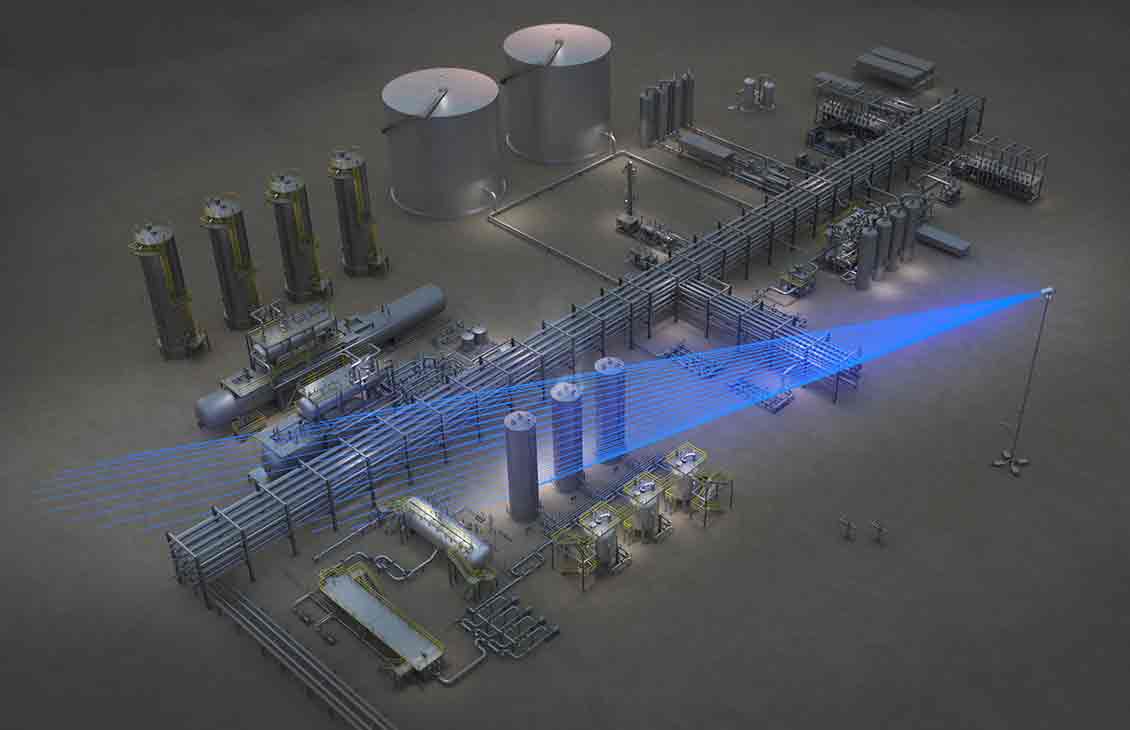
Detects, localizes, and quantifies methane emissions 24/7, in real time

  • Supports efficient leak detection and repair (LDAR) programs
  • Quantifies emissions for regulatory and voluntary reporting

Simple to operate

  • Features a fully integrated assembly that is easy to install
  • Offers a maintenance-free, 10-year life
  • Is scalable for large deployments
  • Streams data automatically on deployment; access and manage data via our digital platform or within your own infrastructure
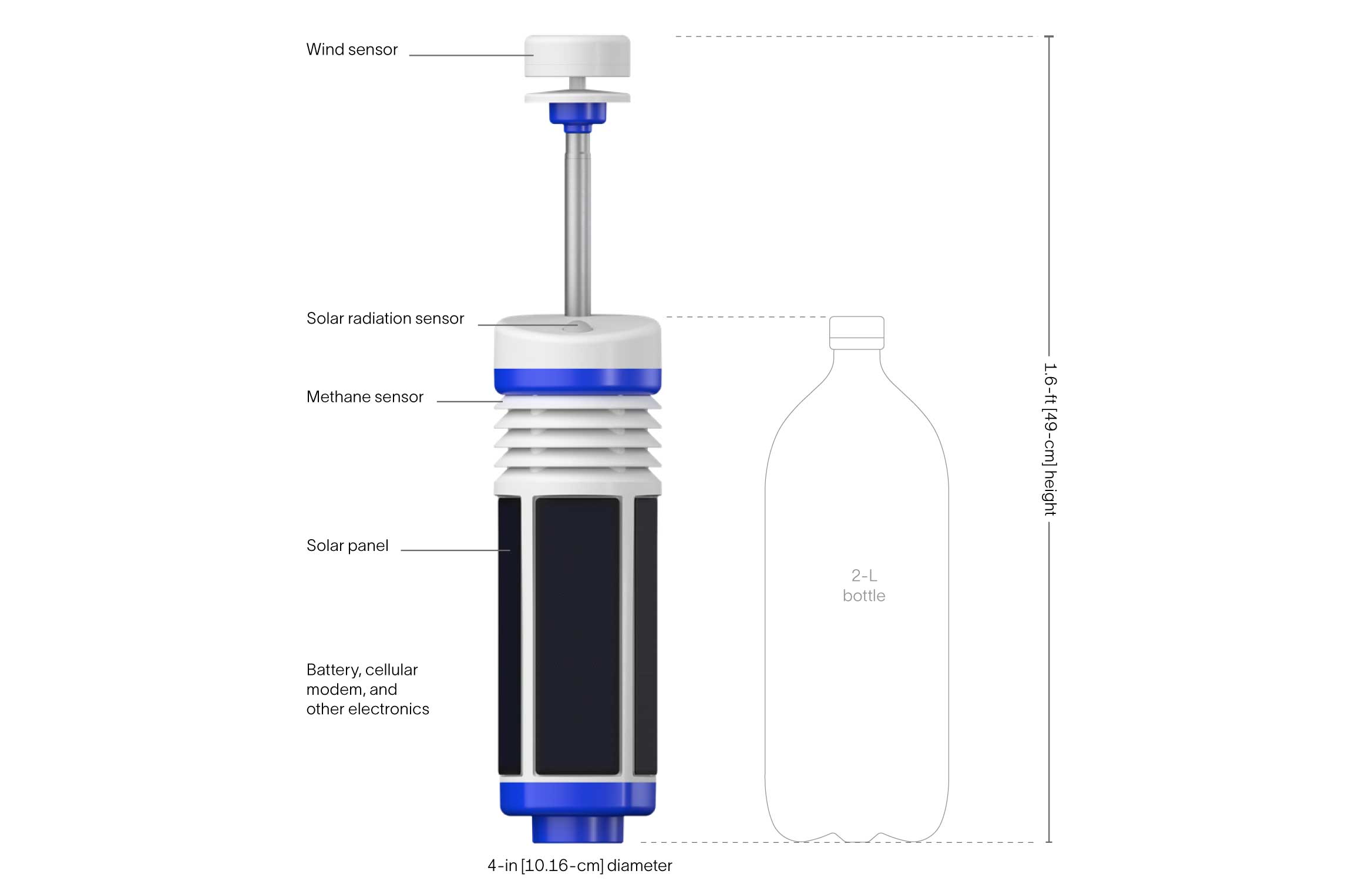
Digital render shows the body of the methane point instrument is equal to the size of a 2-L bottle.
A compact device with integrated solar panels and an anemometer, the SLB methane point instrument can be self-installed in minutes at near-zero installation cost.
Methane Point Instrument—How It Works
How the SLB methane point instrument provides 24/7 real-time methane emissions monitoring.

A small, high-precision device that is installed in minutes

The methane point instrument from SLB is approximately the size and weight of a 2-L bottle. It can be self-installed in minutes; no specialized training or tools are required. Methane point instruments are typically mounted on existing infrastructure, powered by integrated solar panels, and connected automatically to the global LTE-M cellular network. Alternative mounting and power options are available.

After the device is installed, sensor data are automatically streamed and displayed within our digital platform or yours. Users can log into the platform and intuitively access real-time emission data, history, and trends.

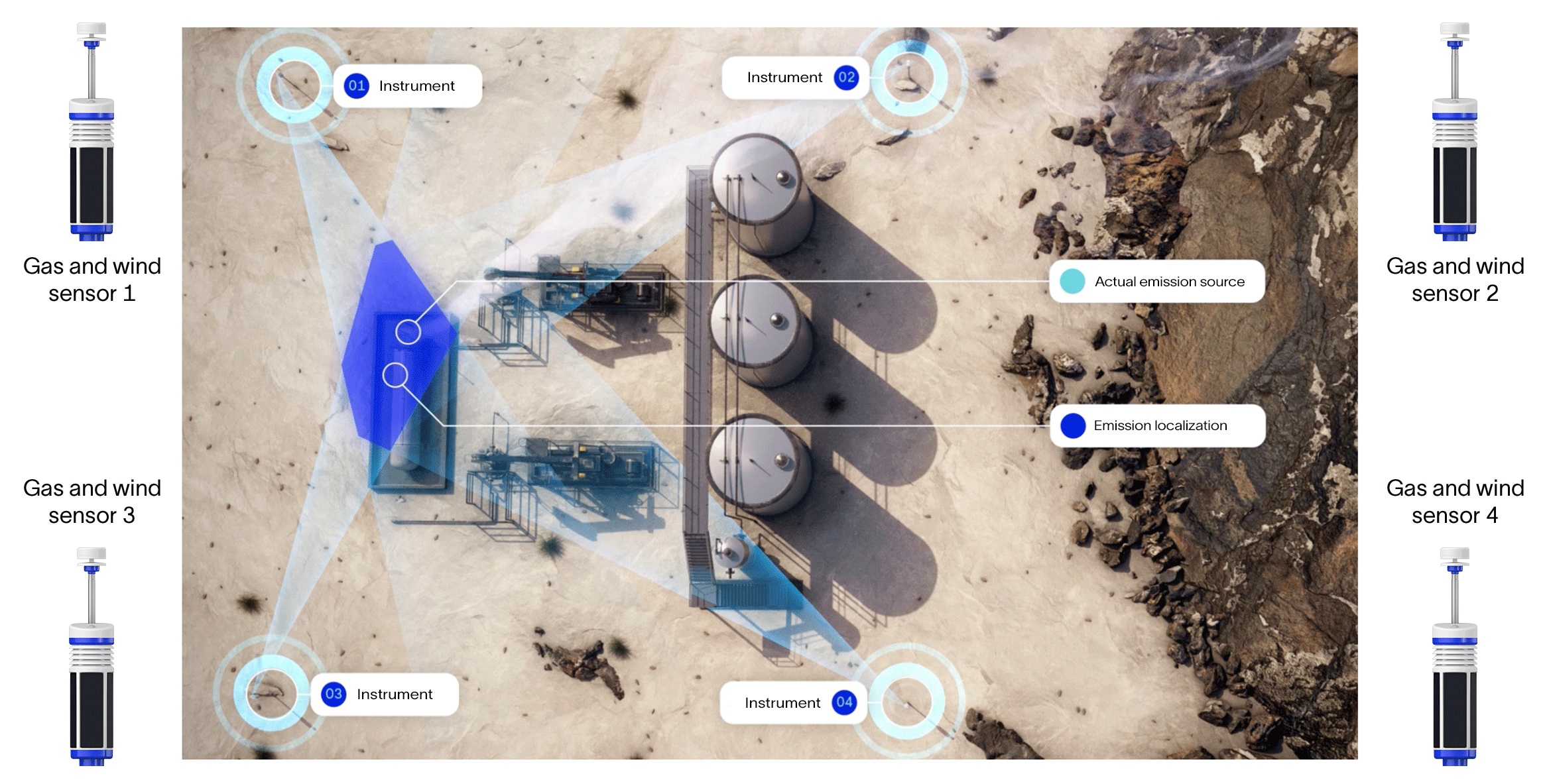
Methane concentration and wind measurements are analyzed using a modified version of the Gaussian plume model to determine emission rate, location, and timing. The proprietary algorithm leverages the latest academic results, resulting in a customized interpretation that handles the realities of oil and gas facilities.

Methane lidar camera visual data (without) Methane lidar camera visual data (with)
The downwash effect causes methane emitted from an elevated source to move down toward ground level, even though methane is lighter than air. This effect is measured in wind tunnel experiments (grayscale) and modeled using computational fluid dynamics simulations (color). Models of the downwash effect are used to identify the optimal height at which to mount the sensors and interpret data when emissions originate from sources at different heights.
SLB methane detection
Measurements of methane and wind by multiple sensors enable our proprietary algorithm to triangulate to the emission source. The algorithm then quantifies the methane emission rate and determines the start and stop times of emission events.