Machine learning-driven temperature gradient prediction
A Petrel™ subsurface software native machine learning plug-in that automates 2D and 3D temperature gradient prediction for geothermal projects.

Challenge
- Temperature gradient is the defining KPI for geothermal viability.
- Inaccurate estimates undermine project bankability and increase operational and economic risks.
- Highly manual, slow, and specialist‑dependent workflows delay project timelines and compromise the efficiency required for economic development.
- Data scarcity and fragmented information sources limit the prediction accuracy.

When the plug-in launches, users can load data from objects in Petrel software or external files, review data quality, and generate statistical insights.
Solution
- The ML-driven temperature gradient prediction solution combines global and local dataset-trained ML models with an intuitive Petrel software native workflow.
- Predicts 2D and 3D temperature gradients.
- Automates multidisciplinary data integration, reducing manual analysis for geothermal SMEs.
- Provides a guided workflow in Petrel software for data loading, trend exploration, and supervised and unsupervised ML model selection.
- Delivers temperature gradient maps and CSR play fairway maps directly in Petrel software.
Results

Speed
The geothermal play fairway process is automated, with teams able to process diverse datasets and generate temperature maps in minutes rather than days or weeks.

Decision support
Smarter well‑placement decisions, reduced exploration risk, and strengthened project economics.

Accuracy
Global and regional geothermal datasets used to complement scarcity of project data.

Usability
Simplified interface and Petrel‑native deployment make advanced ML accessible without requiring specialized data science expertise.
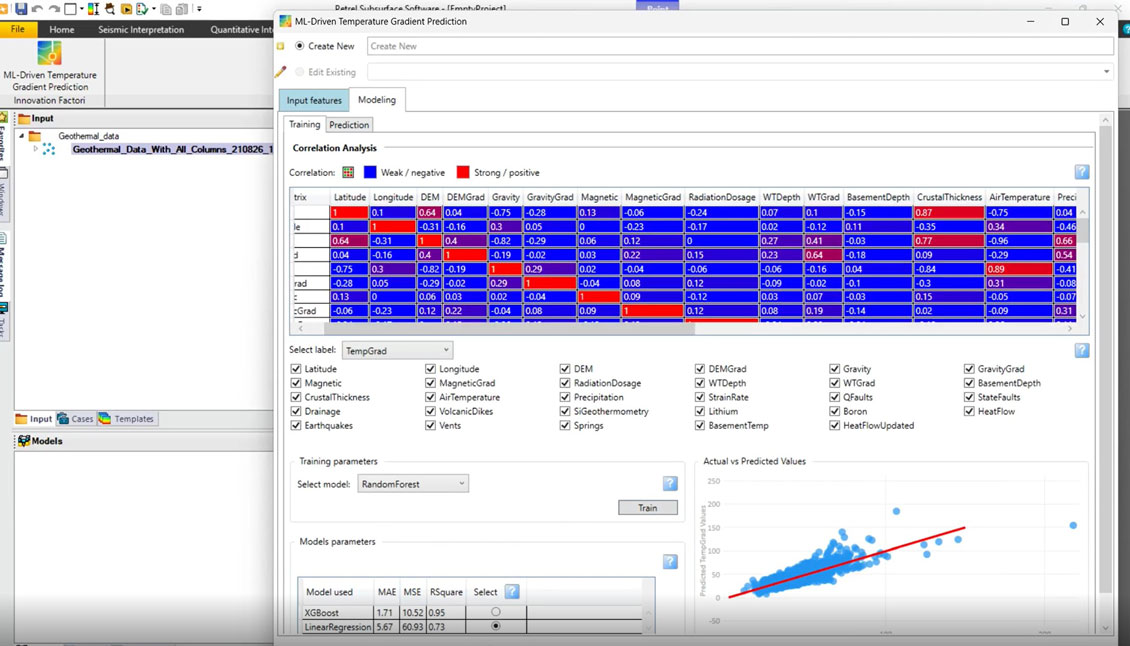
The Prediction section on the Modeling tab enables users to visualize and compare the performance of trained models. Once the model is finalized, users can select the model to predict the temperature gradient for test and/or blind datasets.
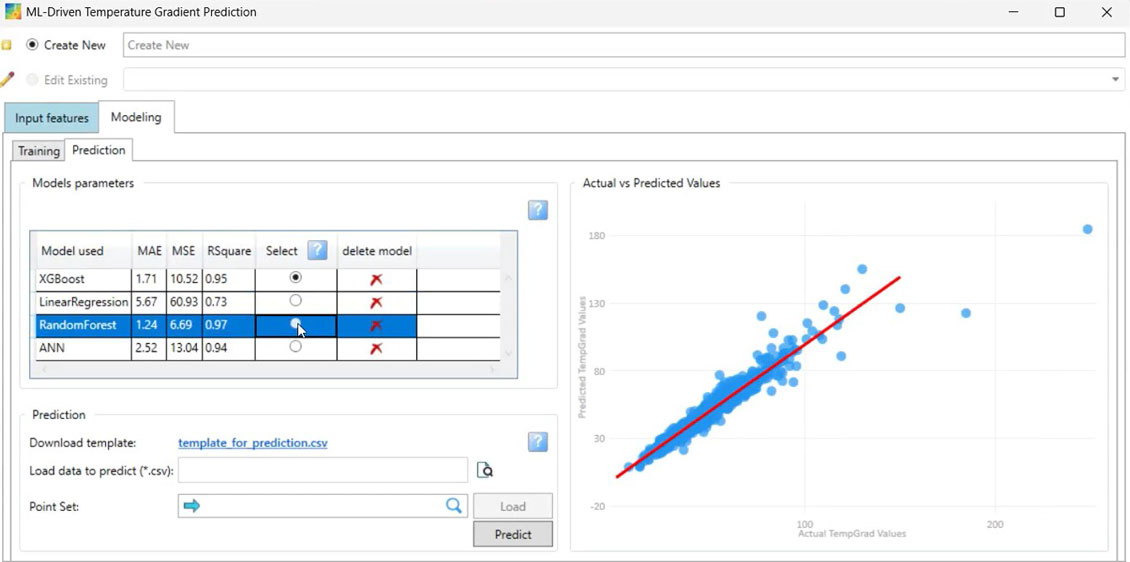
The Prediction section on the Modeling tab enables users to visualize and compare the performance of trained models. Once the model is finalized, users can select the model to predict the temperature gradient for test and/or blind datasets.

