OmniCem
Optimized geopolymer-based cementing system

Applications
- Primary, remedial, and abandonment jobs
- US Land
Benefits
- Shorter wait-on-cement time compared to ordinary portland cement (OPC) systems
- Significantly reduces embodied CO2 vs. OPC systems
- Does not require modification to standard cementing workflows
Features
- Optimized compressive strength development
- Significantly reduced permeability compared to OPC
- Broad spectrum of applications with wide density and temperature ranges
- No change to job execution and evaluation operations
- Equivalent compatibility to OPC with standard fluids
How it improves performance
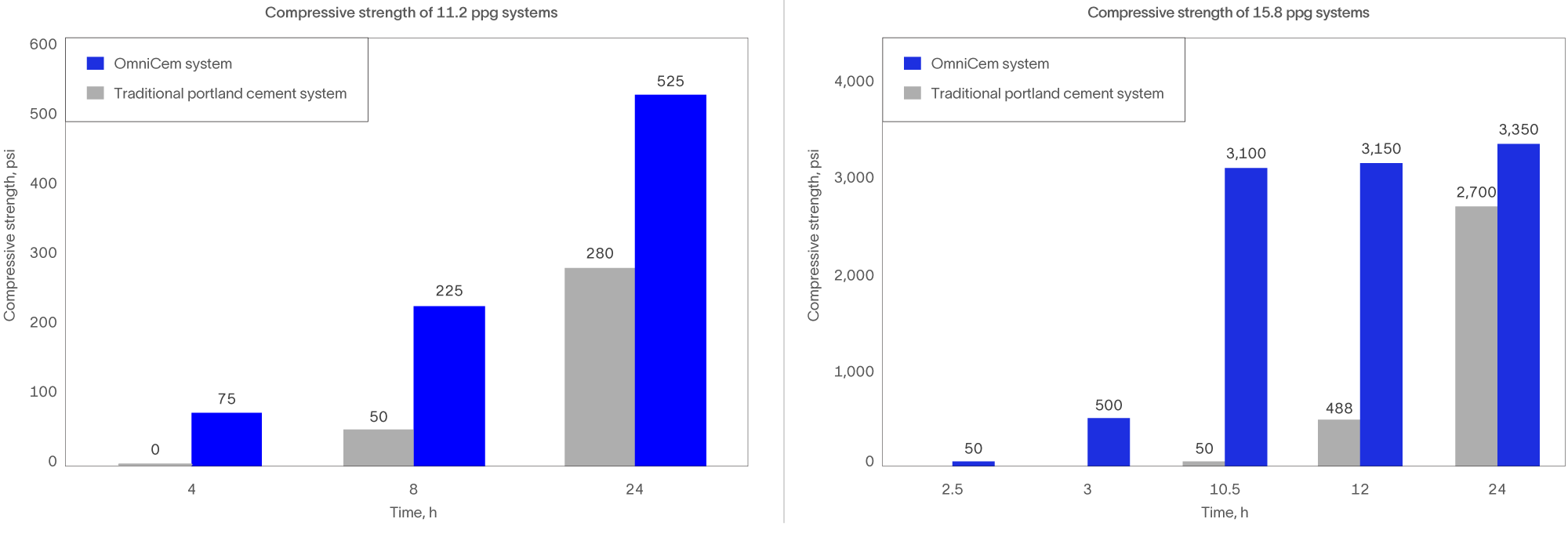
The OmniCem™ optimized geopolymer-based cementing system provides faster and higher compressive strength development than OPC, reducing wait‑on‑cement time and improving flat‑time metrics.
The OmniCem system also has very low permeability compared to OPC. The system can be customized for gas‑tight performance and corrosion resistance. These properties provide assurance of long‑term well integrity. The OmniCem system placement can be evaluated using conventional or advanced logging tools.
OmniCem has been extensively deployed across US land operations, with reliability proven in a wide range of well conditions.
How it works
The OmniCem system is an alkaline‑activated geopolymer‑based chemistry that maximizes the system’s performance. Geopolymerization reactions form strong covalent bonds, which enable fast and high compressive strength development in the system when compared to OPC systems at similar densities.
The OmniCem system typically have permeabilities an order of magnitude lower than OPC systems, reducing the likelihood of formation fluids migrating into the cement sheath. The system have reduced vulnerability to attack by acidic or sulfate‑rich fluids. These properties help to ensure permanent zonal isolation for long‑term well integrity.
Specifications
| Typical density range | 10.5–15.8 ppg [1,261–1,897 kg/m3], extendable with lab testing |
| Typical circulating temperatures | 80–230 degF [27–110 degC], extendable to higher temperatures with lab testing |
| Fluid loss | As low as 25 mL API |
All specifications are subject to change without notice.
