Understanding and managing casing wear is critical for ensuring well integrity, particularly in complex wells and deepwater environments.
The Casing-wear Analysis workflow in DrillPlan™ coherent well planning and engineering solutions delivers a fully integrated, engineering-grade solution that allows drilling teams to predict, visualize, and compare casing wear against permissible limits—directly within the planning workflow.
Built on API Standard 7CW methodology, the casing-wear engine leverages side forces calculated from DrillPlan solutions’ stiff-string torque and drag model, combined with operational parameters such as RPM, ROP, depth intervals, mud properties, and user-defined wear factors.
This enables accurate prediction of casing wear across all planned drilling operations, without the need to export or recreate data in standalone tools.
Integrated, flexible, and efficient
Casing-wear Analysis is fully embedded in DrillPlan solutions and reuses the same shared predefined inputs for the well—trajectory, wellbore geometry, BHA designs, drilling fluid programs, and operational parameters.
This ensures consistency across disciplines and provides a true single source of data entry for all required inputs. Any changes made to the well design are automatically reflected in the casing-wear calculations, eliminating manual updates and reducing the risk of inconsistencies.
The overall well design in DrillPlan solutions is intrinsically linked to the activity plan, enabling casing wear to be calculated cumulatively across the full sequence of operations. This removes the need to calculate wear for individual activities and manually aggregate results, significantly simplifying workflows and improving accuracy.
In essence, the workflow supports:
- Initial wear definition for re-entries or sidetracks.
- Predicted wear from simulated drilling and completion operations.
- Additional wear from non-simulated activities such as wireline or logging runs.
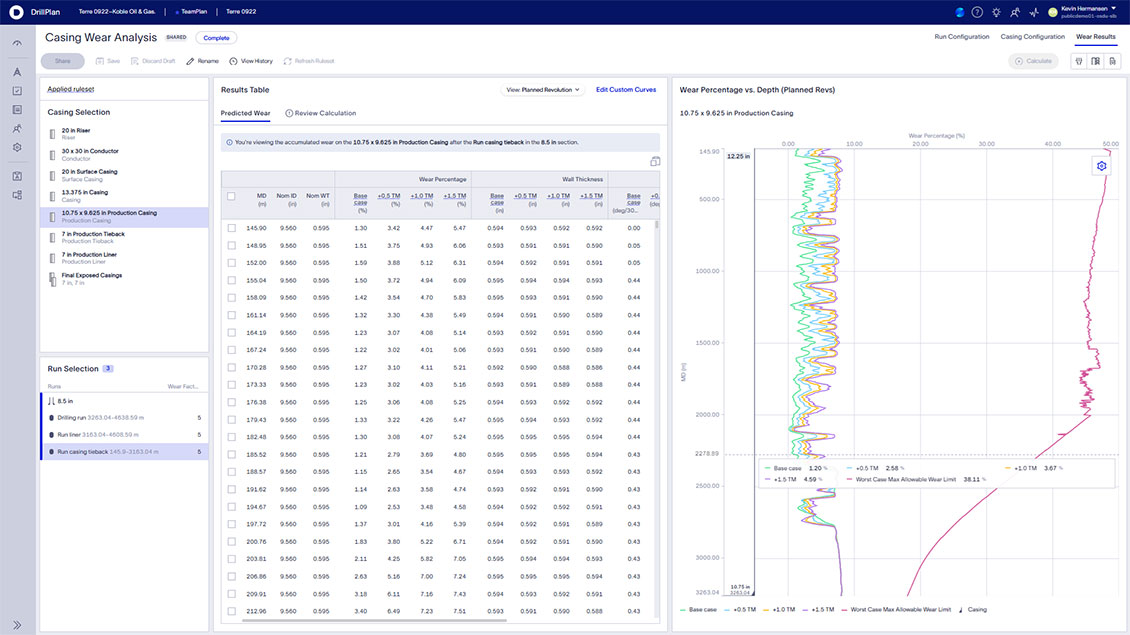
Engineers can apply wear factors at section or run level, perform tortuosity sensitivity analyses, and review results through tables and depth-based plots that also display maximum allowable wear limits derived from casing design load cases. Optional non-linear wear correction further improves realism by accounting for how wear rates change as grooves develop over time.
Physics-based insight and visualization
Because DrillPlan solutions uses a stiff-string model, the contact points between the drillstring and the borehole are explicitly calculated, and better models complex downhole geometries caused by horizontal/U-shaped trajectories, high DLS zones, tortuosity etc.
This allows the system not only to quantify casing wear, but also to accurately simulate and visualize where along the casing the wear will occur. This level of spatial insight helps engineers better understand wear distribution, and identify localized risk areas that may not be visible with simpler modeling approaches.
Clear results and reporting
Results are presented through intuitive tables, plots, and dynamic display items (DDIs), making them easy to include in reports and design reviews. Wear curves can be compared directly against connection limits, casing design limits, and custom curves, helping teams identify risks early and make informed design or operational decisions.