Reduce production risk and improve returns.
Up to 8× more H2S removed via innovative downhole injection of proprietary non-triazine scavenger
When surface solutions for sweetening multiphase flow proved unable to meet sales specification, SLB helped an operator address the challenge by engineering a novel approach that enabled downhole H2S mitigation.
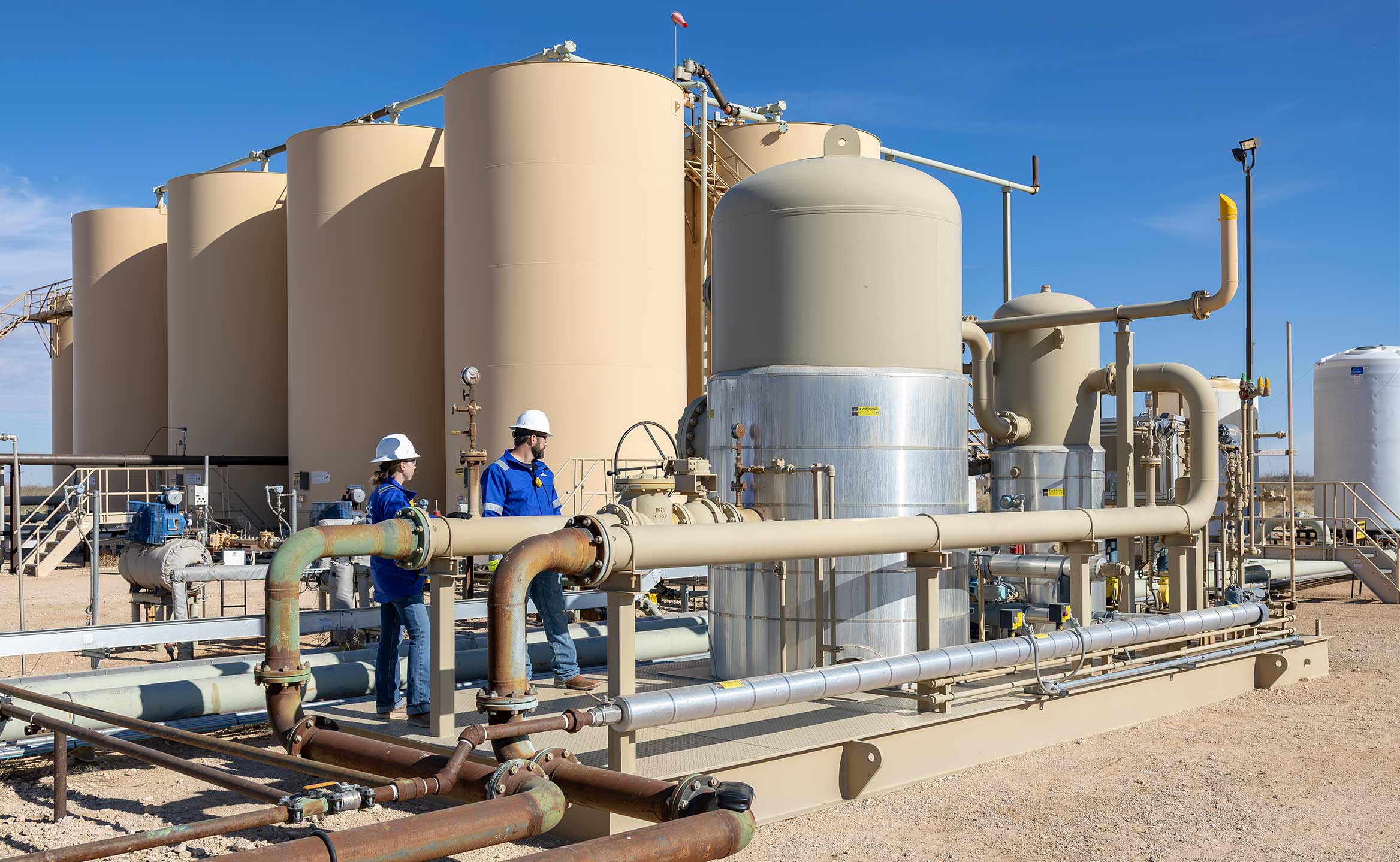
A well pad in southeast New Mexico had seven gas lift wells that were producing sour gas equivalent to 400–550 lbm of sulfur/day. The gas was directed to a contact tower for H2S removal by a non-triazene scavenger.
Collectively, the wells generated approximately 20 million ft3 of gas per day, which consequently flowed through the contact tower at high velocities. Coupled with the cooler temperatures at surface, shorter contact time was leading to lower scavenging efficiency. A typical solution would be injecting triazene or inhibited triazene products directly into gas lines or multiphase flowlines at surface, removing an average of 0.2 lbm of sulfur per gallon of chemical injected. Subsequently, additional quantities of sulfur can be removed in the contact tower. However, this performance would not meet the operator’s requirements.
To meet sales specifications, SLB proposed a novel strategy—injecting HSCV17055A, a ChampionX™ non-triazine H2S scavenger, with the lift gas at a downhole injection point, optionally followed by polishing the gas in the contact tower. This product creates none of the issues associated with downhole application of most H2S scavengers, including scale formation, reaction byproducts that create flow assurance challenges, and incompatibility with other production chemistries.
The engineered solution removed 1.4–1.6 lbm of sulfur per gallon of treatment chemical, enabling the operator to comply with sales specifications, while reducing chemical consumption by 50% and eliminating the need for contact towers.