Integrated borehole imaging, sonic analysis, and geomechanics to unlock geothermal flow zones

minus
Japan, Asia, Onshore

In a challenging volcanic geothermal well in Japan, an integrated workflow combining borehole imaging, sonic analysis, and geomechanics revealed productive fracture zones. This approach enabled accurate flow zone identification, advancing geothermal reservoir development through high-resolution, single-well subsurface insights.

Geothermal exploration in Japan is particularly challenging due to the volcanic terrain, limited surface seismic data, and highly variable subsurface geology. Conventional methods struggle to identify fractures that truly contribute to flow, as conductive features in borehole images may not be hydraulically open or productive. In this case study, a new exploration well was drilled in an area with no offset well data, necessitating a data-rich, single-well solution.

SLB’s objective was to determine which fractures could serve as productive flow paths in this complex environment. The solution needed to go beyond conventional fracture imaging, incorporating additional acoustic and geomechanical insights to confirm openness, stress interaction, and permeability of fracture systems critical for geothermal production.

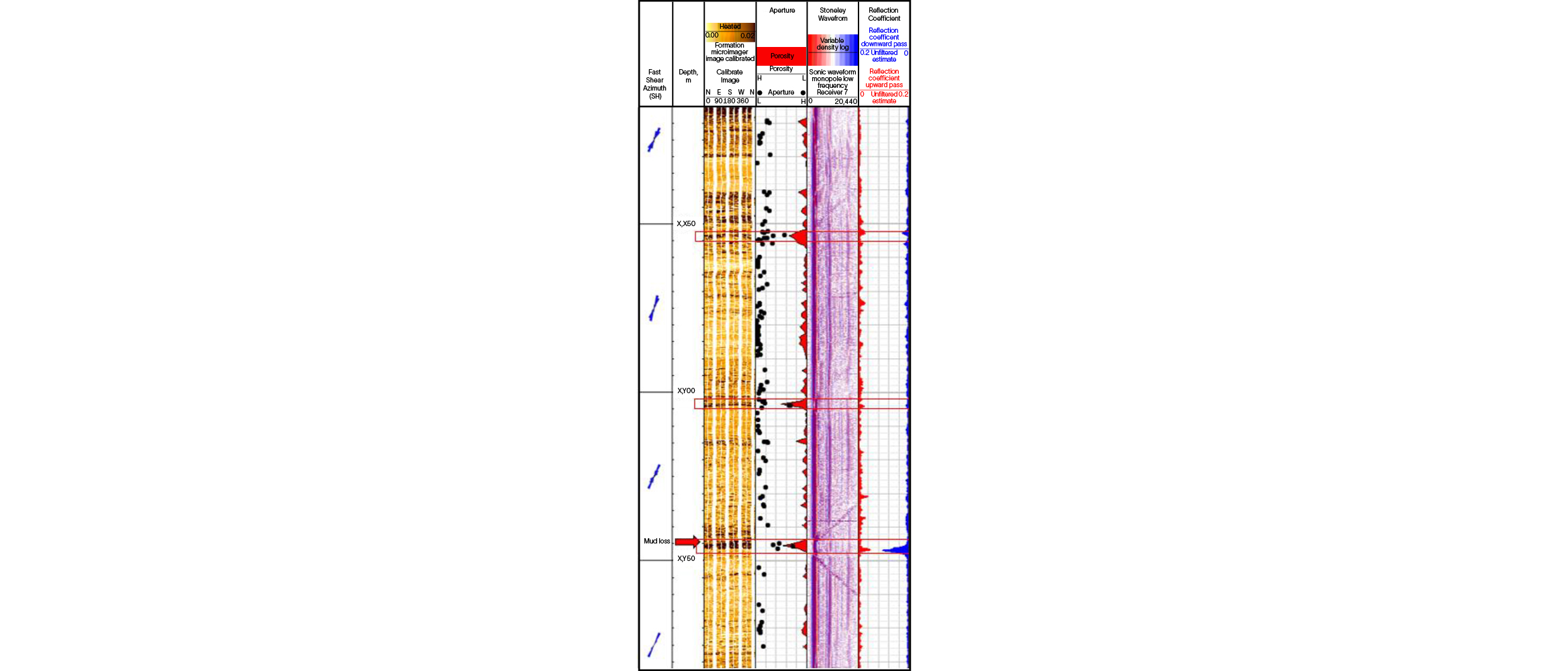
To meet this challenge, SLB implemented a multidisciplinary workflow combining borehole image logs, advanced sonic data, and geomechanical modeling. High-resolution resistivity imaging revealed natural fractures, while sonic data—particularly Stoneley wave analysis—confirmed fracture openness and permeability. These were cross-validated with 1D mechanical earth models to identify critically stressed fractures likely to support fluid flow.

The integrated analysis revealed that several low-angle fractures (around 20° dip) were both hydraulically open and critically stressed, aligning with mud loss zones during drilling. Stoneley reflections showed chevron patterns at these intervals, indicating high permeability and wide apertures. These findings were corroborated by porosity imaging, anisotropy mapping from dipole shear waves, and stress modeling, which confirmed a thrust fault regime influencing fracture behavior.

The success of this integrated approach enabled the identification of three primary flow zones with high confidence, despite the lack of external well control. This result not only guided future reservoir development in the region but demonstrated the scalability of SLB fracture analysis methodology for other geothermal fields with limited data.

For more information, read SPWLA-JFES-2022-B.

FMI™ fullbore formation microimager analysis with the Stoneley reflectivity to identify permeable fractures.
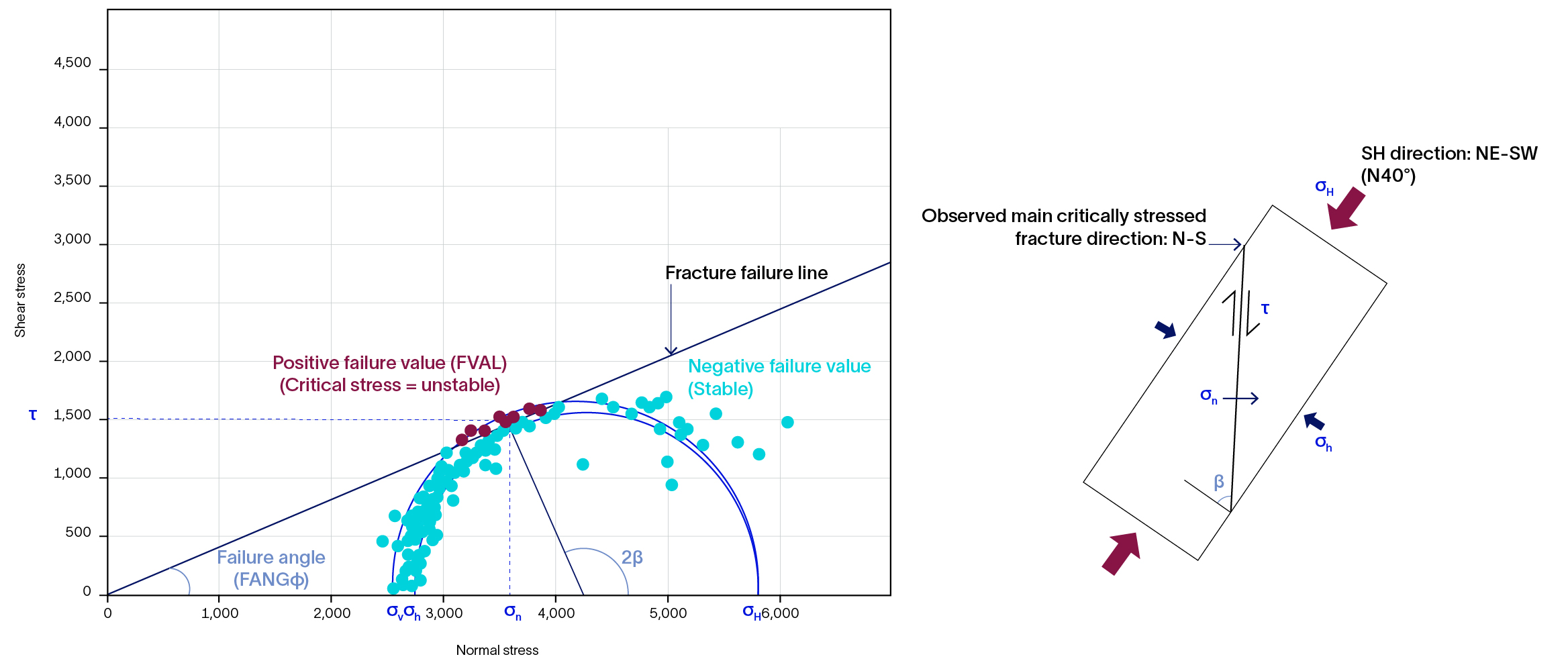
Geomechanical analysis of the fracture stability
Geomechanical analysis of the fracture stability. Left: Crossplot of shear and normal stress for each fracture relative to the fracture stability line. Fractures shown in red are considered critically stressed and are more likely to be open for flow. Right: Diagram of the far field horizontal stresses acting on a rock mass with a fracture at an arbitrary angle. This shows the normal and shear forces acting on the fracture.
Products Used