Thermal-resistant diamond element bit delivers 21% higher ROP

minus
California, United States, North America, Onshore

In a challenging California geothermal reservoir, the 8.5‑in ThermoBlade™ thermal-resistant diamond element bit with StingBlade™ conical diamond element delivered a 21% increase in ROP compared to offset runs, while also significantly extending footage per run by as much as 88%. The advanced bit technology overcame severe bit life limitations caused by high temperatures, abrasive formations, and natural fractures. As a result, the operator achieved longer drilling intervals, improved efficiency, and reduced costly trips in extreme geothermal conditions.

The operator faced one of the most technically demanding intervals in a California geothermal field, where the 8.5-in reservoir section required drilling through fractured, moisture-sensitive, and high-pressure rocks at temperatures exceeding 450 degF [232 degC]. The combination of abrasive air-drilling conditions and complex hard-rock lithologies—mélange, felsite, hornfels, greywacke, and argillite—created an environment where maintaining both high penetration rates and bit durability was exceptionally difficult.

Previous attempts to address these challenges included deploying various PDC bit designs and conventional roller cone bits. While PDC bits showed promise with higher ROP than historical offsets, their runs were frequently cut short by sudden cutter damage and severe impact events, especially when encountering large natural fractures. These failures led to frequent trips, each consuming approximately 20 hours, and prevented the operator from fully realizing the benefits of faster drilling. The key challenge was to develop a drilling system that could maintain cutter integrity, mitigate fracture-induced damage, and extend bit run length in this extreme geothermal environment.

To address these challenges, the operator selected the ThermoBlade bit technology equipped with the StingBlade diamond element, which initiates rock failure ahead of the primary cutting structure, reducing impact loading and mitigating the torque spikes caused by drilling through natural fractures. The ultrathermal-resistant diamond cutting element, engineered for enhanced thermal stability and wear resistance, further ensured cutter sharpness and durability in the high-temperature, abrasive environment.

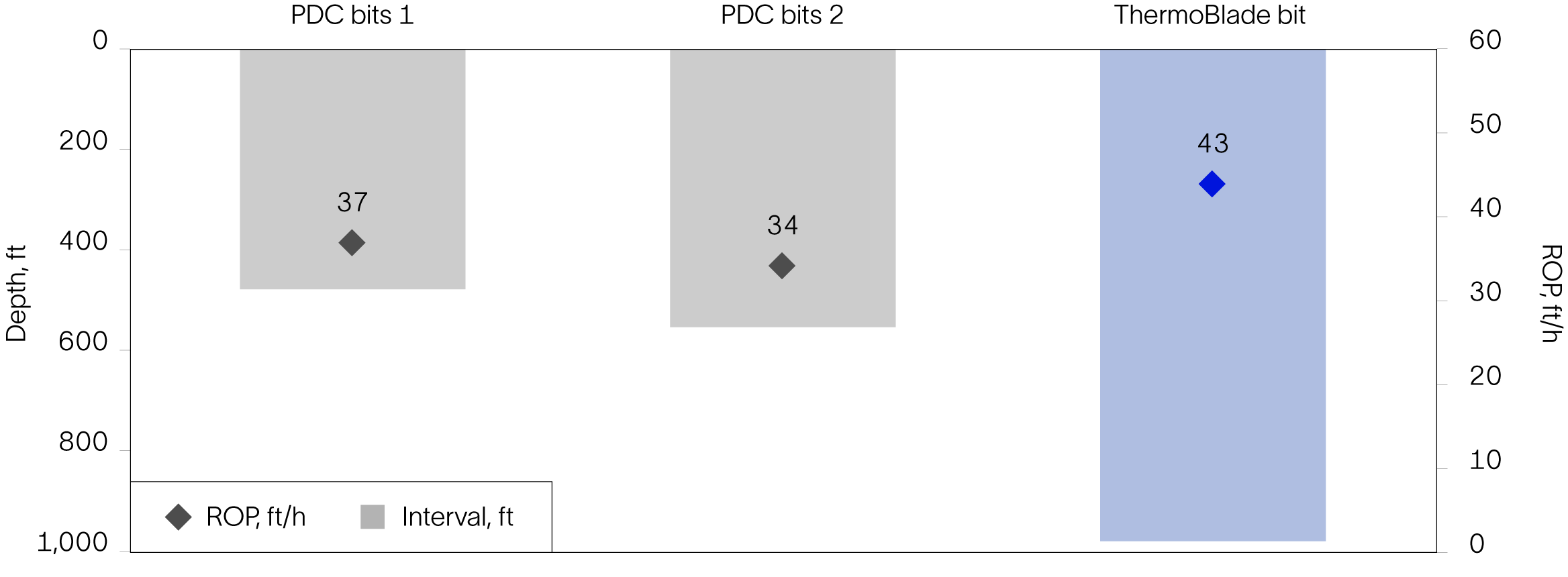
The ThermoBlade bit delivered the best overall performance in the reservoir section. It achieved an average ROP of 43 ft/hr, outperforming other PDC bits in the field, which averaged 34–37 ft/hr—a 21% improvement. More importantly, the ThermoBlade bit delivered significantly longer run lengths, with average footage per run far exceeding offset records by as much as 88%. This superior performance translated into reduced NPT and improved overall drilling efficiency in the reservoir section.

By combining the ThermaBlade bit advanced thermal stability with the fracture-tolerant cutting structure of the StingBlade diamond element the operator was able to drill both faster and longer. This not only addressed the primary challenge of balancing speed and durability but also set a new benchmark for drilling efficiency in extreme geothermal environments.

ThermoBlade bit outperforms other PDC bits in average drill depth and ROP.
Average drill depth and ROP for ThermoBlade bit versus other PDC bits.
Products Used