Facing what it takes to make projects scale

After nearly two decades working in offshore energy—first in subsea oil and gas and more recently in offshore wind—I am no stranger to the challenges presented by large-scale energy projects.
Early subsea developments were seen as complex and high risk, with custom-engineered equipment, long installation campaigns, and limited operational track records. Offshore wind faced similar skepticism: bespoke foundation designs, immature supply chains, and uncertain construction schedules drove up costs and slowed investment.
In both cases, the difficulty was not only technical feasibility, but whether projects could be delivered reliably and at scale.
I see similarities with today’s carbon capture and storage (CCS) projects.
Many are treated as first-of-a-kind developments. They’re often faced with high capital costs, complex execution, and uncertainty, which makes achieving final investment decision (FID) difficult—particularly for industrial emitters operating on thin margins. Might explain why there are just over 50 operational facilities globally.
This is where I believe modularization and standardization can play a transformative role and where much of our efforts at SLB Capturi are focused.
Opportunities exist to leverage carbon dioxide removal (CDR) and 45Q tax credits to apply modular post-combustion CO2 capture solutions, particularly across the pulp and paper sector in North America.
Installing CCS systems on pulp and paper mills is unique in that it results in net negative emissions. How? The biogenic CO2, which was absorbed from the atmosphere by trees, is stored permanently underground.
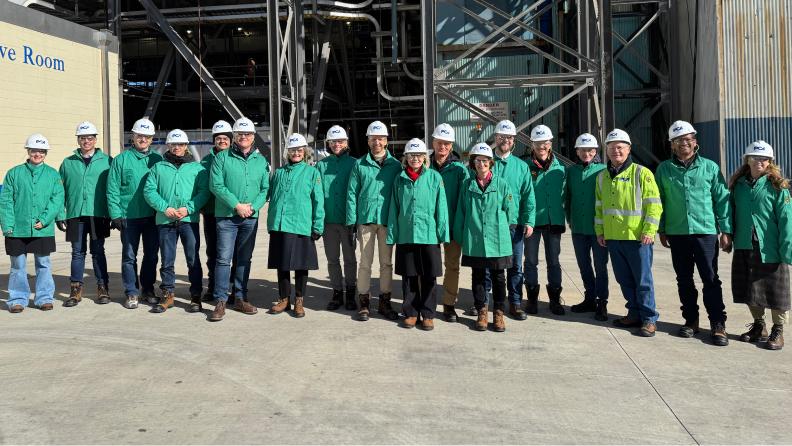
SLB Capturi is working closely with leading CDR developer, CO280, along with other partners to drive these projects.
Just last year, we completed a field pilot to validate the performance of our liquid amine technology on a recovery boiler stack at a pulp mill on the U.S. Gulf Coast.
SLB Capturi’s Mobile Test Unit (MTU) operated for more than 4,000 hours, achieving a consistent capture rate efficiency of 95%. During the test program, the MTU met all key performance indicators including capture rate efficiency, energy consumption, solvent durability, and absorber emissions.
This project (and others) gives me confidence that we’re making progress. And while challenges certainly remain when it comes to scaling CCS, with the right partners, technology, and approach, economic viability is achievable.
Now that I think about it, our ability to strike this delicate yet fundamental combination is what has allowed SLB to bring groundbreaking innovations to the forefront for 100 years. And as we continue celebrating this noteworthy milestone throughout the year, I can’t help but wonder what our next century of pioneering will bring.
