It’s not your father’s wireline anymore…

There it is again, that sharp knocking sound coming from my left. My eyes open and my head turns as I awaken in a totally disoriented state from a deep sleep.
Someone is knocking loudly on the driver’s side window of my bright blue and white Ford Crown Victoria. My finger involuntarily pushes a button and the glass rolls down. The cold night air rushes in as my eyes try to focus.
“Waitin’ on you, Slumber-J!”, a man says in a thick West Texas accent.
It dawns on me that the lighted structure rising behind him is not the Eiffel Tower. Still in a daze, I can only nod. My head turns toward the catwalk, where FSLC-2030, my dependable giant blue logging truck—my home away from home—is nowhere to be seen. It’s been replaced by a…small white pickup?
I start to panic. It’s time to log and my truck has vanished! A young man in blue approaches. I feel like I know him from somewhere. “Let’s go Rob! Your turn to drop the toolstring in the well!”
What a horrible dream I’m trapped in! Dropping a toolstring is the “cardinal sin” of wireline, the stuff nightmares are made of. It would cost the client millions. It would cost SLB millions. It could cost the field engineer his job.
Stepping out in my PPE, I’m jolted again: my Crown Victoria morphs into a sleek white EV. Things finally make sense as my brain realizes that I’m not in 1994—it’s 2026!
I stride to the rig floor, where the pipe is held in the slips. Everyone watches as I turn the hand crank on the surface release tool. Momentarily, I’m staring down the empty drillpipe as the toolstring has dropped. I grin from ear to ear as the crew cheers.
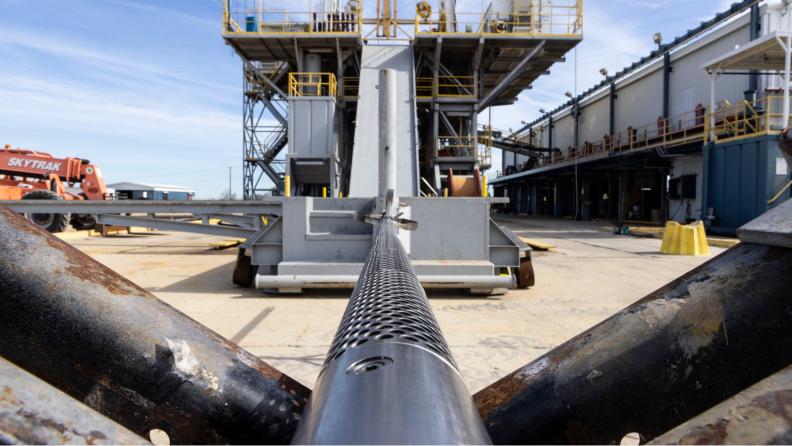
In just a few short minutes, the OnWave toolstring will be 20,000 feet below surface, safely hung below the bit, autonomously acquiring all the data I need to interpret the well, as the rig trips back to surface. No messy wireline to rig up, no million-dollar truck required, and fewer personnel on location.
OK. So, back to reality.
It’s been roughly three decades since I’ve worked as a wireline field engineer. And, quite frankly, it’s hard to wrap my mind around how much the landscape has evolved.
Dropping the tool used to be an unforgivable error. Today, it’s done with intention. It’s how we answer our clients’ insatiable drive for efficiency, while obtaining the high-quality datasets they count on us for. And it’s a strong example of how SLB stands out from the competition, even on its 100th anniversary.
Here’s to driving the formation evaluation industry even further into the future!
