
Key takeaways
- As industrial operations become more connected, automated, and remote, the reliability of digital workflows increasingly depends on the integrity of underlying control and safety system configurations.
- Configuration drift—driven by years of undocumented changes, software updates, alarm tweaks, and partial upgrades—can create hidden operational, cybersecurity, and process safety risks.
- Effective configuration management isn’t just an engineering documentation exercise; it’s a core requirement for functional safety, cybersecurity resilience, operational recovery, and regulatory confidence.
- Before operators can fully trust AI-enabled tools, digital twins, remote operations, or autonomous workflows, they must first ensure that their control and safety systems are accurate, validated, secure, and aligned with approved design intent.
The energy industry is moving steadily toward more integrated, connected, and automated operations. From upstream production and liquified natural gas to power and industrial facilities, organizations are consolidating control into remote operations centers and digital platforms that use advanced analytics and AI to improve visibility, efficiency, reliability, and response time.
These technologies are already unlocking measurable value by surfacing abnormal conditions earlier, reducing unplanned downtime, and supporting faster, better‑informed decisions. But as assets become more automated and interconnected, operators face a critical question with significant operational consequences:
“How much confidence do we truly have in the control and safety system configurations that underpin our digital operations?”
The hidden risk of configuration drift
In many process facilities, the live state of the control system may not be fully known with confidence. This is particularly true with brownfield assets, where the accuracy of the “as-built” configuration can erode over time. Years of modifications, software updates, alarm changes, partial upgrades, and incomplete documentation gradually create a gap between what’s recorded and what’s actually running in the plant.
In high-hazard industries like oil and gas, the gap can introduce hidden operational, cybersecurity, and process safety risks that go unnoticed until they’re exposed during transient events like startup or shutdown, plant upsets, or an emergency response scenario.
This is why configuration management must be treated as a core element of operational integrity, not simply as an administrative engineering activity.
Consider a decades-old gas processing facility where a compressor control system had been modified many times over a 15-year period. During one turnaround, a nuisance alarm related to discharge pressure was temporarily reclassified to a lower priority to reduce alarm flooding during restart. Several years later, a control logic adjustment was made to improve compressor availability during transient operating conditions. Both changes were technically reasonable at the time, but neither was fully documented through the management of change (MOC) process nor effectively communicated to personnel currently operating the equipment.
Years later, the facility began operating the compressor remotely as part of a broader digital operations program. During a production upset, discharge pressure began rising faster than expected. The remote operations team received multiple alarms, but the high discharge pressure alarm that should have drawn immediate operator attention had previously been reclassified as a lower-priority advisory. Meanwhile, an earlier (undocumented) modification to the control logic delayed the automatic load reduction that operators believed would occur in response. By the time the issue was escalated, the compressor reached its protective trip point and shut down, forcing an unplanned outage and production loss.
While independent safety instrumented systems can successfully perform their intended function by bringing processes to a safe state, undocumented changes to control logic, alarm priorities, operating setpoints, and system configuration can progressively invalidate the original process design—along with the assumptions established during engineering design, hazard and risk assessments, and safety integrity level checks. These changes can, in turn, reduce the effectiveness of independent protection layers, alter risk reduction strategies, and compromise the overall integrity of your protection system. This is why rigorous configuration management and MOC processes are so important: they ensure that engineering analyses, safety functions, operational documentation, and AI-based systems remain aligned with your plant’s configuration.
The unplanned outage described above wasn't caused by equipment failure or a design defect. It was the result of accumulated configuration drift. Small, undocumented changes made over many years had altered how the system behaved, how alarms were presented, and how operators expected the asset to respond. The facility was being operated based on an assumed configuration that no longer reflected the actual configuration of the live control system.
Safety, cybersecurity, and configuration integrity
From a functional safety perspective, IEC 61511 emphasizes the importance of life cycle governance, management of change, documentation control, verification, validation, and maintaining the integrity of safety-instrumented systems throughout their operational life.
These requirements are particularly important because safety functions aren’t static. Setpoints, logic, and operating modes can, and frequently do, evolve over time. Without disciplined configuration control—as with the hypothetical compressor trip scenario I described earlier—the assumed performance of the safety system may no longer reflect the actual installed and operating condition.
Similarly, IEC 62443 highlights configuration management as a key component of industrial cybersecurity. Effective operational technology (OT) cybersecurity depends on accurate asset inventories, controlled system changes, patch and version management, secure remote access, system integrity, backup, and life cycle governance. A facility can’t effectively protect, monitor, or recover systems it doesn’t fully understand. Configuration management provides the factual basis for both cybersecurity resilience and operational recovery.
What major incidents reveal about unmanaged change
Lessons from major industrial incidents reinforce the point. Investigation reports from organizations like the U.S. Chemical Safety and Hazard Investigation Board and the UK Health and Safety Executive (HSE) have repeatedly shown how weak change management, undocumented modifications, operational drift, and gaps in governance can contribute to serious operational and process safety events. The findings demonstrate that risk doesn’t just arise from poor initial design; it accumulates over long periods when the facility is operating reliably.
One UK HSE study on programmable electronic system failures found that control-system-related failures originate across multiple life cycle phases, including design, installation, operation, and post-commissioning modification.
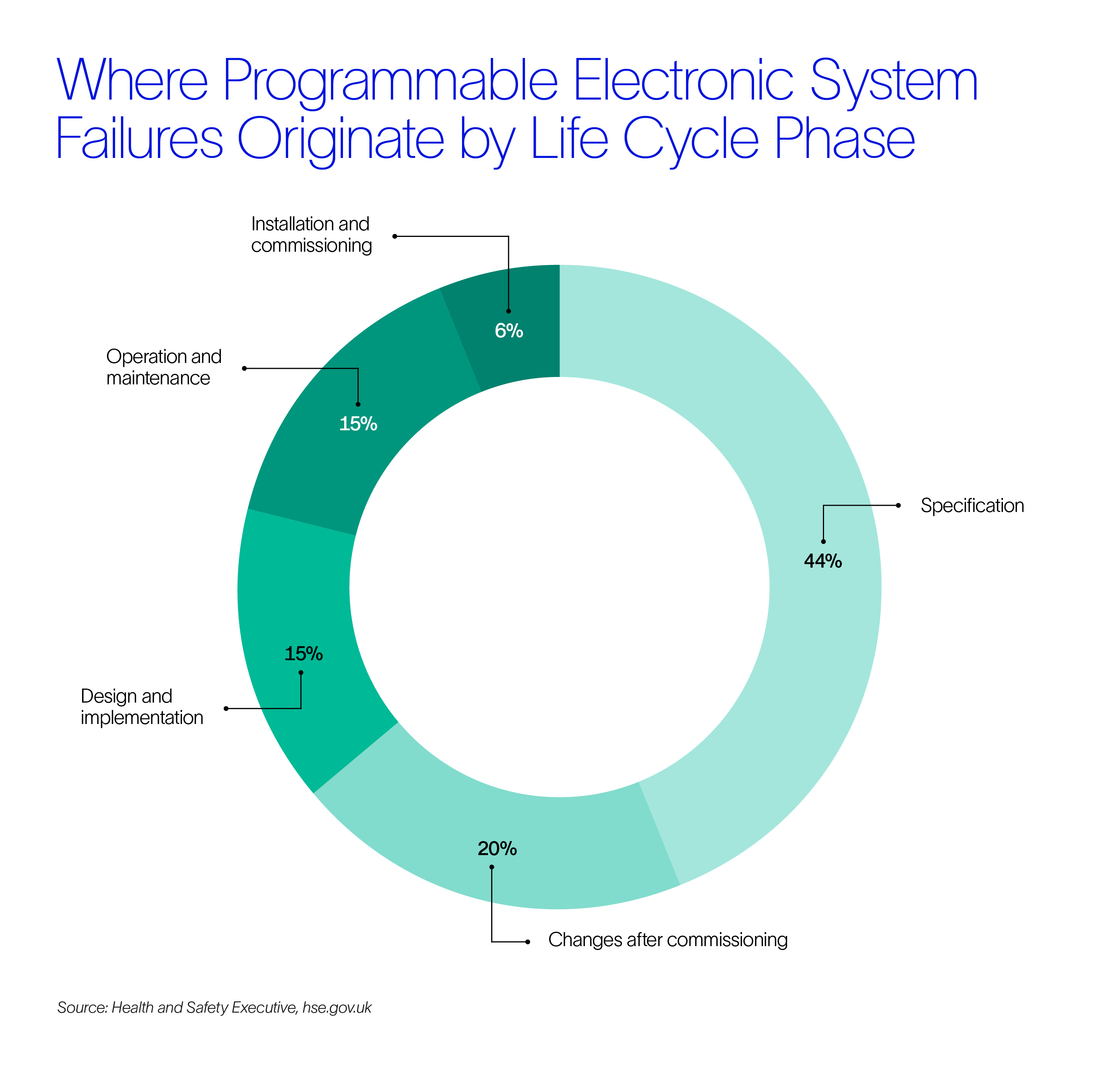
Again, this challenges the common assumption that most control system risk is created when the system is initially implemented. It’s proof that unmanaged changes and modifications after commissioning are a major contributor to system-related failures.
Brownfield facilities and configuration exposure
Configuration management is especially relevant for mature facilities. Brownfield assets often operate for decades, during which control systems are expanded, modified, patched, migrated, partially upgraded, and integrated with new digital platforms. Each change may be technically sound and beneficial in isolation, but without strong governance, the cumulative effect can be a loss of configuration integrity.
Obsolescence compounds this challenge. Many operating facilities continue to rely on unsupported operating systems, legacy network infrastructure, and control hardware that are no longer supported by the original vendor. As these systems age, the risks associated with spare parts availability, maintainability, and cybersecurity exposure increase. When obsolescence is combined with incomplete documentation or weak configuration governance, operators may face greater difficulty diagnosing faults, restoring systems, or demonstrating compliance.
This inevitably results in a loss of confidence in the most basic elements of operational control. Plant personnel may not know if backups are complete and restorable or whether cause-and-effect logic reflects approved design intent. Effective configuration management should therefore include:
- Clear ownership and governance
- Formal integration with management of change
- Controlled system baselines
- Validated backup and recovery processes
- Software and firmware version control
- Obsolescence and life cycle planning
- Cybersecurity alignment
- Auditability and traceability
- Robust testing and validation
These elements help ensure that changes aren’t only implemented correctly, but also understood in relation to process safety, cybersecurity, reliability, maintainability, and future operations.
Control and safety systems as the backbone of trusted autonomy
Configuration management becomes even more important as industrial operations move toward remote and autonomous models. After all, AI-enabled tools, digital twins, advanced analytics, and automated decision-support systems are only as reliable as the systems and data sources they depend on.
The path to more intelligent industrial operations begins with trusted operational foundations. Organizations need confidence that their control and safety systems are accurate, documented, secure, and aligned with approved design before they can fully rely on remote operations or autonomous workflows.
The future success of oil and gas and energy facilities ultimately depends on the integrity and reliability of these underlying systems.
Robust configuration management ensures that any and all modifications made to control and safety architecture (including software and hardware) is properly risk assessed, tested, and documented throughout the operating life of the facility. It ultimately provides the foundation needed to maintain confidence that the perception of how systems and equipment will behave, especially during abnormal scenarios, is representative of actual operational reality.