Petromod for CCS applications
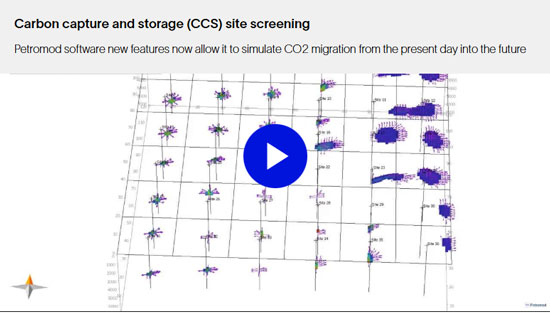
The latest features added to Petromod software now allow it to simulate CO2 migration from the present day into the future:
- Component injection table.
- Year time step resolution.
- Interfacial tension (IFT) table for CO₂.
- Improvement of Invasion Percolation (IP).
Key Applications:
Subsurface characterization:
Petromod helps model the temperature, pressure, and fluid flow history of sedimentary basins, which is crucial for identifying suitable CO₂ storage sites such as depleted oil and gas reservoirs or deep saline aquifers.
Seal and trap integrity analysis:
The software can simulate caprock integrity and trap mechanisms, ensuring that injected CO₂ remains securely stored over geological timescales.
Reservoir simulation and capacity estimation:
By modeling porosity, permeability, and fluid saturation, Petromod aids in estimating the storage capacity and injectivity of potential CO₂ reservoirs.
Risk assessment and scenario testing:
Petromod allows users to run multiple geological scenarios to assess risks such as leakage pathways, fault reactivation, or pressure buildup.
Integration with other data:
It integrates seismic, well, and geological data to create 2D and 3D models, which are essential for accurate CCS planning and monitoring.
Illustrative cases and references
Carbon storage site selection in aquifers: scalable dynamic and static methods at basin to local scale
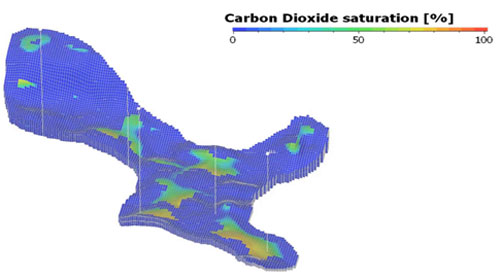
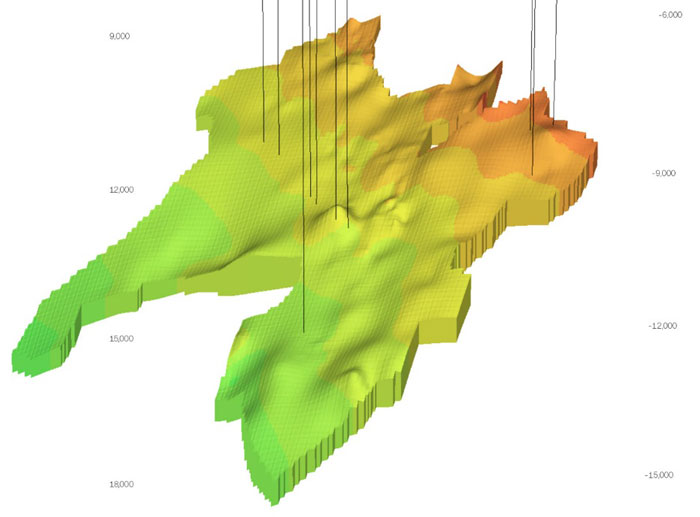
3D visualization of the CO2 saturation in the Cobia Subgroup unit of the Latrobe Group formation in the Gippsland basin, Australia
Paper to introduce two scalable methods for assessing carbon storage at basin scale: a dynamic approach using adapted basin and petroleum systems modeling to simulate CO₂ trapping over time, and a static approach leveraging seismic data for direct storage modeling.
Torres, C. S., Hidalgo, J. C., & Kauerauf, A. (2023, June). Carbon storage site selection in aquifers: Scalable dynamic and static methods at basin to local scale. In 84th EAGE Annual Conference & Exhibition (Vol. 2023, No. 1, pp. 1-5). European Association of Geoscientists & Engineers.