Conical diamond element bit enables record drilling performance in East Java geothermal well

minus
Indonesia, Asia, Onshore

An operator in East Java faced significant drilling challenges in the region's hard, abrasive geothermal formations, where conventional roller cone bits resulted in low ROP and multiple bit trips. Deploying the 9.875-in StingBlade™ conical diamond element bit enabled the operator to drill 872 m in a single run through tuff-breccia and andesite, achieving a 65% ROP increase over the previous roller cone offset. The operation saved an estimated one bit trip and 2.5 days of rig time, demonstrating the StingBlade bit’s efficiency and value in geothermal drilling.

Improving drilling efficiency in hard, abrasive geothermal formations

The operator’s primary objective was to drill the challenging tuff-breccia and andesite interval in East Java’s geothermal field in a single, efficient run to reduce flat time and improve overall well delivery. Previous campaigns relied on roller cone TCI bits for the 9.875-in section, but these bits could not sustain high ROP and required multiple bit trips due to bearing life limitations. Attempts to use conventional PDC bits were unsuccessful, as standard PDC cutters could not survive the extreme conditions of the geothermal rocks.

Seeking to overcome these limitations, the operator required a revolutionary drillbit technology that could significantly improve drilling penetration rates while reducing drilling time and cost.

Achieving record ROP and operational savings with StingBlade bit

To address the low ROP and frequent bit trips associated with the previous TCI approach, the operator deployed the 9.875-in StingBlade bit, specifically designed for hard, abrasive geothermal formations. The concentrated point loading of Stinger™ conical diamond element enabled the StingBlade bit to efficiently fracture high-unconfined compressive strength (UCS) tuff-breccia and andesite formations where conventional PDC and roller cone cutters lost effectiveness. This design enhanced cutting efficiency and durability, enabling the bit to withstand severe shock, vibration, and thermal-mechanical stresses typical of geothermal drilling.

The StingBlade bit drilled 872 m in a single run, achieving a 65% ROP improvement (12.1 m/h) over the offset TCI performance. This marked the first time the section was drilled in one run at high ROP, eliminating repeated bit trips that previously slowed operations. The hybrid cutting mechanism—combining efficient PDC shearing with Stinger element-driven point loading—maintained drilling stability, minimized vibration, and delivered a smooth, in-gauge borehole, allowing the 8-5/8-in production liner to be run to total depth without issues. The improved durability and interval-length capability of the StingBlade bit design translated directly into operational savings, avoiding at least one full bit trip and reducing overall drilling time by approximately 2.5 days.

This performance demonstrates that the StingBlade bit provides a more efficient, reliable, and cost-effective solution for hard-rock geothermal drilling compared to the TCI roller cone bit.

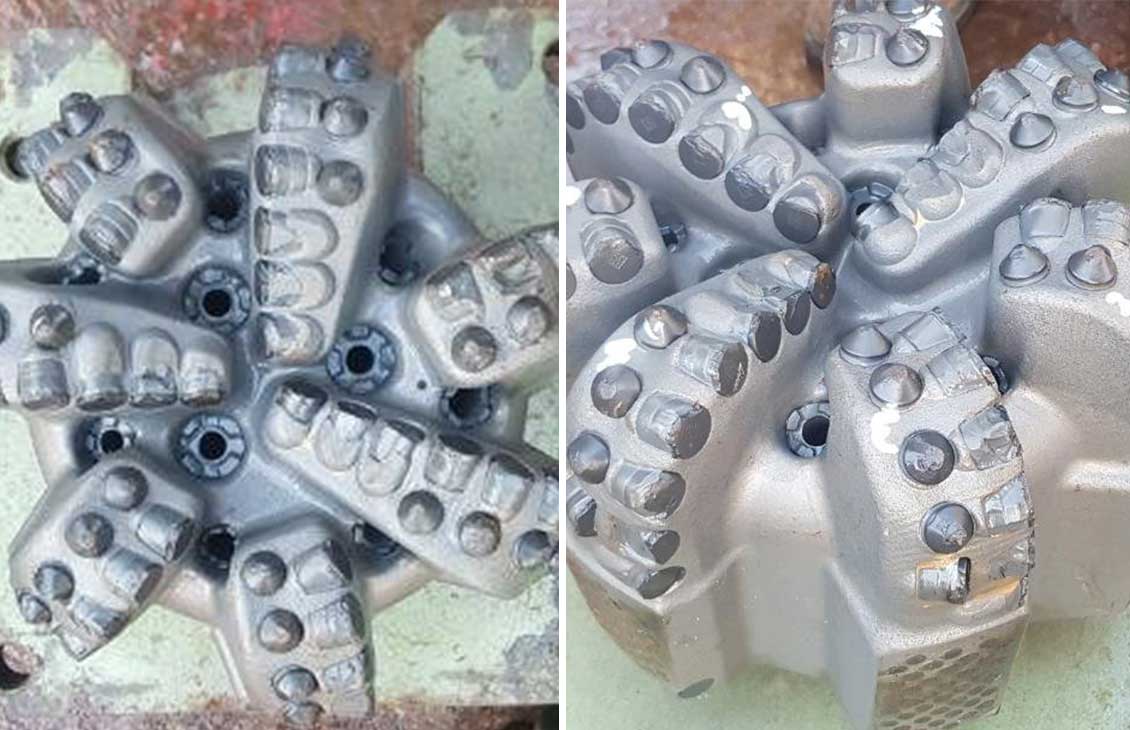
After a demanding geothermal run, the StingBlade bit shows minimal cutter damage, demonstrating outstanding durability and stable drilling performance in the toughest formations.
Products Used