Improving reservoir characterization and well conformance using multiphysics and multidimensional measurements in fractured carbonate reservoirs

minus
Middle East, Qatar, Offshore

In mature, heterogeneous fractured carbonate reservoirs with extensive waterflooding, conformance between injectors and producers is critical for maximizing recovery and supporting field development planning. Conventional approaches lack the resolution needed to fully characterize subsurface structures and fluid movement. To reduce these uncertainties, an integrated solution using advanced azimuthal technologies in horizontal wells—including 3D reservoir mapping, ultrahigh-resolution borehole imaging, and 3D sonic imaging—was deployed to improve subsurface characterization.

The customer’s geoscience study team faced several technical challenges related to reservoir characterization and waterflood performance. These included resolving disparities between surface seismic methods and downhole multiphysics azimuthal measurements at near- to far-wellbore scale to achieve higher-resolution subsurface insights across varying property sensitivities.

Additional challenges included evaluating reservoir layers, intralayers, fault geometry, and natural fractures in relation to reservoir texture; understanding fluid distribution across structural and stratigraphic features, including damage zones and their interactions; and identifying the factors controlling communication pathways at both well and reservoir scale.

The team also sought to integrate static and dynamic subsurface insights into a high-resolution 3D dynamic model to improve history matching, enhance predictability, and support more effective reservoir management and field development planning.

Previous attempts to address these challenges were unsuccessful, resulting in continued high water production and poor sweep efficiency.

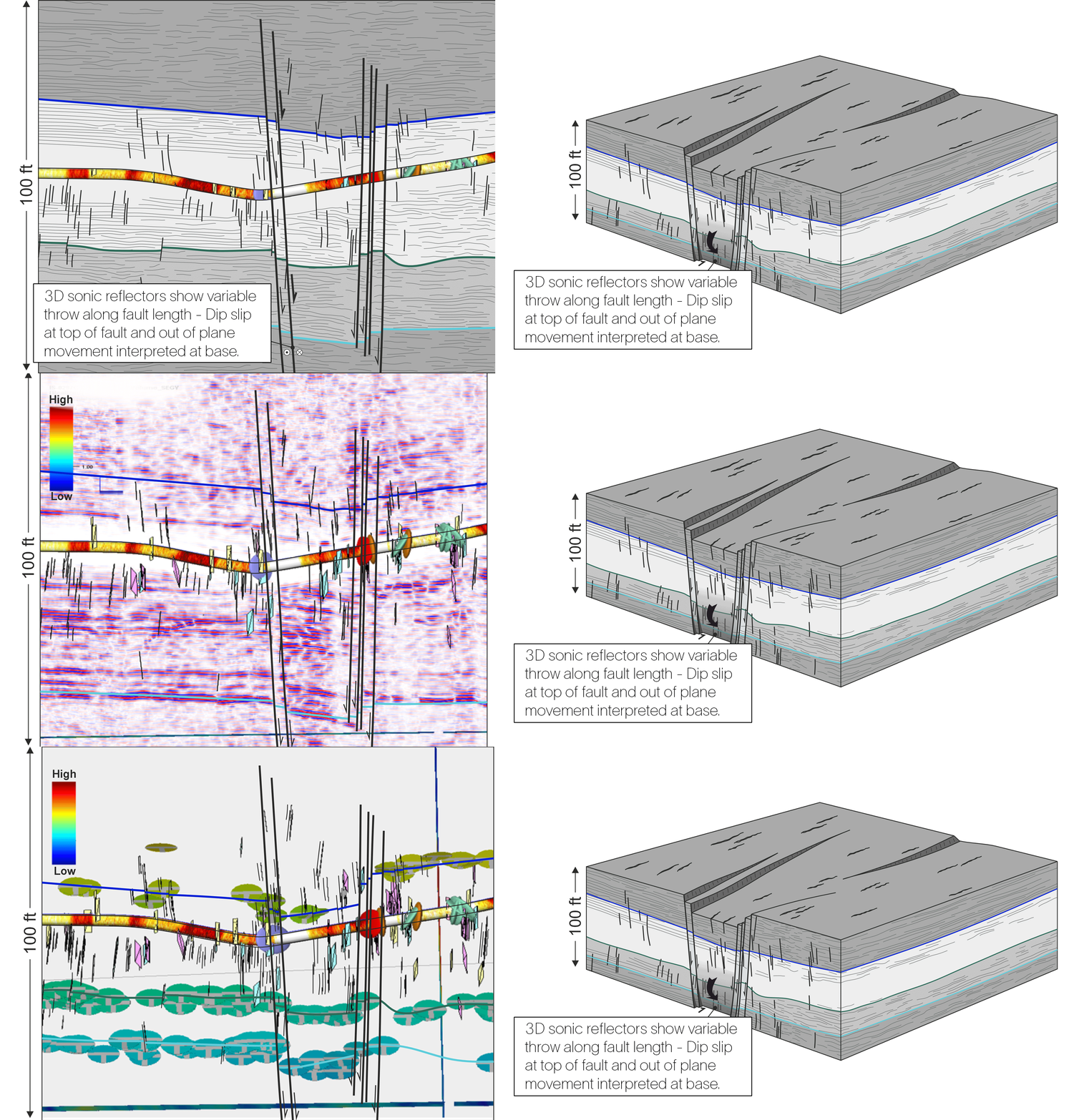
The integrated workflow improved reservoir characterization and provided a clearer understanding of the structural and fluid-flow complexities affecting reservoir performance. The combination of 3D reservoir mapping, high-resolution borehole imaging, and 3D far-field sonic imaging provided multiscale measurements that resolved structures from the near-wellbore environment to subseismic scales. The 3D far-field sonic data identified subseismic reflectors and thin interlayers influencing fluid flow behavior that were not resolved through conventional methods. Integration with deep resistivity mapping and borehole image data enhanced interpretation of faults, fractures, stratigraphic boundaries, and fluid distribution, enabling a better understanding of injector-producer communication pathways and factors contributing to high water production and poor sweep efficiency. The integrated dataset provided improved characterization of fault geometries, fracture networks, and fluid contacts, supporting updates to the high-resolution 3D dynamic model. Improved history-matching confidence and structural predictability enabled the customer to refine reservoir strategies, optimize injector-producer pairing, and improve long-term sweep efficiency.


3D far-field sonic service reveals subseismic reflectors, thin interlayers, and fracture corridors that control fluid flow and injector–producer communication in fractured carbonate reservoirs.
Products Used