Advanced spectroscopy log enables mineralogical modeling for CCS in depleted gas fields


SLB applied advanced core-log integration and cased-hole spectroscopy to deliver high-resolution mineralogical models in a depleted gas field in Italy. These insights were critical for assessing CCS feasibility, improving storage predictions, and reducing geomechanical risk—unlocking new potential in legacy assets for carbon storage.
As part of Italy’s energy transition strategy, a depleted gas field was selected for potential conversion into a CCS storage site. The operator faced two key challenges: (1) insufficient mineralogical detail in legacy petrophysical models—particularly for sealing caprock intervals, and (2) limited openhole log availability in many wells, leaving critical gaps in data coverage. Accurate characterization of mineralogy was essential to model injectivity, CO2-fluid interactions, and long-term containment stability.
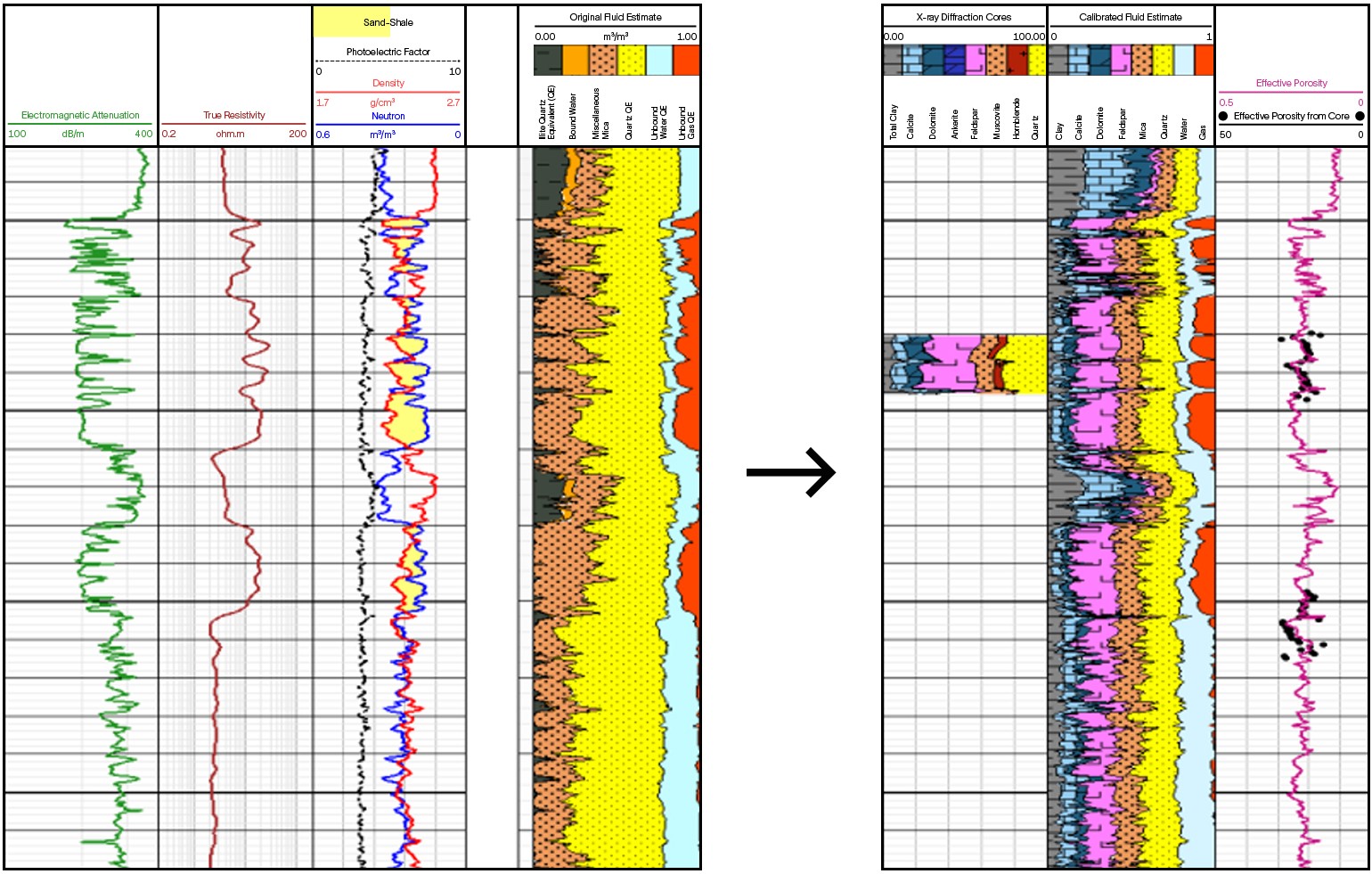
SLB recommended an integrated mineral modeling approach using core-log analytics and pulsed neutron elemental spectroscopy, enabling comprehensive subsurface evaluation without new drilling. In openhole wells, core X-ray diffraction (XRD) data were merged with legacy logs using a machine-learning workflow to predict mineralogy at scale. For cased-hole-only wells, SLB applied dimensionality reduction techniques to transfer mineral knowledge from core to spectroscopy data. This dual-path approach ensured both scalability and consistency across the asset, with minimal operational disruption.
In openhole wells, the data-driven approach achieved high correlation between core-measured and predicted mineral fractions, enabling reservoir-wide propagation of accurate mineralogical curves. This improved estimates of porosity, carbonate content, and clay distribution—key inputs for CO2 storage modeling.
In cased-hole wells, SLB deployed pulsed neutron spectroscopy combined with machine learning to translate elemental data into mineral assemblages. Even in challenging borehole conditions, this approach delivered robust mineral profiles validated against available core data. The technology enabled petrophysical modeling in wells previously excluded from the CCS evaluation.
Together, these workflows supported the redefinition of injection zones, improved storage capacity estimates, and derisked caprock sealing models. The operator gained a unified, high-resolution mineral framework across openhole and cased-hole wells, accelerating project qualification and demonstrating CCS viability in a brownfield setting. The SLB integrated, low-footprint approach avoided the cost and risk of new wellbores—offering a scalable model for CCS reuse of mature assets globally.