Optimizing water injection in heavy oil field with fiber-optic solutions and digital slickline


SLB utilized digital slickline and Optiq™ fiber-optic solutions distributed temperature sensing DTS data to optimize water injection and ensure well integrity in a brownfield water flooding project in South America. The innovative approach provided detailed insights, leading to improved recovery and enhanced field management.
The customer faced significant challenges in optimizing water injection distribution and ensuring well integrity. The complex geological environment, characterized by compartmentalization and fault systems, hindered efficient recovery in this mature heavy oil field. Previous attempts to resolve these challenges using production logging tools (PLTs) and radioactive tracer flowmeters were limited in providing comprehensive insights, making it difficult for the customer to fully evaluate injection at the perforation level and identify formation damage, fractures, or detect potential well integrity issues behind tubing.
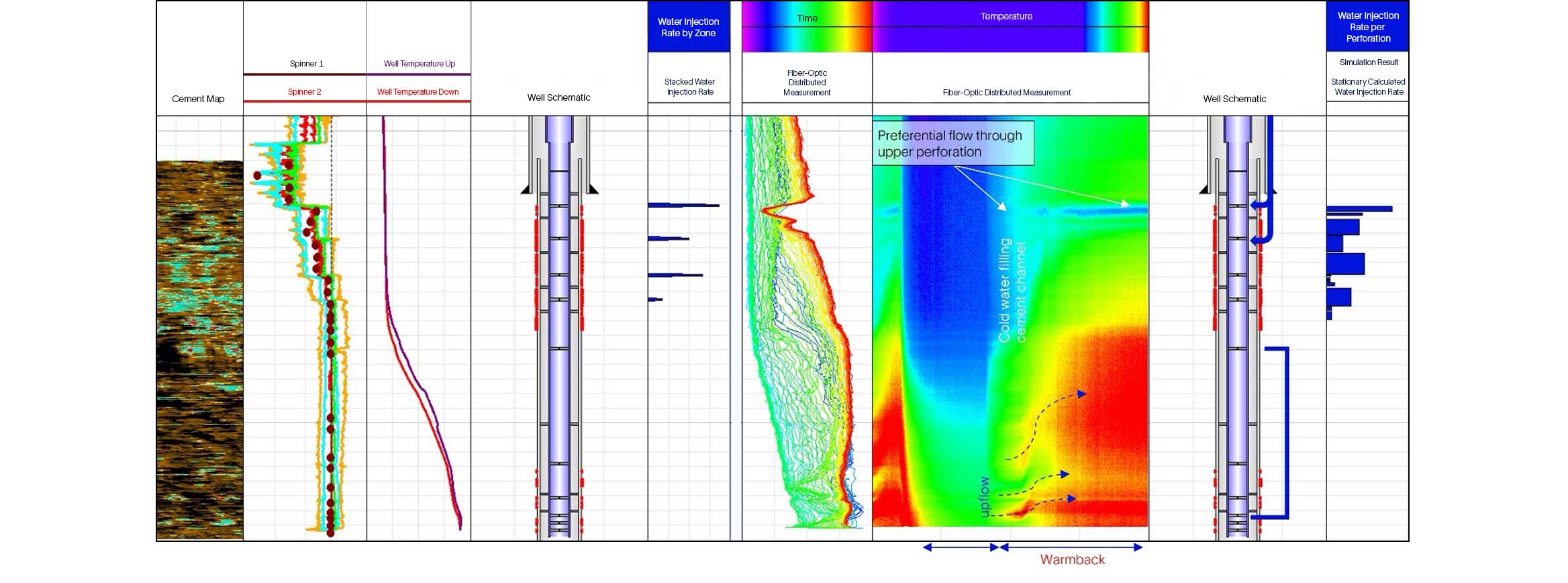
The digital slickline provided an agile and efficient method for performing mechanical interventions and real-time logging, essential for monitoring the FRVs and identifying any malfunctioning components. Optiq solutions DTS data acquired on the fiber-optic cable enabled continuous monitoring of temperature dynamics, delivering a comprehensive view of injection behavior at the perforation level. The DTS data was processed using THERMA™ distributed temperature and DAS analysis software, part of Techlog™ wellbore software. This thermal simulator combines Darcy’s equations with the Joule–Thomson effect to model temperature behavior. The approach enables accurate determination of flow rates from temperature warmback, supporting validation of injection logging results and confirming injection patterns.
SLB, in collaboration with the customer’s technical team, identified preferential flow, crossflow, and integrity compromises at packers and cement. Consequently, the operator was able to make informed decisions on field management and now operates with more optimal water injection strategies, improved well integrity monitoring, and enhanced recovery efficiency. The methodology has been approved for standard surveillance, and the technology is being expanded to other fields. Key learnings from this campaign include the importance of continuous temperature monitoring for comprehensive well evaluation, the value of integrating DTS with an ILT for precise injection rate calculations, and the necessity for periodic monitoring and validation with tracers.
