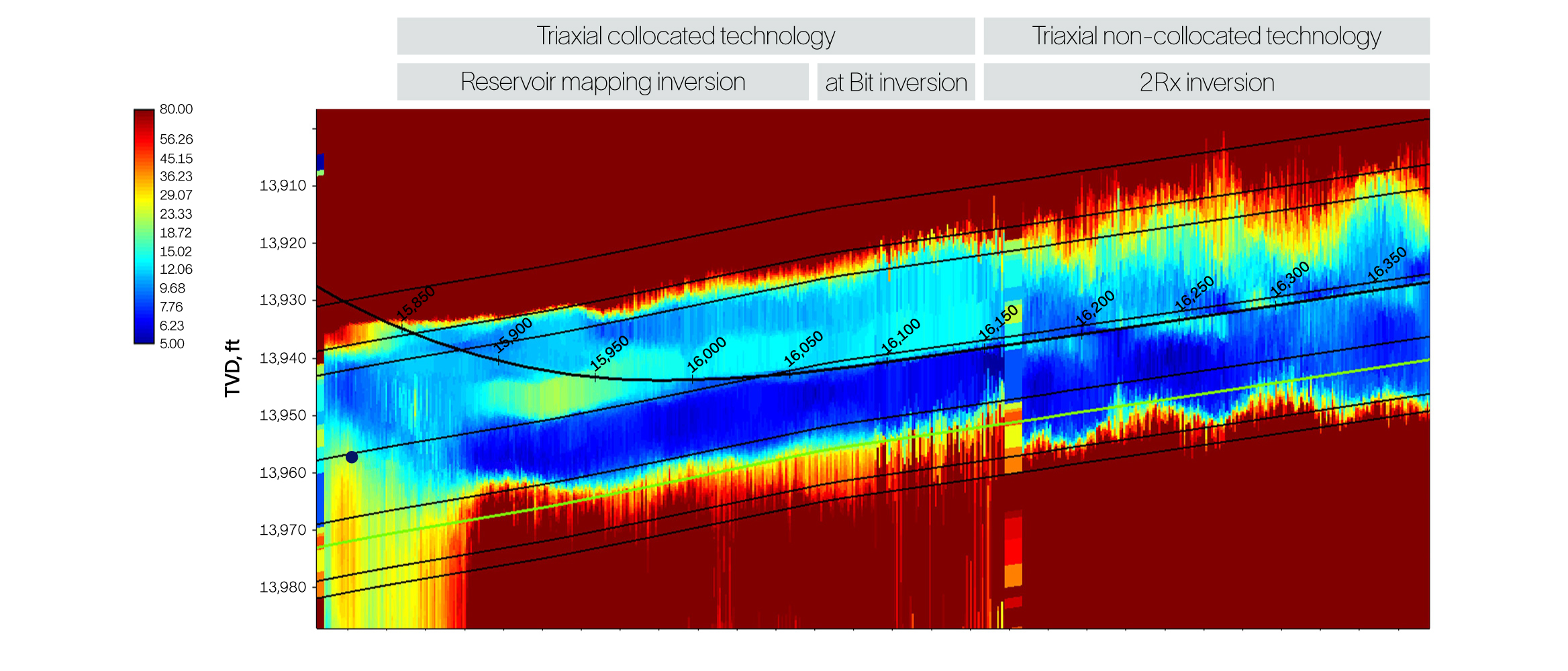
AlphaSight Service provides superior measurement sensitivity and certainty for confident reservoir mapping.
Industry-first collocated multidepth resistivity RSS platform delivers precise geosteering to reservoir top with no sidetracks
SLB deployed AlphaSight™ 3D multi-depth reservoir mapping and horizontal look-ahead-while-drilling service, the industry’s first triaxial, collocated, multi-depth resistivity platform integrated with a high-dogleg severity (DLS) point-the-bit RSS, to precisely land a gas-producing well in a layered carbonate reservoir—targeting entry within a 1-ft window below the reservoir top. The system combines two key inversion technologies—reservoir mapping inversion (RMI) for deep structural imaging and enhanced boundary detection in low-contrast environments, and at-bit inversion (ABI) for real-time resistivity inversion at the bit to enable immediate proximity detection and steering corrections during landing. Its collocated triaxial antenna design, with a wider frequency bandwidth, improves vertical resolution and boundary mapping accuracy, enabling macroscale mapping and precise trajectory control in a single run.
Kuwait Oil Company (KOC) aimed to land a gas-producing well with extreme precision in a layered carbonate reservoir, targeting entry within a 1-ft window below the top while maintaining drilling performance in a section with 8°/100 ft DLS. The formation’s low resistivity contrast between laminations reduced the effectiveness of conventional azimuthal resistivity tools, creating geosteering challenges. The job required sharp trajectory control without compromising tool reliability or borehole stability, making accurate boundary mapping and landing control exceptionally difficult.
Using the AlphaSight service, the well was landed successfully within 1 ft of the reservoir top, achieving KOC’s geosteering objective without sidetracks. Real-time inversion outputs of RMI and ABI enabled faster and more confident steering decisions under dynamic formation conditions, while the delineation of thin laminated layers improved, allowing higher-precision placement in a low-contrast environment. The operation maintained consistent RSS performance under 8°/100 ft DLS. After landing, a comparison with a conventional pseudotriaxial, noncollocated, ultradeep system showed improved boundary clarity, finer vertical resolution, and reduced interpretation uncertainty by up to 50%. This project demonstrated the first landing with a collocated multidepth resistivity RSS platform, representing a step change in development for layered carbonate reservoirs.