Dynamic Gyro Compass technology reduces survey time in North Sea sections by 76%

minus
United Kingdom, Europe, Offshore

In the North Sea, SLB and bp achieved a significant advancement in gyro-while-drilling (GWD) technology with the deployment of Dynamic Gyro Compass (DGC) technology in the Clair Ridge development. This innovation enables accurate, real-time survey measurements under all heave conditions, independent of the BHA provider, delivering consistent performance in offshore environments. By eliminating the need for wireline scoping runs, this solution reduced survey time by 76%, decreased personnel on board exposure in red zones, and enhanced health and safety outcomes.

While drilling the tophole sections on the Clair Ridge platform in the UK North Sea, bp encountered significant challenges. The noisy tophole conditions rendered traditional gyro tools ineffective, forcing the team to rely on wireline scoping gyro surveys. This time-consuming approach required multiple personnel and required frequent entries into the red-zone, which increased safety risks as well as operating costs. As a result, bp sought a solution that would reduce the time taken to drill the section and the time spent sitting on bottom, minimize red-zone entries, and lower the numbers of persons on board (POB).

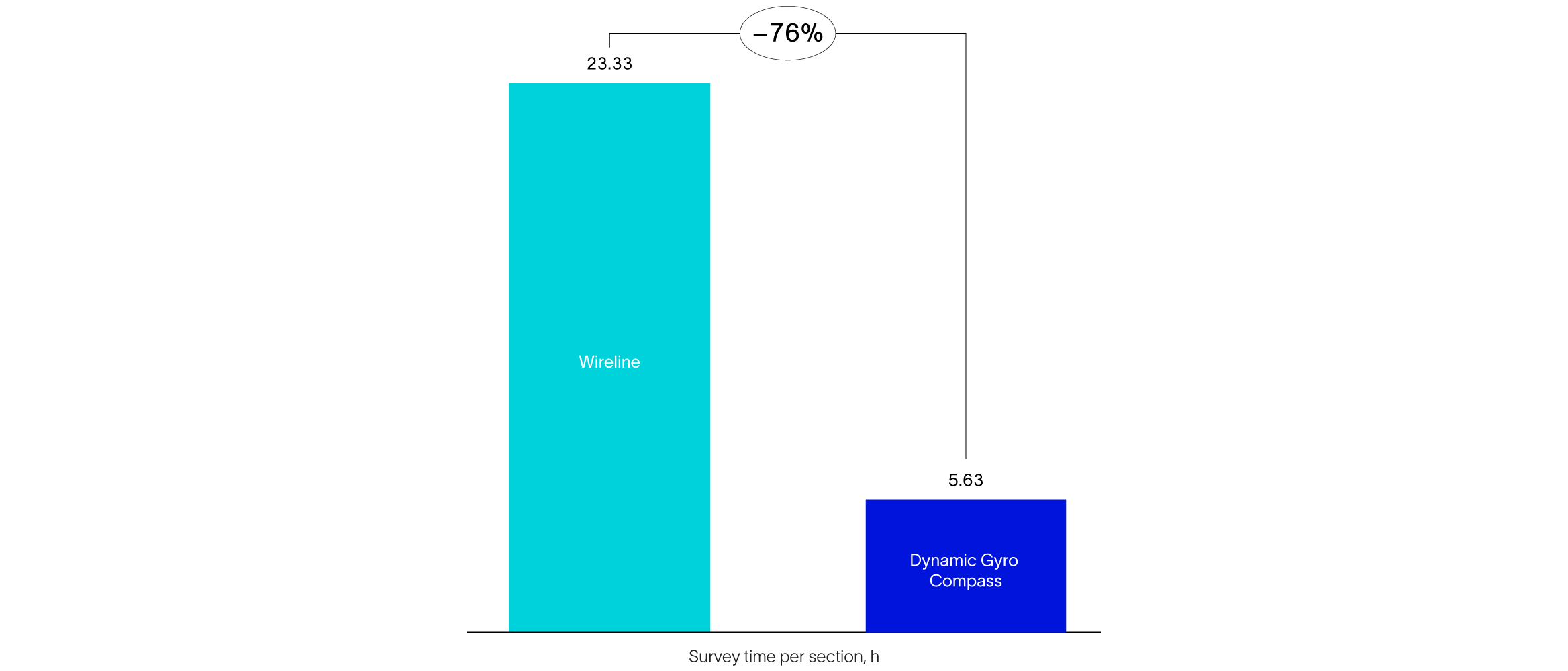
SLB integrated its DGC technology with Quest GWD™ solid-state gyro while drilling to address the challenges faced by bp. The DGC technology effectively filtered out noise, enabling accurate surveys in the challenging tophole environment. This eliminated the need for wireline scoping gyro surveys, significantly improving operational efficiency. Over the two runs, the average survey time was 13 minutes, compared to an average of 66 minutes per wireline run—a time saving of 53 minutes per survey.  As there are typically 21 wireline runs in each section, this represented a savings of nearly 18 hours per section. The two sections drilled using DGC technology represent the fastest ever completed in the field.

Beyond saving time, the technology eliminated red-zone entries that previously required multiple personnel per run. This improved safety and reduced the number of POB by four, freeing up rig space and allowing casing crews to arrive earlier, further optimizing operations.

Chart shows how DGC technology reduced survey time by 76% versus wireline survey.
With DGC technology, bp saved nearly 18 hours of survey time per section compared to using wireline surveys.
“The use of DGC technology with the Quest GWD solid-state gyro while drilling tool allowed us to eliminate multiple wireline surveying runs typically required during tophole operations. This significantly enhanced operational efficiency and safety by improving red-zone management and reducing the risk of dropped objects.”
Jim O'Leary, VP Wells North Sea, Mauritania, Senegal & Brazil, bp

Other company, product, and service names are the properties of their respective owners.

Products Used