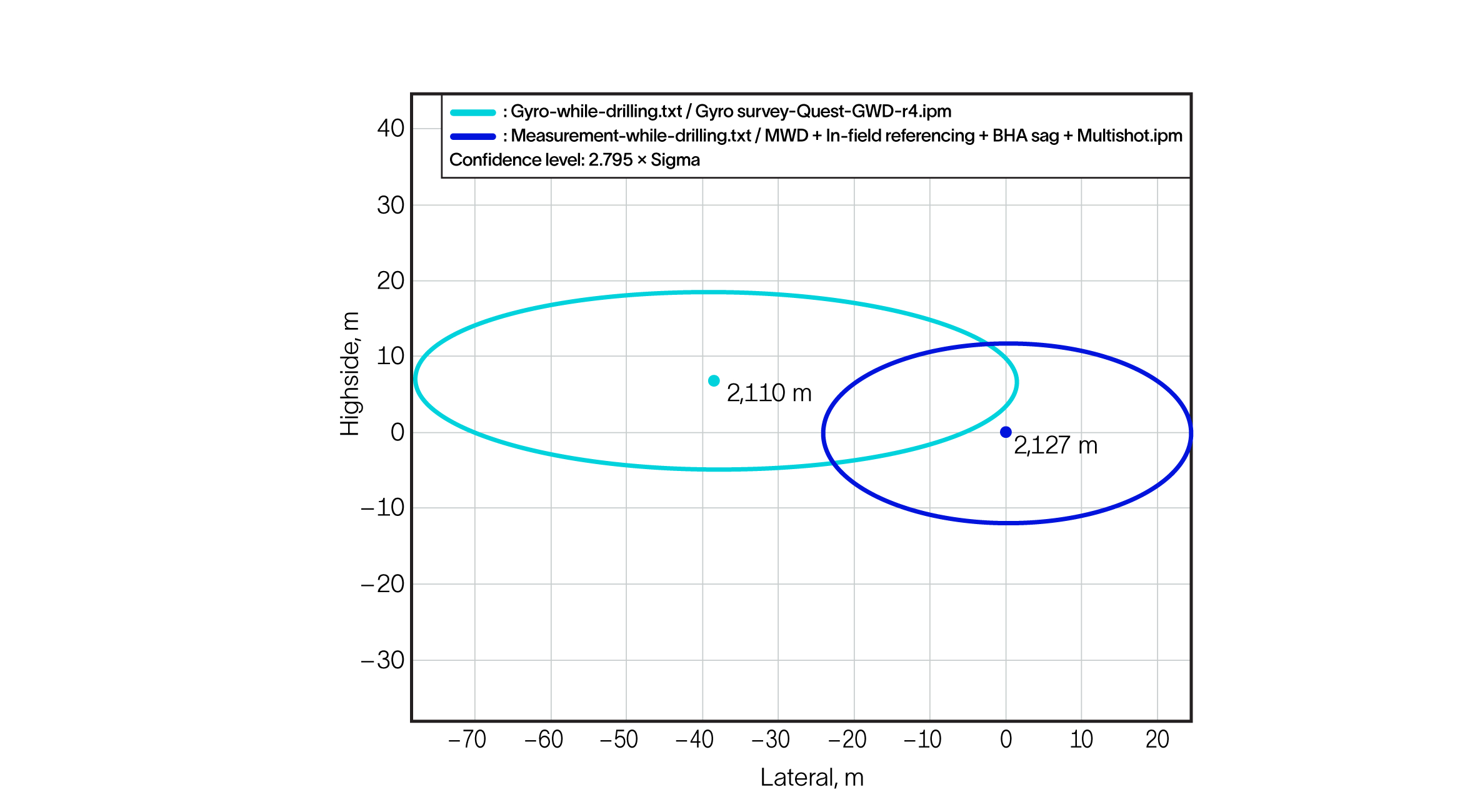
Quest GWD solid-state gyro while drilling reduces wellbore surveying time and the ellipse of uncertainty.
Solid-state gyro while drilling ensures precise well placement in SAGD operations
The SLB Quest GWD™ solid-state gyro while drilling technology enabled an oil sands operator in Northern Alberta to successfully drill a challenging lateral sidetrack well in an SAGD field. The solution overcame severe magnetic interference and anticollision concerns, achieving precise well placement with virtually no downtime. The customer has since adopted Quest GWD technology for multiple future projects, recognizing its unmatched accuracy and reliability.
An oil sands operator in Northern Alberta faced significant challenges while drilling a lateral sidetrack well in an SAGD field. The well is located in an HPHT environment up to 260 degC [500 degF] within an active steam chamber, surrounded by numerous producing wells and existing infrastructure. The operator needed to maintain a precise trajectory while avoiding collisions with nearby wells, which required accurate survey data.
Previous attempts using MWD technology were insufficient due to severe magnetic interference, resulting in large azimuthal swings and a high ellipse of uncertainty (EOU). This created significant anticollision risks and made it nearly impossible to achieve the desired well placement. The operator sought a solution that could provide reliable, high-quality survey data to ensure safer and more efficient drilling operations.
SLB deployed its Quest GWD technology to address the operator’s challenges. Unlike traditional MWD systems, the Quest GWD tool provided superior survey accuracy and reliability, even in environments with high magnetic interference. The tool’s tighter EOU allowed the operator to plan the well closer to the intended target while maintaining a safe distance from existing wells.
During the operation, Quest GWD technology demonstrated the ability to deliver consistent and accurate azimuthal readings, eliminating the need for additional nonmagnetic collars in the BHA. This not only reduced the bit-to-sensor offset but also minimized downtime associated with verifying survey accuracy. By TD, the highest separation between the GWD and MWD surveys was 36 m horizontally, providing the assurance needed to avoid potential collision events.
The customer was highly impressed with the tool’s performance, as it enabled them to achieve their well placement objectives without compromising safety or efficiency. The operation showcased the value of Quest GWD technology in overcoming complex drilling challenges, leading the operator to adopt the technology for multiple future projects.
SLB Quest GWD technology proved to be the optimal solution for this challenging SAGD operation, delivering precise well placement, reducing downtime, and ensuring safe drilling practices. The success of this project highlights the tool’s reliability and accuracy, making it a preferred choice for future wells in complex environments.