Geosteering boosts confidence in achievement of heat production objectives

minus
France, Onshore

An operator used logging while drilling (LWD) to optimize geothermal well productivity in a mature field. PeriScope Edge™ multilayer mapping-while-drilling service and proVISION Plus™ magnetic resonance-while-drilling service enabled maximizing reservoir contact within challenging, thin, heterogeneous carbonate intervals.

Geothermal district heating projects in the Paris Basin rely on the Dogger Carbonate aquifer, an extensive but thin reservoir system characterized by strong heterogeneity. Decades of production have led to declining performance from aging geothermal doublets, and urban surface constraints limit well placement options. With productive intervals often just a few meters in thickness and strong lateral variations in reservoir properties—such as porosity and permeability—over short distances, wells with conventional slant profiles are not optimal for sustained production.

An operator wanted to replace traditional well architectures with subhorizontal drilling to increase exposure to productive layers, while staying within the strict surface location constraints typical of urban geothermal developments. The objective was to land and steer a well within the most permeable sublayers of the formation in an 800-m-long horizontal section.

Delivered precise well placement via boundary mapping

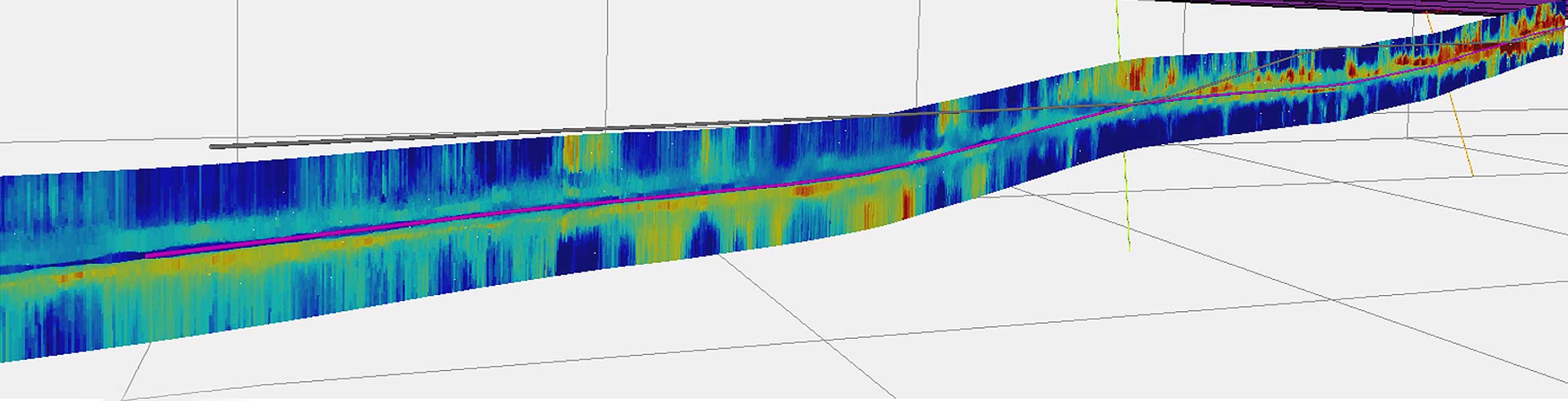
SLB deployed PeriScope Edge multilayer mapping-while-drilling service to resolve the top and bottom boundaries of thin carbonate targets. These measurements were especially critical in areas where pilot wells and offset data demonstrated that target thickness could vary significantly from predrill estimates.

Supported geosteering decisions with real time reservoir permeability insights

proVISION Plus magnetic resonance-while-drilling service was used to evaluate reservoir properties. The real-time measurements provided directional guidance for informed steering decisions; when permeability declined within a given layer, the drilling team adjusted the trajectory to target alternative productive sublayers. Near-perfect matches in density-porosity and porosity-permeability relationships provided by the service confirmed that drilling was hitting the sweet spots and gave the operator greater confidence that it would meet its heat production objectives.

Reduced subsurface uncertainty and simplified well design

The geothermal doublet was completed in just 24 days. Previous Paris Basin projects had relied on pilot holes for reservoir characterization before the horizontal producers were drilled. However, real-time boundary detection and reservoir property evaluation eliminated the need for a pilot hole, saving time and improving well economics. As subhorizontal and horizontal well designs are increasingly adopted in the basin to replace aging wells and address growing district heating demand, LWD technologies will be key to maximizing results.

Image shows PeriScope Edge service inversion results for the subhorizontal well trajectory.
Multibed boundary mapping enabled the drilling team to adjust the well trajectory in real time and remain within productive intervals about 3–5 m thick.
Products Used