Full-Waveform Inversion
High-resolution velocity models for a range of E&P scenarios and geological settings

Overcome your imaging challenges
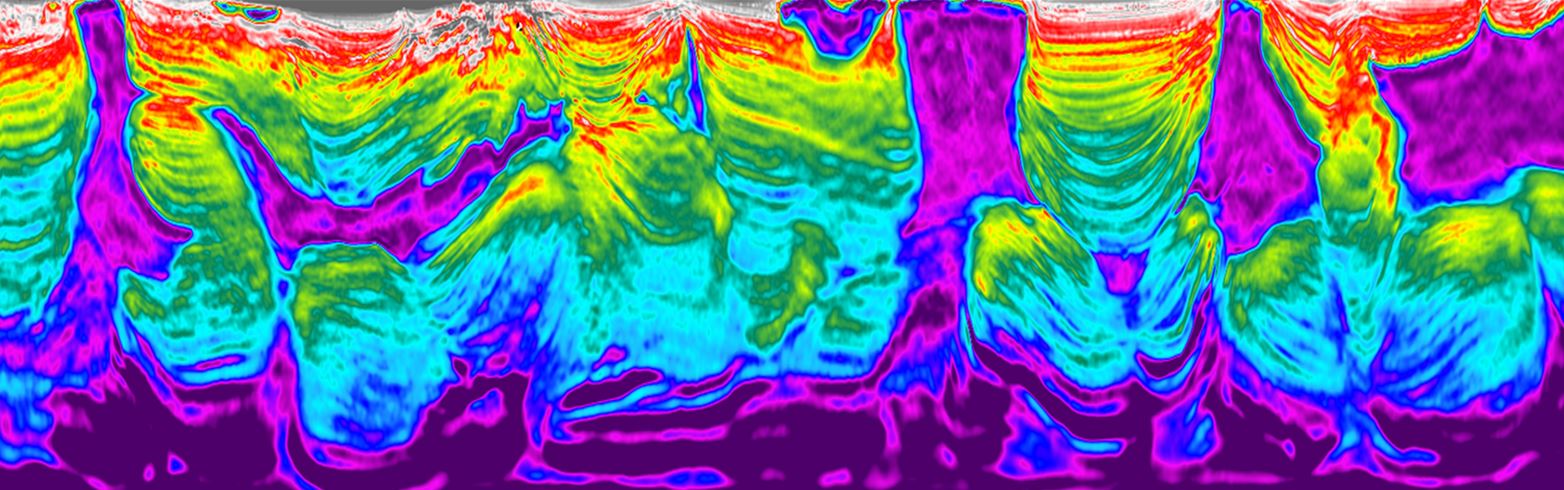
With full-waveform inversion (FWI) solutions for every exploration, appraisal, or production environment, we can create highly detailed velocity models that honor the geologic structures in your reservoir. Not only do our FWI algorithms work with all acquisition geometries, but they also complement the low frequencies inherent to broadband seismic data. The result is a high-fidelity image that enables you to achieve a wide range of subsurface objectives across the E&P life cycle.
FWI portfolio
QI-FWI™ quantitative interpretation full-waveform inversion solution
The next generation of reservoir-ready seismic
The QI-FWI™ quantitative interpretation full-waveform inversion solution moves beyond imaging to deliver reservoir-ready properties. Built on elastic, multi-parameter full-waveform inversion, it inverts for Vp, P-impedance, Vp/Vs, and further derives Vs, density, and AVA attributes from the inversion. This gives explorationists and interpreters the rock and fluid discrimination needed for faster, more confident decisions. Because the workflow is elastic and physics-based, it captures the full seismic wavefield, opening new opportunities for quantitative reservoir characterization by improving the discrimination of lithology and fluid effects.
The QI-FWI solution replaces a multistep path—image, invert, interpret—with one continuous workflow. Full-waveform inversion feeds directly into AVA intercept and gradient volumes, validated against well-log synthetics, eliminating a separate AVO inversion step. The result is a single, interpretation-ready output set spanning FWI-derived reflectivity, impedance, and Vp/Vs volumes, supporting exploration and appraisal, development, and reservoir monitoring within one integrated framework. Backed by our earth model heritage and multiclient seismic footprint, the QI-FWI solution shortens the path from acquisition to a decision-ready subsurface model.

Enhanced template matching FWI
ETM 2.0 FWI, unlock a step-change in subsalt imaging
Enhanced template-matching (ETM) full-waveform inversion (FWI) [ETM 2.0] represents the next evolution of advanced full waveform inversion, delivering faster, more robust, and scalable earth model building for today’s increasingly complex subsurface challenges.
Building on a proven foundation, ETM 2.0 leverages both the kinematic and dynamic components of the full seismic wavefield across entire shot records. By improving alignment between observed and simulated data its multi-dimensional template matching approach significantly reduces cycle-skipping and overcomes key limitations of traditional least-squares based FWI. This enables more stable inversion and more consistent convergence, even in the most challenging environments, including subsalt.
ETM 2.0 is engineered to get the most out of modern long-offset, low-frequency data, including our Offshore U.S. engagement surveys acquired with ultra-low frequency enhanced (ULFE) source. Combined with enhanced inversion optimization and tighter integration across model building, imaging, and interpretation, ETM 2.0 shortens the path from seismic data to high-confidence subsurface insight.
The result is faster convergence, more accurate earth models, clearer imaging, giving exploration and development teams greater confidence in decision making across diverse geological settings worldwide.
ETM 2.0 is the engine behind advanced inversion workflows and products—including elastic 4D FWI, FWI impedance imaging (FWI3), and FWI-derived reflection gathers.

FWI-derived reflectivity
Reveal steeply dipping structures with FWI-derived reflectivity (FDR)
FWI is a robust algorithm that can produce a high-resolution velocity model update when using the higher bandwidths in the input data. A pseudo-reflectivity volume (FDR/FWI imaging) could be directly derived from the FWI velocity field by computing the impedance contrast normal to a structure interface, which can be accurately obtained by considering the structural tensor computed from the FWI update velocity model. Compared with a conventional migrated image, FWI-derived reflectivity can improve the imaging of steeply dipping reflectors.

Elastic FWI
Achieve greater accuracy and detail with elastic FWI
Elastic full-waveform inversion (EFWI) takes into account both the compressional (P-wave) and shear (S-wave) components of the seismic wavefield during seismic wave propagation simulation, which leads to more accurate and detailed estimation of the subsurface velocity models.
Elastic full-waveform inversion (EFWI) is particularly useful for velocity model building in complex geological settings where there are large velocity contrasts, such as around salt or carbonate formations. In these environments, traditional inversion techniques that rely solely on the acoustic wave equation can struggle to accurately image the subsurface, as they cannot account for the shear (S-wave) component of the seismic wavefield.

4D full-waveform inversion
Transform time-lapse seismic into actionable reservoir intelligence with 4D FWI
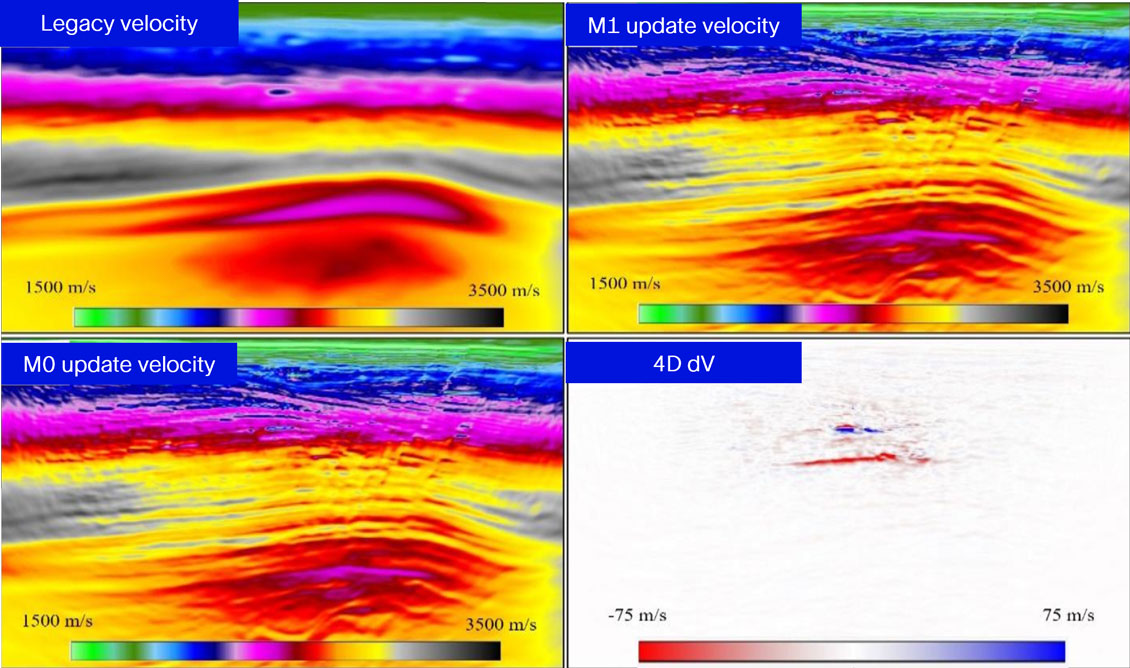
We offer robust elastic and acoustic 4D FWI to invert for the 4D velocity differences between the baseline and monitor surveys in a 4D acquisition. Using enhanced template matching (ETM), baseline and monitor models are inverted simultaneously or sequentially, preventing convergence to different local minima and reducing acquisition-related artefacts. Full multi-vintage data is used at every iteration, enabling accurate recovery of pressure‑ and saturation‑driven reservoir changes due to ongoing production without the need for conventional depth or time alignment prior to 4D differencing.

FWI impedance imaging (FWI3)
Accelerate subsurface understanding with elastic multiparameter FWI
FWI3 is a multiparameter inversion technique that simultaneously updates velocity and impedance to produce a high-fidelity, high-resolution seismic image. The multiparameter inversion innovation enables a leap in FWI inversion frequency once the kinematic aspect of the velocity model is well-resolved, allowing for direct high-resolution impedance imaging.

Reflection-based FWI


Land FWI


