Well radar services leveraging multiphysics well ranging provide accurate and reliable collision avoidance

minus
Norway, Europe, Offshore

In offshore Norway’s high-density drilling environment, integrating GeoSphere 360™ 3D reservoir mapping-while-drilling service with TruLink™ definitive dynamic survey-while-drilling service enabled the operator to precisely detect the position and direction of a nearby well during sidetrack operations. This multiphysics solution achieved unprecedented detection accuracy—within 5% for distance and 8% for azimuth—far exceeding conventional methods and significantly enhancing operational safety.

A major operator faced increasing collision risks while drilling sidetracks and infill wells in Norway’s North Sea. Despite using established services, operations were repeatedly delayed and safety margins narrowed due to uncertain positional information. The operator needed real-time visibility of both the distance to, and the azimuth toward, the adjacent well during drilling. However, conventional ranging methods—based on a single physical technology—often yield high uncertainty, limited detection depth, and do not provide real-time results or operate while drilling. These shortcomings created an urgent need for a reliable, real-time, while-drilling solution that could independently verify proximity and direction, enabling safer and more efficient drilling.

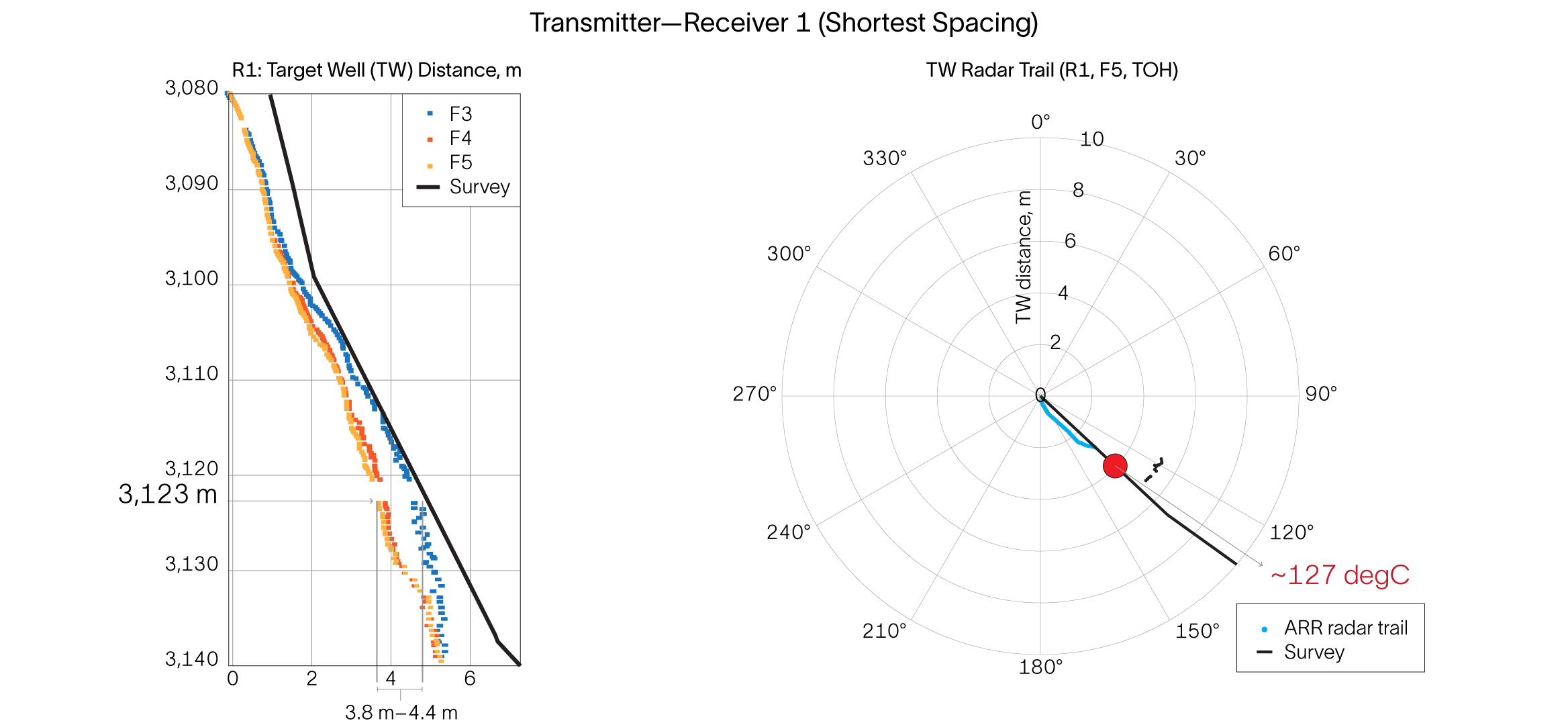
Well Radar™ ranging and interception services, which combine the GeoSphere 360 service with the TruLink service, enabled highly accurate detection of the nearby well during offshore North Sea drilling. By leveraging both active resistivity ranging (ARR) and passive magnetic ranging (PMR), the operator was able to determine the relative distance and azimuth of the target well with high spatial precision—within 5% for distance and 8% for azimuth—overcoming previous limitations. This multiphysics approach produced two independent measurements, significantly enhancing operational safety and reducing uncertainty during the drilling process. As a result, safety improved, downtime decreased, and well placement was optimized with confidence. Beyond collision avoidance, this dual-method solution also showed potential for other critical applications, such as relief-well interception and borehole twinning for advanced geothermal systems.

Image of graph showing accurate detection of a nearby well during offshore North Sea drilling.
Well Radar services using the GeoSphere 360 service and the TruLink service detected the target well with combined ranging solutions within 5% distance and 8% azimuth margins.
Products Used