Uncompromised Connections: Why Electris Contactless Wet-Mate Connectors Matter

Published: 12/03/2025

3D representation of Electris completions

The Challenge: How to improve completion lifetime reliability in tortuous, multilateral or extended-reach wells requiring multitrip installation?

In today’s completions, reliability is non-negotiable. From mechanical to hydraulic and electrical continuity, each connection must stand the test of time—especially in deeper, longer, or more compartmentalized wells.

That’s why operators around the world are choosing Electris™ contactless wet-mate connectors (WMCs)—designed to deliver flexible, repeatable, high-integrity connectivity across the full life of the well.

That’s where Electris WMCs come in.

The Why: Enabling modern multitrip installation strategies

Operators often face a tough reality: in longer or more tortuous wellbores, reaching total depth with a fully integrated completion in one run isn’t always possible. In many cases, installing the lower completion and returning later with the upper is the only operationally viable path.

Without a way to reliably connect power and telemetry downhole—without running fragile control lines across mechanical junctions—this becomes a high-risk proposition.

Electris WMCs solve that challenge.

They allow engineers to make electrical connections between upper and lower completion stages without pins, physical contact, or alignment dependencies. And they do it reliably, even after multiple trips.

The What: How Electris WMCs work

Electris contactless WMCs use inductive coupling to transfer power and high-speed digital telemetry between completion segments. Think about wireless charging of your phone or your toothbrush—same principle! That means:

  • No exposed electrical contacts—minimizing risk of damage or misalignment
  • Debris-tolerant design—engineered for harsh downhole conditions
  • High data integrity—maintains telemetry performance through multiple installations

These features make WMCs an ideal solution for both planned reentry operations and long-term system resilience.

Electrification_3 Well Images
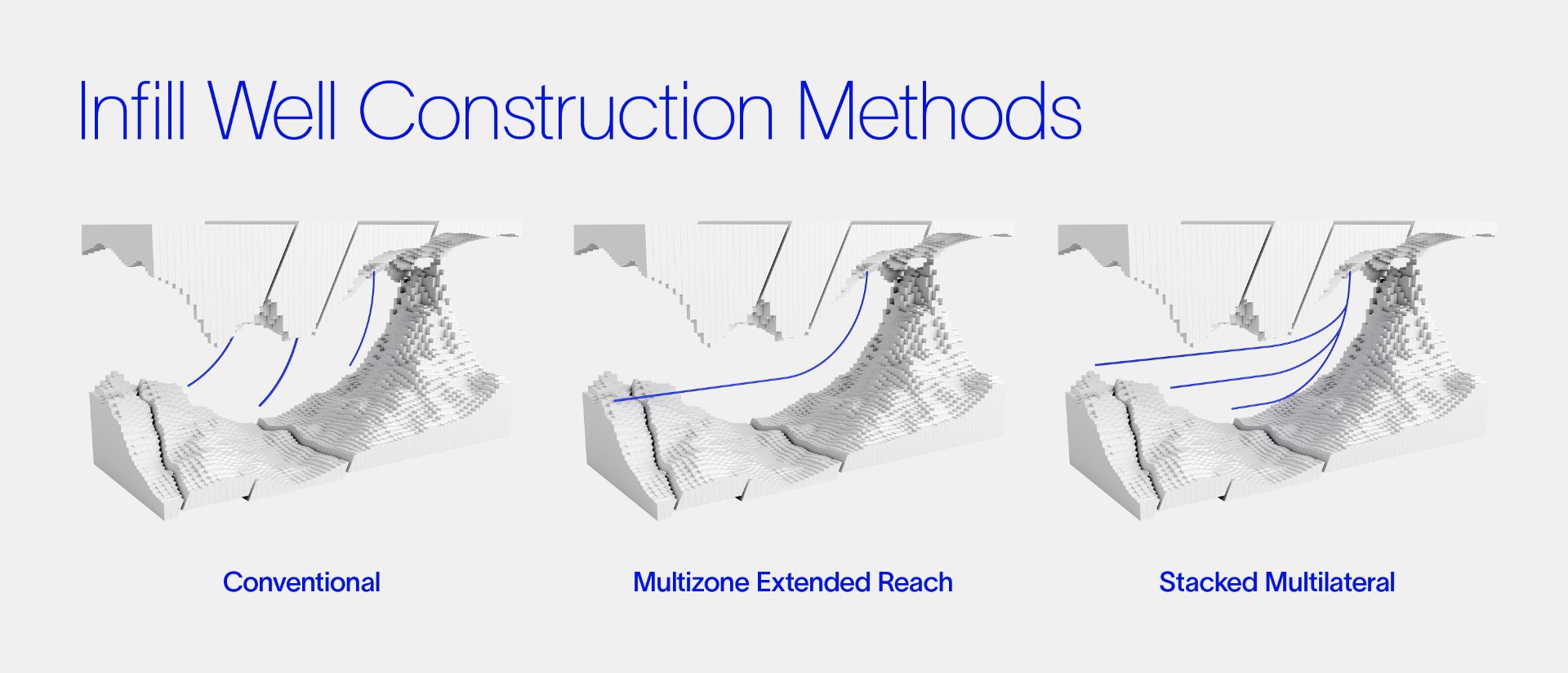
Early-phase development wells are typically less complex, enabling quicker production startup and steady cash flow. However, as fields mature, infill wells become more technically challenging. These later-stage wells often require advanced architectures—such as multizone extended-reach or multilateral designs—to access remaining reserves. To maximize value and manage reservoir uncertainties, particularly risks of water or gas breakthrough, these complex completions demand precise control and intelligent reservoir management.

The Who: Operators who benefit most

Electris WMCs deliver the greatest value when operational flexibility and uptime matter most:

  • For wells requiring sand control and reservoir segmentation, standalone screens must be deployed on drillpipe to ensure reaching TD, reservoir isolation, and barrier testing. The upper completion is then installed in a separate run.
  • Extended-reach wells, where modular deployment improves reach and reliability due to limits imposed by mechanical friction preventing one-run installs
  • Multilateral wells, where long-term connectivity is essential for zone-level optimization
  • Wells with ESPs, tubing, or safety valves that may require multiple upper completion interventions
  • Deepwater and shelf environments, where rig time, reliability, and life-of-well performance are key
  • Projects with complex access strategies, where Electris WMCs support installation confidence even in difficult trajectories, tight doglegs and tortuous paths

Field deployments have already exceeded 8 to 12 years of reliable operation across extended-reach, multilateral, and ESP-equipped wells—demonstrating robust performance in high-stakes environments.

More than just a connection—they are a key enabler

Electris WMCs don’t work in isolation—they’re a critical part of the broader Electris™ completions system, enabling:

  • Real-time zonal flow control
  • Micrometric bidirectional choke actuation
  • Wireless running tools for multitrip assurance
  • Simplified junction architecture for clean system integration

Together, they make a completions system that adapts to your well—and evolves with it.

Field-proven, life-of-well reliable

These aren’t conceptual technologies—they’re already delivering value in the field. Operators using Electris completions with WMCs are:

  • Completing wells that were previously unviable
  • Reducing rig time and complexity on interventions
  • Achieving zone-level production optimization in real time

And with the ability to disconnect and reconnect upper completions without compromising the lower, Electris WMCs ensure long-term flexibility—whether you're managing an ESP failure, replacing tubing, a subsurface safety valve or adjusting production strategy years down the line—without compromise.

Is your completion strategy built for what’s next?

If your wells demand modularity, deeper reach, or more life-of-well flexibility, Electris contactless WMCs are ready to deliver.

It’s time to stop treating electrical connection points as failure points—and start using them as enablers.


Contact Steve and the team today

Let's talk about your wells
Article Topics
Intelligent Completions Multilateral Completions