Enabling drilling data for the next generation of AI
AI is reshaping industries across the globe, from healthcare and manufacturing to finance and transportation. But one sector where its transformative potential is just beginning to be realized is oilfield well construction. This article will explore how drilling data can be harnessed to power the next generation of AI-driven insights and operations.
The growing relevance of AI in drilling
Generative AI has the potential to assist in designing well trajectories, bottom hole assemblies (BHAs), and even entire drilling programs. With better cross-domain data integration, operators could optimize well designs not just for cost-efficiency but also to maximize production. During operations, AI could help determine optimal drilling parameters, anticipate risks ahead of the bit, and support real-time decision-making. And when it comes to analyzing historical data, having a centralized, structured repository could enable unprecedented levels of performance analysis and insight generation.
The reality check: data challenges in the field
Despite the promise, the path to AI clarity has its challenges. Drilling data is often siloed, stored in legacy systems, and presented in inconsistent or unstructured formats. Operators may have used different service providers over the years, each with their own databases, naming conventions, and data standards. Language changes, unit discrepancies, and poorly labelled or missing data further complicate integration.
These issues are not just technical, they are also tied to domain expertise. The knowledge and technical understanding required to sift through historical reports, identify, and resolve discrepancies to create a unified source of truth comes from experience. Deep domain knowledge is key to making sense of complex, fragmented data.
Why legacy systems aren’t enough
Many operators continue to rely on legacy data stores, but these systems were designed as archives—not as platforms for AI or data science. They lack the scalability, flexibility, and computational power needed to support modern AI tools. Adding more data to these systems won’t solve the problem.
What’s needed is a purpose-built AI platform, one that not only stores data but also supports custom language models, AI agents, and collaborative model development. These platforms must be capable of ingesting vast volumes of data, handling diverse data structures, and enabling data analytics and decision-making.
Where vision meets reality
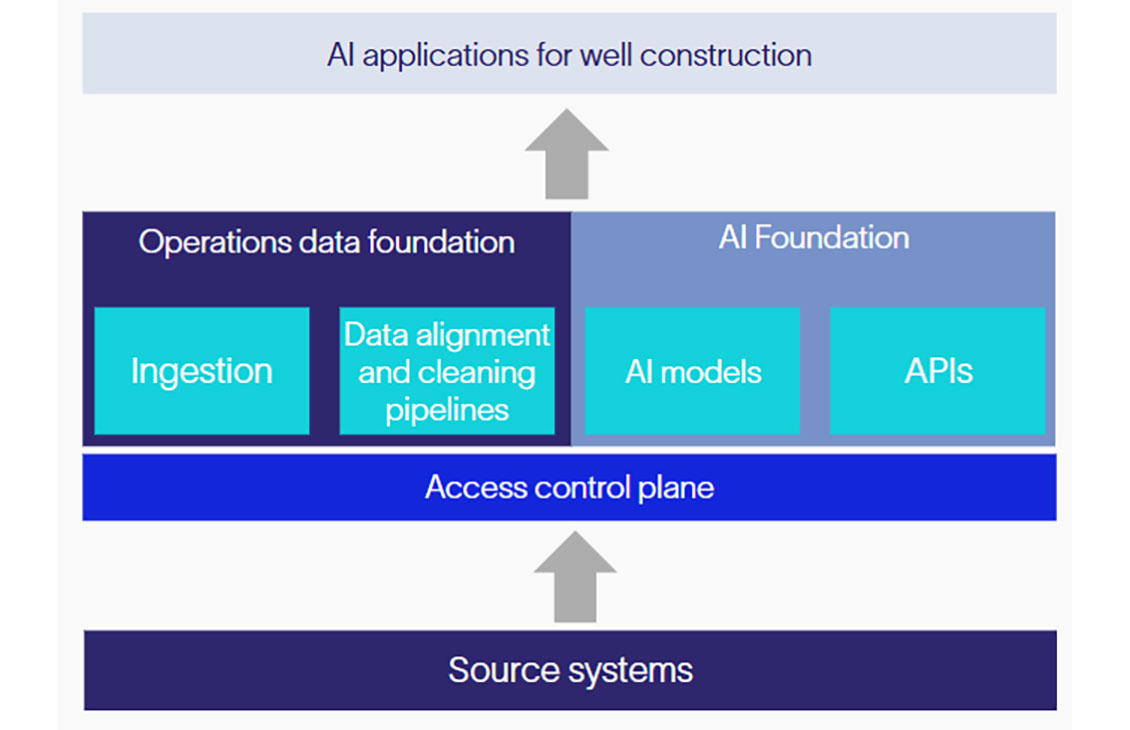
To address these challenges, within the Lumi™ data and AI platform, SLB is developing the Operations Data Foundation for drilling, a robust and flexible framework designed to unify drilling data and enable AI-driven insights. This foundation includes:
- Connectors that ingest data from a wide range of sources, including legacy systems, reporting tools, and even unstructured documents.
- Intelligent pipelines that merge and clean data, resolve inconsistencies, standardize units and mnemonics, and flag or correct poor-quality data.
- AI agents and models, tailored for well construction, enabling conversational insights and predictive analytics.
- Cybersecurity and access control through our rigorous ”digital license to operate”, ensuring data safety while leveraging the scalability of the cloud.
The Operations Data Foundation is more than a repository; it’s the robust data backbone that powers real AI at scale. By delivering trusted, well-structured operational data, it gives teams the foundation they need to train and deploy models, accelerate insight sharing across domains, and integrate seamlessly with the broader Lumi platform.