Constructing projected 3D data from 2D vintages over the Barents Sea using machine learning workflow

Norway map
minus
Barents Sea, Europe, Offshore

SLB used ExploreCube™ rapid frontier intelligence for a reconstruction over a pilot study area in the Barents Sea. This produced a coherent, high-resolution 3D volume, significantly enhancing regional geological understanding and enabling more precise identification of exploration targets.

This demonstrates the potential of machine learning (ML) approaches in transforming legacy seismic datasets into valuable and actionable geological insights—effectively guiding exploration decisions and informing future 3D seismic acquisition acquisitions.

 Constructing projected 3D data from 2D vintages over the Barents Sea using machine learning workflow
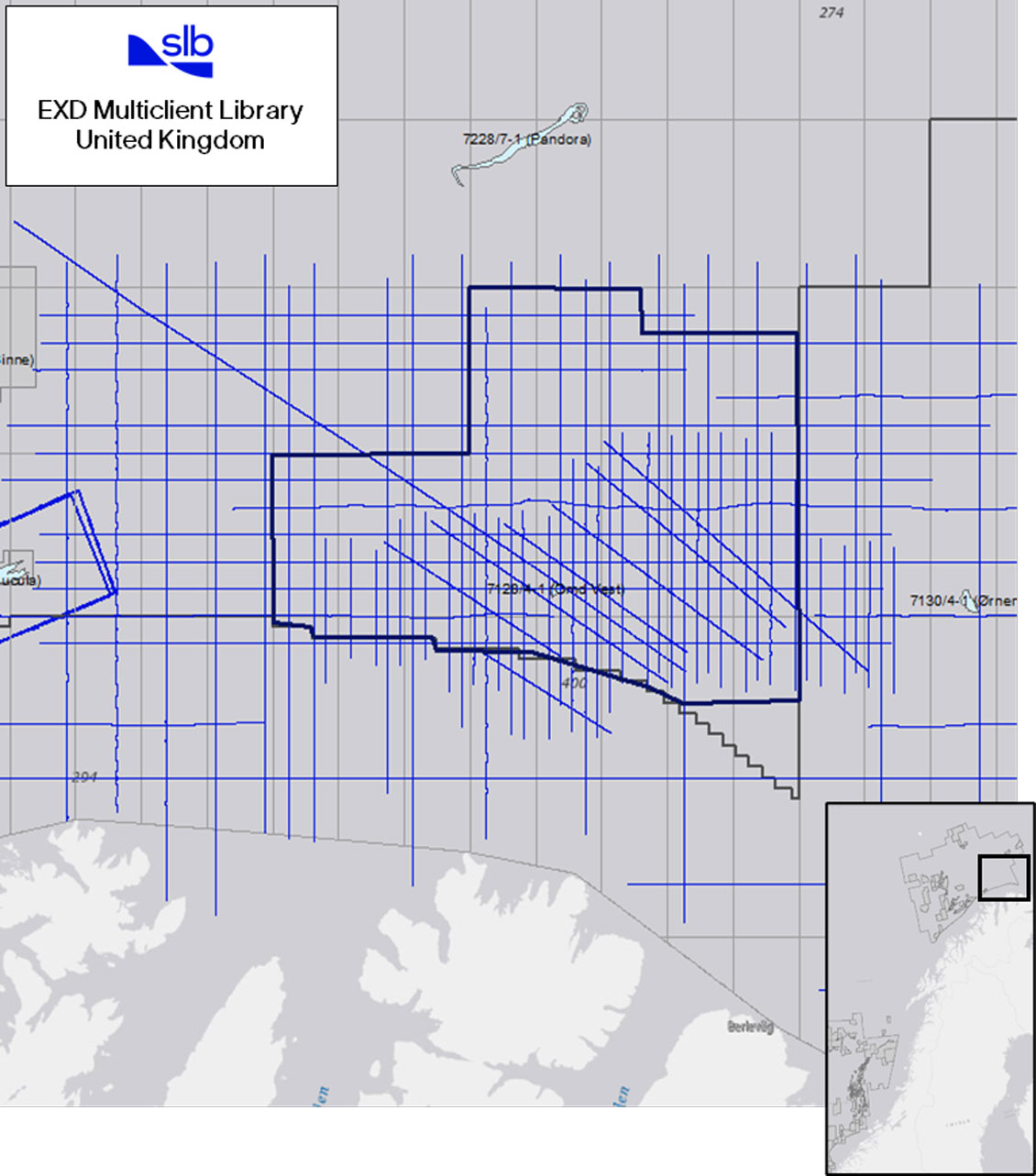
Figure 1: Target pilot area in the Barents Sea overlaid by the existing 2D seismic vintages in the region

This project aimed to evaluate the effectiveness of ExploreCube intelligence in addressing seismic imaging challenges in the eastern Barents Sea—a frontier region with sparse and heterogeneous character 2D seismic data. Geologically, the study area covers the Eastern Finnmark Platform, where basement depth ranges from 4 to 10 km and is influenced extensively by Plio-Pleistocene glacial erosion. Previous exploration efforts yielded minor hydrocarbon discoveries within Upper Permian spiculitic chert, notably exemplified by the well 7128/4-1. By applying a deep learning-driven 2D-to-3D seismic conversion workflow, the study sought to:

  • Generate a regional and consistent quality 3D subsurface image in geologically complex areas with limited data coverage.
  • Improve structural interpretation and prospectivity assessment in support of Norway’s APA 2024 licensing round.
  • Demonstrate the value of combining deep learning, deterministic interpolation, and geological guidance to produce realistic, artifact-minimized 3D seismic volumes.

The pilot highlights the potential of ExploreCube intelligence to unlock exploration opportunities in underexplored regions, reduce uncertainty, and support data-driven decision-making in frontier basins.

ExploreCube intelligence integrates deep learning, deterministic operators, and geological expertise to deliver high-quality 2D-to-3D seismic image conversion. It significantly outperforms traditional signal processing-based methods by better honoring original 2D lines, maintaining realistic geological styles, and minimizing directional artifacts. Approximately 3,500 km of vintage 2D seismic data—primarily acquired in the late 1980s with irregular spacing (4.5 km × 4.5 km and 4.5 km × 2 km)—were used as input (Figure 1) for this project.

Seismic datasets from different vintages were preprocessed to harmonize amplitude, phase, and kinematic features prior to ExploreCube intelligence application. Six key geological formations, including the seabed and basement, were used to constrain the regional stratigraphy and structural framework.

Figure 2 illustrates each 2D seismic line mapped onto a 3D seismic grid across defined slices (inline, crossline, and time), highlighting the sparse coverage of input data across the target area.

The ExploreCube intelligence projection in Figure 3 shows how missing information is seamlessly integrated, resulting in a consistent and stable regional geometry of the basin.

 Constructing projected 3D data from 2D vintages over the Barents Sea using machine learning workflow  Constructing projected 3D data from 2D vintages over the Barents Sea using machine learning workflow
Figures 2-3: 2D seismic lines used as input for ExploreCube intelligence are projected onto a 3D seismic grid with inline, crossline, and time-slice sections, highlighting the sparse distribution of the original data, while ExploreCube intelligence results over the same sections provide a consistent and stable regional geometry representation of the basin

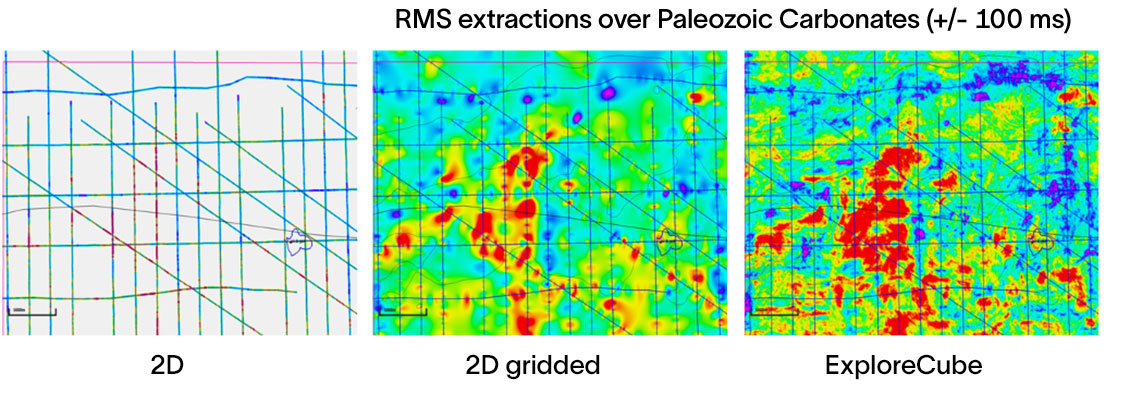
Figure 4 demonstrates the value of ExploreCube intelligence in extracting higher-resolution attributes, outperforming conventional techniques applied to measured 2D seismic data and extrapolated grids.

 Constructing projected 3D data from 2D vintages over the Barents Sea using machine learning workflow
Figure 4: Root mean square (RMS) amplitude extraction of the Paleozoic carbonate interval displays for the 2D seismic locations (left), expanding the 2D measurements over a set of gridded locations (middle) and extracted from the ExploreCube intelligence output (right). ExploreCube intelligence provides a higher definition when delineating the spatial character of the amplitude variation of the attribute.
Products Used