North Sea carbon storage opportunities

Accelerate your carbon storage projects with high-resolution 2D and 3D seismic data

North Sea map illustration

Transforming North Sea seismic data into actionable insights for safe, efficient, site evaluation

Enhance confidence in site selection and de-risking with advanced 2D and 3D data, reprocessing, and imaging workflows tailored for carbon storage.

Whether you’re investing in carbon capture and storage (CCS) or looking to revitalize your exploration portfolio, SLB provides the geophysical data and expertise you need to make confident, informed decisions across the UK Continental Shelf (UKCS).

Our extensive multiclient 2D and 3D data library helps you close data gaps, identify optimal 3D survey locations, and access reprocessed data for fit-for-purpose results.

SLB has recently revamped its 2D and 3D database for CCS-related projects across the Southern North Sea and Central North Sea. The seismic data has been reprocessed and re-imaged to deliver a high-resolution product, supporting improved site de-risking for carbon storage. This work applies a comprehensive broadband processing workflow with pre-stack depth migration and full-waveform inversion (FWI) imaging, capturing fine subsurface details with exceptional clarity.

Our processing sequence incorporates adaptive deghosting, advanced demultiple techniques, and FWI-driven velocity model building, utilizing the latest advances in signal processing and earth modeling to maximize imaging accuracy and resolution.

Enhance confidence in site selection and de-risking with advanced 2D and 3D data, reprocessing, and imaging workflows tailored for carbon storage.
Top reservoir (a) and overburden (b) interpreted horizons textured with color processed (red-green-blue) seismic data showing the slope channels and shallow, gas bearing fault systems in their regional depositional context. Top reservoir (a) and overburden (b) interpreted horizons textured with color processed (red-green-blue) seismic data showing the slope channels and shallow, gas bearing fault systems in their regional depositional context.
Top reservoir (a) and overburden (b) interpreted horizons textured with color processed (red-green-blue) seismic data showing the slope channels and shallow, gas bearing fault systems in their regional depositional context.

Accelerate carbon storage projects with ready-made interpretation products

To help fast-track your carbon storage projects, we have carried out dedicated studies across our 2D and 3D seismic datasets, revealing new features of interest.

These regional programs span both the Central North Sea and Southern North Sea, delivering interpretation products that provide a robust framework for evaluation of subsurface potential at every stage—from early screening, through site appraisal, to planning and development.

The results help reduce uncertainty, improve geological understanding, and support confident decision-making, as you progress toward selecting, maturing, and ultimately developing safe and viable CO₂ storage sites in the region.

Revitalizing legacy seismic with modern reprocessing

Reprocessing your existing 2D and 3D datasets unlocks new value from legacy seismic data, delivering clearer images and actionable insights without the cost of new acquisition.

In the evolving UK North Sea energy landscape, this approach is vital for carbon storage projects, where maximizing data quality and minimizing costs are key to commercial success. Our advanced reprocessing workflows help you transform legacy data into modern, high-resolution products ready to tackle today’s CCS challenges.

Legacy data before After final pre-stack depth migrated data
Legacy data before (left) and after (right) final pre-stack depth migrated data

Sharper seismic for safer storage

Our advanced reprocessing and imaging techniques deliver significantly clearer seismic images of critical overburden structures, including improved fault definition and seal continuity.

This uplift enhances confidence in assessing top-seal integrity and containment risk, key factors in screening and certifying viable CO₂ storage sites, that may have been previously overlooked.
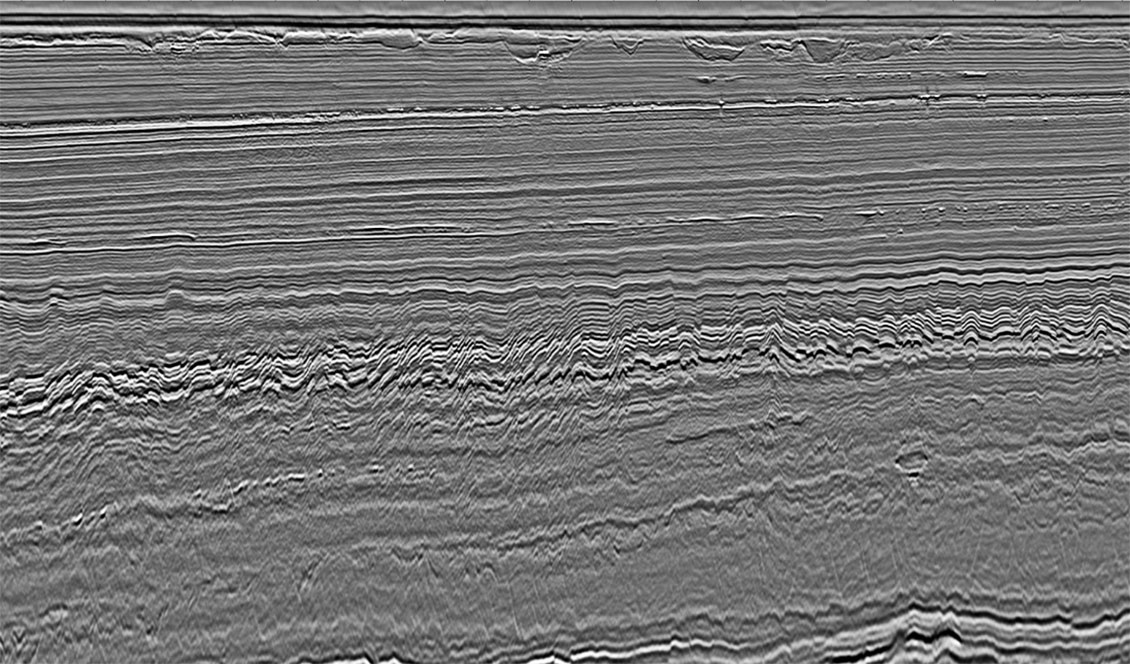
Final East Mey 3D data in central North Sea. High sample rate processing (2ms) highlights subtle overburden features in high-resolution.

Resolve shallow geological complexity with full-waveform inversion (FWI)

FWI unlocks high-resolution velocity models without the need for mature starting models, low frequencies, or long offsets.

Our advanced FWI workflows deliver sharper, more reliable seismic images, particularly in the shallow waters of the UK Continental Shelf, where complex overburden geology can obscure critical detail. This enhanced clarity supports more accurate characterization and de-risking of carbon storage sites.
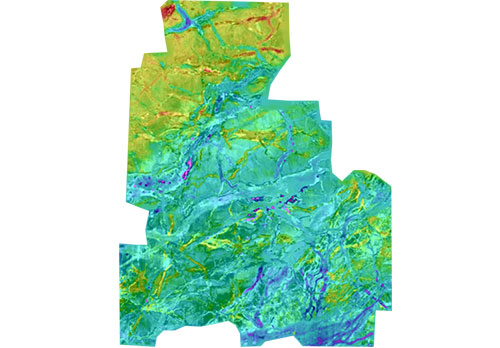
High-resolution overburden details such as fault networks and shallow gas captured by FWI on a shallow depth slice (1000m).

High-resolution overburden details such as fault networks and shallow gas captured by FWI on a shallow depth slice (1000m)

Initial velocity model before (left) after FWI (right) in the shallow overburden section
Initial velocity model before (left) and after FWI (right) in the shallow overburden section

Construct 2D seismic into seamless 3D volume

We’ve used ExploreCube™ rapid frontier intelligence to enable the transform regional 2D seismic data, integrated with prior geological information, into a seamless 3D volume. This streamlines interpretation reducing time and effort required for desktop studies. The resulting 3D volume provides a cohesive view of the regional geological framework, enhancing understanding of subsurface structures and supporting more informed carbon storage evaluation and rapid investment decisions.