Precision in Action: How Electris Completions Are Reshaping Production—Zone by Zone

Published: 12/03/2025

3D representation of Electris completions

What are the benefits of an electric completion versus a conventional intelligent completion?

Electris completions are designed for responsiveness

In oilfield production, change is constant—but completions haven’t always kept up.

Once a well is completed, the system in place typically remains static while production conditions shift. Reservoirs evolve and flow dynamics fluctuate. Yet many conventional completions offer only limited flexibility, actuation with predefined choke settings, and fixed capabilities. That means engineers are often forced to overcorrect, intervene, or compromise performance.

It’s time for completions to catch up.

During my years in well testing, production enhancement, technology development, and project management roles, and in my previous position as our reservoir domain head, I witnessed our customers realize the production and recovery benefits of an electric intelligent completion architecture with our product Manara™ first-generation electric interval control valves. The challenge for the operators of those assets to scale technology deployment was a lack of options. We have eliminated that challenge today with our Electris™ completions portfolio.

Electris completions were developed to give production teams real-time, responsive control over inflow—without the mechanical complexity or limitations of conventional systems. At the heart of this innovation is the Electris interval control valve (ICV), which features

Bidirectional continuous flow control

  • Operators can make micrometric choke adjustments at any point in the valve’s range—no need to cycle through fully open or closed positions.

This shifts the role of the production engineer from a procedural operator to an empowered decision-maker—one focused on discovery, confidence, and continuous learning:

  • Discovery: Understand how subtle adjustments influence flow dynamics across the well, zone, or reservoir.
  • Confidence: Leverage completion design to adapt drainage strategies in response to production targets, sweep efficiency, or facility constraints.
  • Learning: Observe zonal responses to small changes to build a deeper understanding of reservoir behavior—enabling more informed decisions across the asset.
Comparison of hydraulic versus electric ICVs
Overview of the fundamental differences between a hydraulically actuated interval control valve and an Electris interval control valve.

Absolute position sensing

  • Every valve movement is monitored in real time, giving engineers precise visibility over flow dynamics.

Real-time feedback from the monitoring system enables reservoir and production engineers to assess zonal productivity and extrapolate reservoir pressure—without the need to shut in the well or zone. This continuous visibility is fundamental to understanding interval performance over time—delivering the essential insights at the core of modern production engineering.

Up to 20× more actuation frequency

  • Without the wear-and-tear of conventional cycling, engineers can confidently fine-tune drawdown and optimize the well’s productivity index (PI) as frequently as needed.

Engineers should be empowered to use their expertise—not constrained by fear of actuation delays or approval processes. With electrically actuated completions, they can make small, reversible adjustments within the wellbore—without compromising overall well or field production. These systems are designed for dynamic use. Leaving advanced technology idle defeats its purpose—electrical actuators are meant to be operated, not left dormant.

Low-power operation

  • Six Electris ICVs can be powered with less than 100 W— dramatically simplifying system design and enabling active control of compartmentalized laterals, whether extended-reach or otherwise.
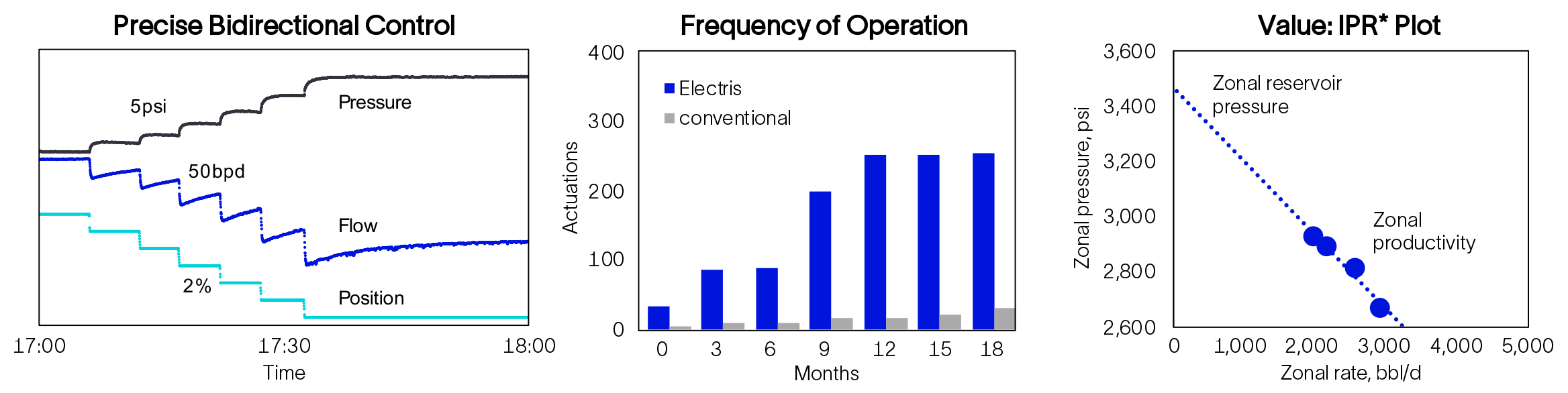
Image showing the effect of precision bidirectional control, the resulting increase in the frequency of operation and lastly how operators are easily able to match IPR.
Observations from Electris completions in the field show that when production engineers can make bidirectional micrometric adjustments to the continuous choke (left), they take action up to 20 times more frequently than with conventional systems (middle)—unlocking meaningful optimization and oil sweep improvement at the compartment or zone level (right). *Inflow Performance Relationship

How does an electric completion simplify installation planning?

From complex challenges to controlled outcomes

Production teams today face more than mechanical barriers—they must strike a balance among three competing objectives: maximizing production, driving down unit development cost, and improving recovery. These priorities can often be at odds. Electris completions help resolve those tradeoffs by delivering real-time inflow control that supports all three while derisking reservoir uncertainty.

Additionally, Electris completions benefit from a field-proven power and telemetry system, inherited and improved from Manara first-generation electric interval control valves. This second-generation system enables Electris wireless running tool (WRT) functionality, providing assurance in multitrip installations where reaching total depth in a single trip may be challenging and completion segments need to be connected via Electris contactless wet-mate connectors (WMCs).

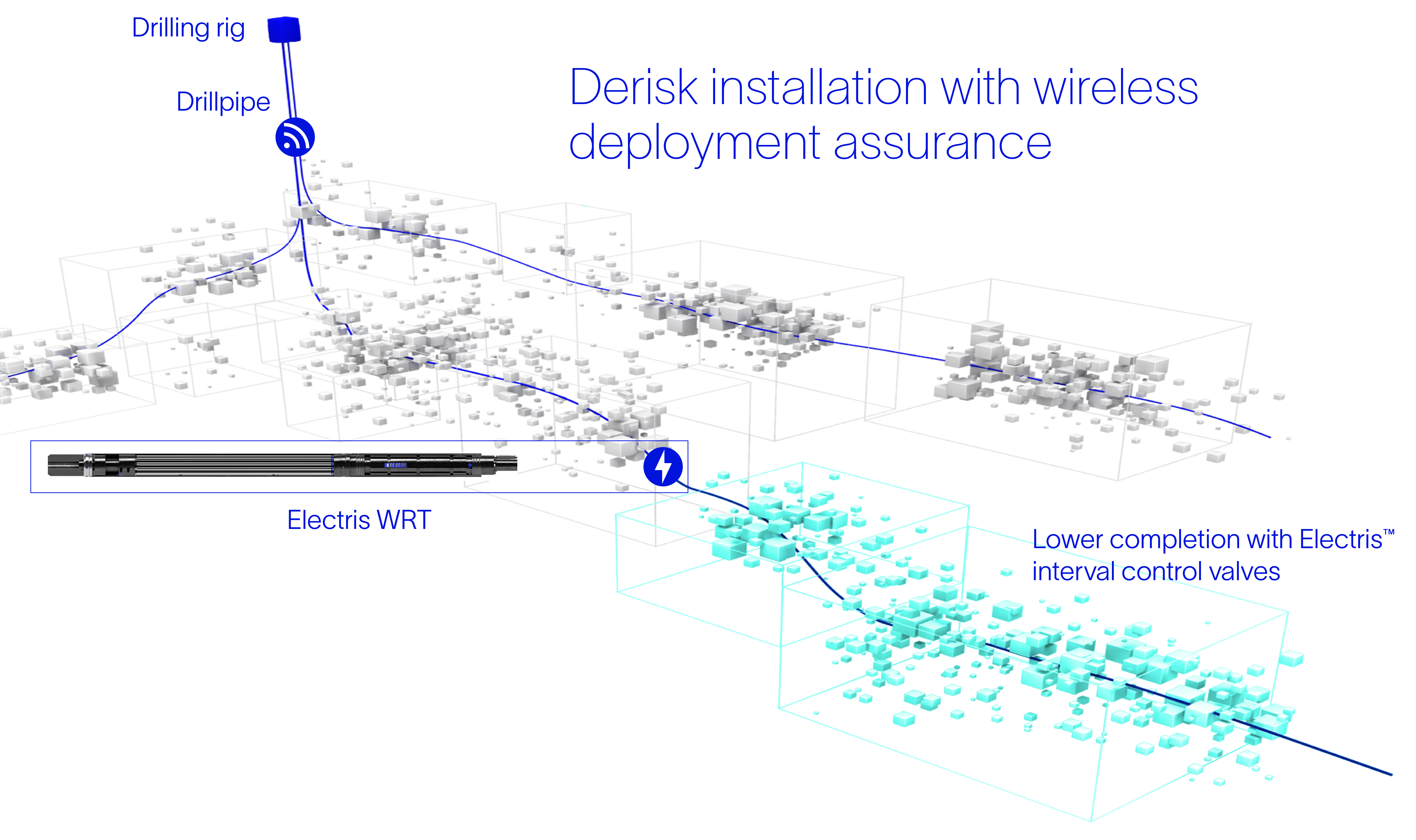
Image of completion process whereby the Electric WRT is used to deploy the lower electric completion using wireless transmission to surface.
The Electris wireless running tool (WRT) is designed for multitrip completions where downhole tools are deployed blind on drillpipe with no electric or hydraulic lines to surface. It empowers operators to wirelessly monitor and control lower and intermediate completion equipment at all stages of deployment for faster and better decision making and optimized operations. Assuring confidence in the integrity of electric and hydraulic equipment as well as electric, hydraulic, and chemical injection lines is critical to the long-term reliability of installed completions.

How does an electric completion architecture improve lifetime completion reliability, even when working over the upper completion?

That same innovation is carried through to the contactless wet-mate connectors, which offer life-of-well benefits beyond just installation. These connectors enable upper completions to be confidently disconnected and reconnected multiple times—streamlining ESP replacement, subsurface safety valve replacements, tubing changeouts, and other upper completion interventions without compromising the lower completion’s integrity.

Real-world impact: controlled outcomes, better recovery.

The power of production intelligence at your finger tips.

Production engineers now have real-time flow control and zonal intelligence—two capabilities that rarely coexist. This combination lets teams react quickly and confidently to changing inflow profiles as they happen, instead of waiting for signs of water or gas breakthrough. For example, an operator in Norway was able to avert a CT intervention and up to 275,000 bbl of deferred production.

More than a completion, Electris completions are a production and recovery optimization platform. One that evolves with the reservoir and gives engineers the power to deliver more—safely, predictably, and with fewer interventions. Learn how an Electris completion enables use of high-GOR zone for in situ gas lift, minimizing lifting costs as part of a novel production strategy.

Field proven. Operator ready.

Having proved themselves in some of the world's most challenging wells, Electris completions are now ready for mainstream deployment—offering value not just for complex or niche wells, but for any operator looking to do more with less. Read how a Norwegian operator battles zonal sand production and wins using their Electris completion.

From optimizing zonal recovery to simplifying workovers and reducing operating cost, Electris completions bring intelligent performance to the core of well operations.

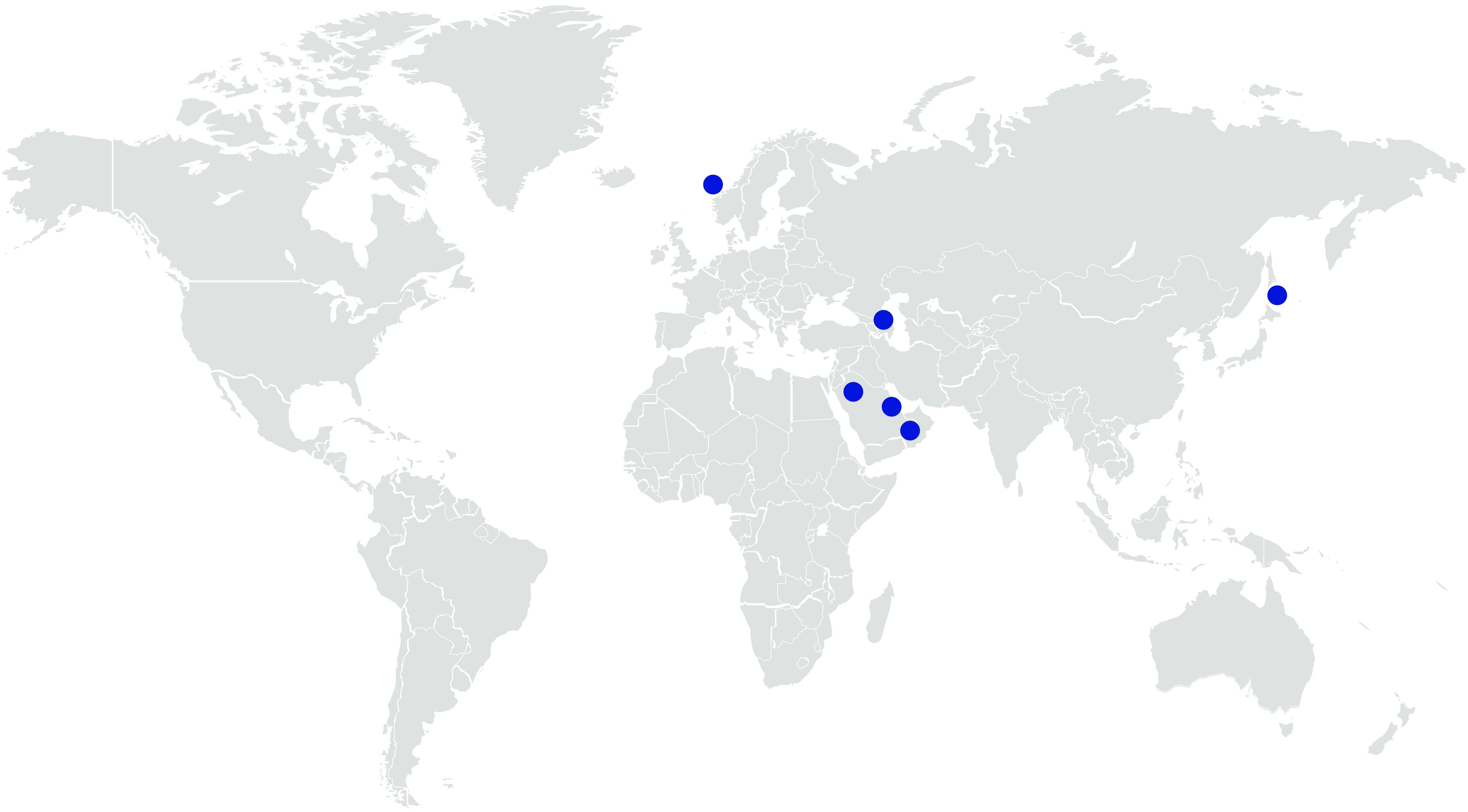
World map showing locations of existing Electris completion installations.
The eastern hemisphere has dominated global installations for Electris completions to date however a quick scroll through the SLB earnings press releases will show future installations shall expand within the Middle East and off the coast of South America and Africa. So what are you waiting for?

Are your completions evolving with your reservoir?

If you’re looking to move from a passive, autonomous, or conventional hydraulic approach to inflow control to real-time active control of multiple reservoir zones or compartmentalized laterals, there is no more proven option than an Electris completion. Please reach out to me and let's schedule a sit down with your team to learn more about your production and recovery challenges and if an Electris completion is right for you.

Contact Steve and the team today

Let's talk about your wells
Article Topics
Intelligent Completions