Intelligent formation pressure-while-drilling service achieves high-quality pressure measurements in tight reservoir

minus
Australia, Oceania, Onshore

The StethoScope Ultra™ intelligent formation pressure-while-drilling service was deployed onshore in Australia, where it repeatedly and successfully obtained high-quality pressure data in a reservoir with extremely low mobility. StethoScope Ultra™ unique electro-mechanical pretesting unit provides minimal controllable drawdown rates 4-times smaller than industry standards. Combined with advanced pretesting capabilities the service closes a technology gap for formation pressure-while-drilling services in tight reservoirs, creating new possibilities for operators.

An operator in Australia needed to acquire accurate formation pressure data in a geologically challenging onshore reservoir characterized by extremely low mobility—under 0.2 millidarcies per centipoise (mD/cP)—and elevated annulus pressures ranging from 5,000 to 6,000 psi. The objective was twofold: to reliably demonstrate SLB’s capability to deliver accurate pressure measurements under these especially demanding conditions, and to enable informed reservoir evaluation in settings where traditional testing had failed or yielded unsatisfactory results. Previously, data acquisition attempts in similar environments were hampered by tool limitations, high rates of test failure, lengthy downhole station times, and unreliable measurements, ultimately restricting both reservoir understanding and future field development decisions.

SLB successfully deployed the StethoScope Ultra service, achieving a reduction of the lowest controllable drawdown flow rate from the standard 0.2 cm³/s to 0.05 cm³/s. This significant improvement expands the operating envelope for formation pressure testing in tight reservoirs. Leveraging domain knowledge, intelligent and digital planning capabilities, a custom pretest prejob modeling provided fit for purpose parameters for the environment. Over three onshore jobs, a total of 55 pretests were performed, reliably acquiring formation pressure data on mobilities as low as 0.05 mD/cP. This elevated level of control resulted in smaller drawdown, better stabilized build-ups, shortened station times by half, and a significantly higher rate of successful data acquisition compared to conventional methods. Ultimately, the operator was able to validate formation pressures for the first time in this field, greatly enhancing future reservoir management and establishing SLB’s commitment to innovation and fit-for-purpose technology in basin-specific applications.

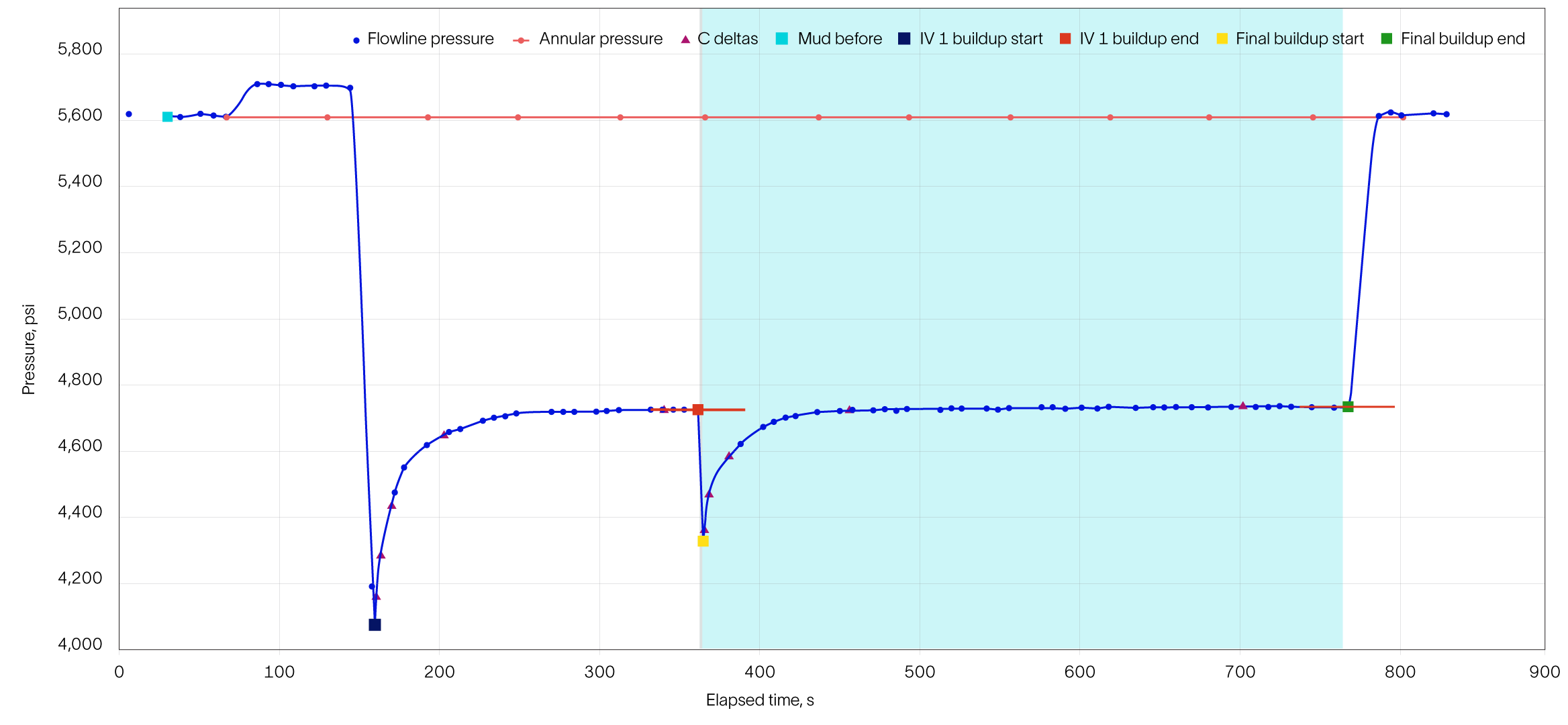
Graph shows retest profile with mobility of 0.13 mD/cP
Pretest profile with mobility of 0.13 mD/cP.
Products Used