





Mobile analysis solutions
Mobile analysis solutions for real-time measurements, accelerated insights, and confident decision making
Obtain real-time measurements, accelerated insights, and make confident decisions with a modular mobile wellsite lab

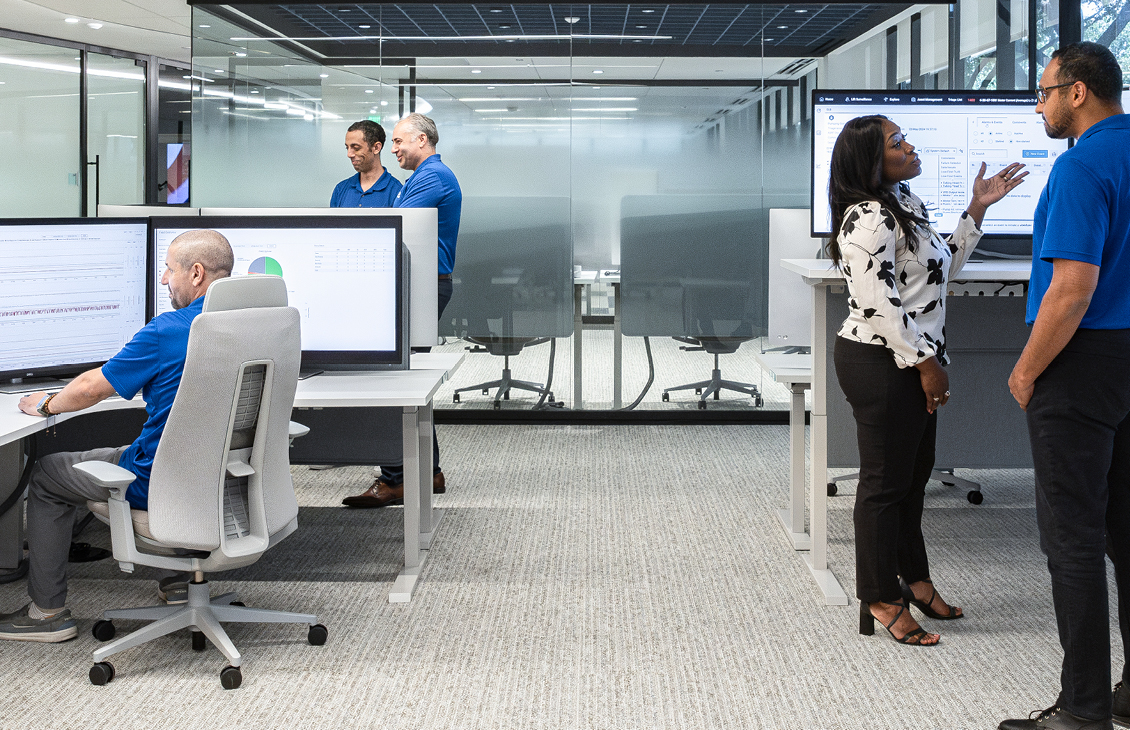
Intelligent solutions enable real-time data interpretation in a collaborative environment. So you can make confident decisions when they matter most.
Built-in deep transient testing (DTT) capabilities eliminate flaring, reducing carbon emissions by up to 96% in deepwater environments.
Deployment on wireline with standard crew increases operational agility and reduces footprint compared with DST.
Could you be missing crucial reservoir insights? Join SLB Reservoir Technical Director Francois-Xavier Dubost and Wireline Formation Testing Product Champion Ashers Partouche to uncover key information about your reservoir.

30 October | 9:00 a.m. CDT, 3:00 p.m. BST
Watch On-DemandOra™ intelligent wireline formation testing platform comprises four building blocks: new downhole digital hardware, intelligent planning, operations control, and contextual insights to enable
The award-winning Ora platform delivers intelligent wireline formation testing capabilities that accelerate your projects. See deeper into your reservoir. Confirm reserves sooner. Expedite your completion strategy. Accelerate your field development plan and facilities design. Get the critical answers you need—all while saving time and mitigating environmental impact.
Redefine what’s possible with connected, intelligent system-level optimization.

Simulate various job scenarios and optimize programs to achieve your data acquisition objectives confidently.

Streamline communications and collaborate on integrated, up-to-date data with multidomain experts in real time.

Accelerate data processing and interpretation at the wellsite. Contextualize and turn insights into
real-time decisions.
Often, the clear picture from wellbore data only appears once processed data are put into context. Sometimes you don’t know if you met your data-acquisition objectives until after the window of opportunity has passed. Other times, you may be waiting on an answer to plan your next operational steps. Wellbore Insights on Delfi™ provides advanced interpretation and contextualization of data in real time, so you can make better, faster decisions. Interpretation workflows that took days are now completed in hours.
The intelligent platform’s digital hardware leverages new architecture and metrology to redefine the benchmark in wireline formation testing capability. Rated to 392 degF and 35,000 psi with dual-flowline architecture and featuring smart downhole automation, the platform performs reliably and effectively in all conditions, including tight or unconsolidated formations and challenging fluids.
Wideband downhole pumps precisely govern the broad dynamic range. The focused radial probe accesses a large flow area to quickly acquire the cleanest fluids—with contamination below laboratory detection limits. The dual-flowline fluid analyzer quantifies fluid properties with digital hardware customized for your objectives: dual-flowline spectrometry, calibrated resistivity, high-accuracy density, full-spectrum viscosity, and the highest-accuracy and -resolution pressure gauges.
0.004 mD
Lowest permeability to date7,500 psi
Highest differential pressure to date383 degF
Highest temperature to dateThought leaders from around the world share their vision and experiences.
AI deployments in oil & gas are shifting from generative to agentic. This is presenting new opportunities for companies, but it also comes with added risk.
When it comes to achieving consistently high performance in oil and gas, contracting models are one of the most powerful, underestimated levers for success.
Drilling automation or autonomous drilling? Here’s the critical difference every operator should know.
Within energy, AI has proven to be a valuable tool in supporting both sustainability and safety objectives.

The Ora platform is part of our Transition Technologies™ portfolio. Efficient, accurate, sustainable DTT and sampling services minimize CO2 footprint by reducing or eliminating flaring, as well as decreasing energy consumption. Conduct best-in-class formation testing while reaching your sustainability goals.
Learn more