


Advanced Liner Installation Planning Analysis
Harnessing the power of DrillPlan coherent well construction planning solution
Optimize liner and liner hanger installation via comprehensive engineering analyses.

Xcelis™ high-performance liner hanger systems are engineered for the most challenging well environments and exceed the requirements for their API Spec 19LH qualification. Plan for success by leveraging our advanced liner installation planning analysis.


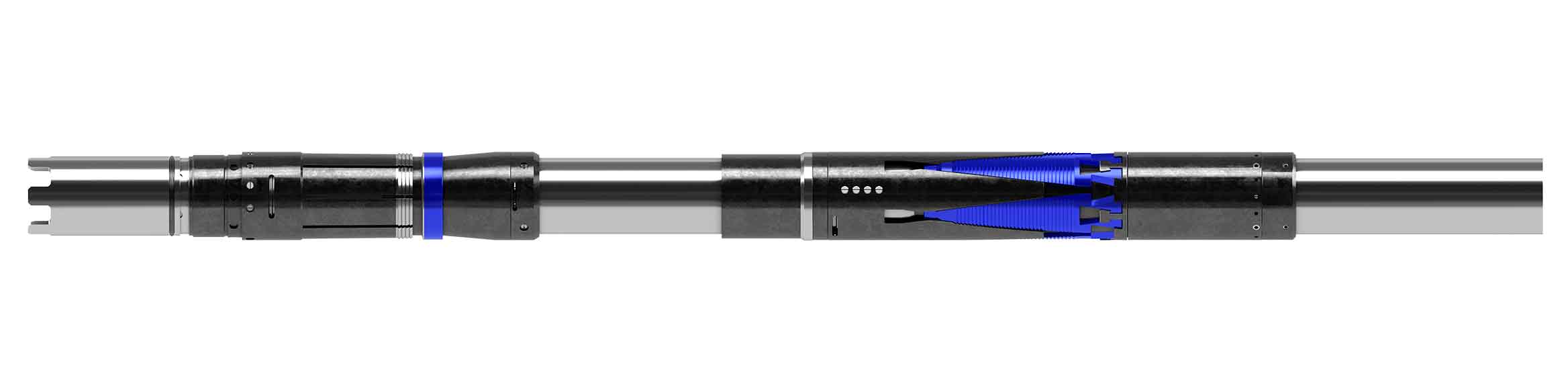


During running of the liner string, whether it is a production liner or an intermediate liner casing string, the Xcelis system's compact length and large bypass area decrease the risk of lost circulation due to surge pressure, allowing faster run-in-hole (RIH) speeds and reducing rig time. The proprietary interlocking pocket slip, cone, and retention ring design prevents presetting caused by friction and avoids loosening or loss of slips while running in hole. Hanger and packer antipreset mechanisms increase reliability and efficiency.
High operational torque capacity enables using rotation to overcome ledges and hole collapse or reduce friction of longer liners to reach target depth. The liner hanger system can be floated or, to limit buoyancy, can be used with modified flotation equipment to employ the mud-over-air method.
During displacement and hole cleaning, the large bypass area and shorter length reduce equivalent circulating density (ECD). The slip and cone interface has the same effective bypass area in both the unset and set conditions, enabling improved hole cleaning and higher tolerance to debris accumulation.
When setting in the previous casing string, the slip design’s aggressive bite improves hanging capacity via deep host casing engagement to avoid slippage. The rail-free slips uniformly distribute the axial load to avoid jeopardizing the host casing’s integrity.
ECD during cementing operations decreases because of the compact length and larger bypass area, which both act to lower the pressure drop across the liner hanger system, reducing risk of poor primary cement placement. Additionally, the Xcelis liner hanger system can be configured with an optional bearing to rotate the liner for optimal cement distribution in the annular space, thereby facilitating long-term zonal isolation and improving well productivity.
After the liner hanger has been set and cemented, the liner packer is set by placing the rotating tamping dog assembly on the tieback receptacle and slacking off the drillstring. Excess cement above the liner top packer can be circulated out after the packer is set.
During run-in-hole, displacement, and cementing operations, the liner top packer sealing element must endure the frictional effects of high-rate fluid circulation and the washing effect of debris carried with the fluid, which can negatively impact its performance. The sealing element for the liner packer uses a proprietary design and compound formulation, which have been rigorously flow tested with debris to ensure resilient high-performance setting and sealing, even in high-solids-content mud. The element is self-energizing, meaning that once the packer is set, the sealing performance is sustained despite high-pressure, high-temperature thermal and pressure cycling throughout the life of a well.
Xcelis liner hanger systems are available for hydraulic-set systems that are compatible with our field-proven setting tools. Xcelis systems are run with the hydraulic collet running tool (CRT) or the mechanical right-hand release tool (RRT).
Xcelis systems have been holistically designed to reduce the constraints of your liner casing well construction operations. A digital twin enables combining analytical and numerical analyses for full understanding of system mechanics. Parametric modeling in close collaboration with your team captures the design intent for your most challenging wells, including features and constraints; it facilitates multiple iterations to deliver an optimal design. Subsequently, rigorous and extensive testing is conducted in compliance with and exceeding requirements for the system's API Spec 19LH qualification.
These systems are available with


